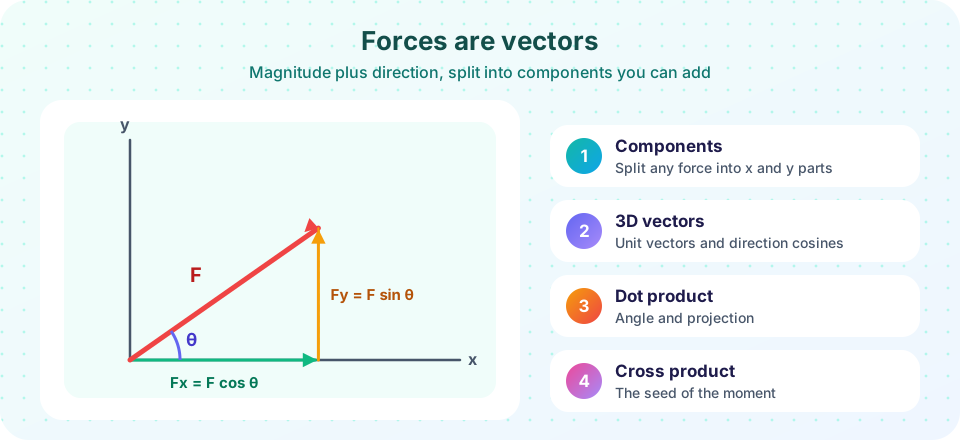
A force is not just a number. Ten newtons pushing east is not the same as ten newtons pushing north, and two forces of ten newtons do not add up to twenty unless they point the same way. To handle forces correctly you need vectors : quantities with both size and direction. This chapter builds the vector toolkit you will use for the rest of the course.
Caption: any force can be replaced by two (or three) perpendicular components. Adding components is just adding numbers. The big picture#
Vector math in statics boils down to one trick: break every force into components along fixed axes, add the components like ordinary numbers, and rebuild the result at the end. Everything in the chapter is a refinement of that trick.
Forces are vectors
➡️
Magnitude
How big, in newtons
🧭
Direction
Which way along a line
📍
Point
Where it is applied
Split into components
↔️
Fx = F cos θ
Part along x
↕️
Fy = F sin θ
Part along y
Add the parts
➕
Rx = ΣFx
Add all x parts
➕
Ry = ΣFy
Add all y parts
🎯
Rebuild R
R = √(Rx² + Ry²)
Go to 3D and products
🧊
i, j, k
Three unit vectors
📏
Dot product
Angle between vectors
✖️
Cross product
Moment of a force
Dot and cross products return in Chapter 4.
1 / 4
Try the idea now: slide the angle and magnitude of a force and watch its components.
Components of a force
Reset
< style>
body { font-family : system-ui, sans-serif; margin : 0; padding : 14px; background : linear-gradient ( 135deg, #f0fdfa, #eff6ff) ; color : #134e4a; }
.card { background : #fff; border-radius : 18px; padding : 14px 16px; box-shadow : 0 10px 24px rgba ( 15, 118, 110, .15) ; }
svg { width : 100%; height : auto; display : block; }
label { font-weight : 600; font-size : 14px; display : block; margin-top : 4px; }
input { width : 100%; accent-color : #0d9488; }
.row { display : flex; gap : 8px; margin-top : 8px; flex-wrap : wrap; }
.p { flex : 1; min-width : 110px; border-radius : 12px; padding : 7px 10px; color : #fff; font-weight : 700; font-size : 14px; }
</ style> < divclass = " card" > < svgviewBox = " 0 0 520 200" > < defs> < markerid = " mr" viewBox = " 0 0 10 10" refX = " 8" refY = " 5" markerWidth = " 6" markerHeight = " 6" orient = " auto" > < pathd = " M1 1L9 5L1 9Z" fill = " #ef4444" /> </ marker> </ defs> < linex1 = " 40" y1 = " 180" x2 = " 500" y2 = " 180" stroke = " #475569" stroke-width = " 2" /> < linex1 = " 40" y1 = " 180" x2 = " 40" y2 = " 10" stroke = " #475569" stroke-width = " 2" /> < lineid = " fx" x1 = " 40" y1 = " 180" x2 = " 200" y2 = " 180" stroke = " #10b981" stroke-width = " 5" /> < lineid = " fy" x1 = " 200" y1 = " 180" x2 = " 200" y2 = " 100" stroke = " #f59e0b" stroke-width = " 5" /> < lineid = " f" x1 = " 40" y1 = " 180" x2 = " 200" y2 = " 100" stroke = " #ef4444" stroke-width = " 5" marker-end = " url(#mr)" /> </ svg> < label> < spanid = " Fv" > </ span> </ label> < inputid = " F" type = " range" min = " 50" max = " 500" value = " 300" > < label> < spanid = " tv" > </ span> </ label> < inputid = " t" type = " range" min = " 0" max = " 90" value = " 30" > < divclass = " row" > < divclass = " p" style = " background : #10b981" > < spanid = " X" > </ span> </ div> < divclass = " p" style = " background : #f59e0b" > < spanid = " Y" > </ span> </ div> </ div> </ div> < script>
function u ( ) {
const F = + document. getElementById ( 'F' ) . value, t = + document. getElementById ( 't' ) . value, r = t * Math. PI / 180 ;
const fx = F * Math. cos ( r) , fy = F * Math. sin ( r) , s = 0.9 ;
const x2 = 40 + fx * s, y2 = 180 - fy * s;
const set = ( id, a, b, c, d ) => { const e = document. getElementById ( id) ; e. setAttribute ( 'x1' , a) ; e. setAttribute ( 'y1' , b) ; e. setAttribute ( 'x2' , c) ; e. setAttribute ( 'y2' , d) ; } ;
set ( 'fx' , 40 , 180 , x2, 180 ) ; set ( 'fy' , x2, 180 , x2, y2) ; set ( 'f' , 40 , 180 , x2, y2) ;
document. getElementById ( 'Fv' ) . textContent = F ; document. getElementById ( 'tv' ) . textContent = t;
document. getElementById ( 'X' ) . textContent = fx. toFixed ( 1 ) ; document. getElementById ( 'Y' ) . textContent = fy. toFixed ( 1 ) ;
}
document. getElementById ( 'F' ) . oninput = u; document. getElementById ( 't' ) . oninput = u; u ( ) ;
</ script>
Python
Components as the angle changes
Reset
Stop
import numpy as np
import matplotlib. pyplot as plt
plt. rcParams. update( { "figure.facecolor" : "#f0fdfa" , "axes.facecolor" : "#ffffff" , "axes.edgecolor" : "#99f6e4" ,
"axes.spines.top" : False , "axes.spines.right" : False , "axes.grid" : True , "grid.color" : "#ccfbf1" ,
"axes.prop_cycle" : plt. cycler( color= [ "#10b981" , "#f59e0b" , "#ef4444" , "#6366f1" , "#38bdf8" ] ) , "font.size" : 12 } )
F = 300.0
theta = np. linspace( 0 , 90 , 200 )
fx, fy = F * np. cos( np. radians( theta) ) , F * np. sin( np. radians( theta) )
plt. figure( figsize= ( 8 , 4.2 ) )
plt. plot( theta, fx, linewidth= 2.5 , label= "Fx = F cos θ" )
plt. plot( theta, fy, linewidth= 2.5 , label= "Fy = F sin θ" )
plt. fill_between( theta, fx, alpha= 0.15 )
plt. fill_between( theta, fy, alpha= 0.15 )
plt. annotate( "45°: both equal 212 N" , xy= ( 45 , F * np. cos( np. radians( 45 ) ) ) , xytext= ( 52 , 250 ) ,
arrowprops= { "arrowstyle" : "->" , "color" : "#475569" } )
plt. xlabel( "Angle θ from the x axis (degrees)" )
plt. ylabel( "Component (N)" )
plt. title( "A 300 N force: components trade places" )
plt. legend( )
plt. show( )
Press Run (or Ctrl + Enter) to see the result here.
Program input · what you'd type while the program runs
Type the answers before you press Run, one per line. Each time the program reads a line (with input()), it gets the next line from this box.
What each lesson covers#
Check your understanding#
1. Which quantity is a vector?
A
Mass
B
Force
C
Time
D
Temperature
2. A 300 N force acts 30° above the x axis. What is Fx?
A
150 N
B
260 N
C
300 N
D
173 N
3. To add many forces, the easiest method is to
A
Add the magnitudes
B
Add the x components and the y components separately
C
Multiply them
D
Take the largest
4. Which product will be used for the moment of a force?
A
Dot product
B
Cross product
C
Scalar product
D
Sum
Summary#
A force is a vector: size, direction, sense, and a point of application.
Resolve forces into components, add components, rebuild the result.
Chapter 2 extends this to 3D with i, j, k and introduces dot and cross products.
Next: Forces in two dimensions