


















Lesson 4 of 47 · Getting Started
A problem-solving method for statics
A five-step routine for every statics problem: sketch, isolate the body, draw the free-body diagram, write equilibrium equations, solve and check. Worked beam example.
Good statics students and weak ones know the same equations. What separates them is a routine. Strong solvers work in the same order every time, so their attention goes to the physics and not to wondering what to do next. This lesson gives you that routine and applies it to a first complete example.
What you will learn
- The five steps of a reliable statics solution.
- Why the free-body diagram (FBD) is the center of every problem.
- How to choose a sign convention and write the equilibrium equations.
- How to check your answer in at least two ways.
Key terms
- Free-body diagram (FBD): a sketch of the isolated body showing all external forces and moments acting on it.
- Reaction: a force or moment a support exerts on the body to keep it in place.
- Unknown: a quantity you must find, usually a reaction or a bar force.
- Sign convention: a fixed rule for which directions are positive.
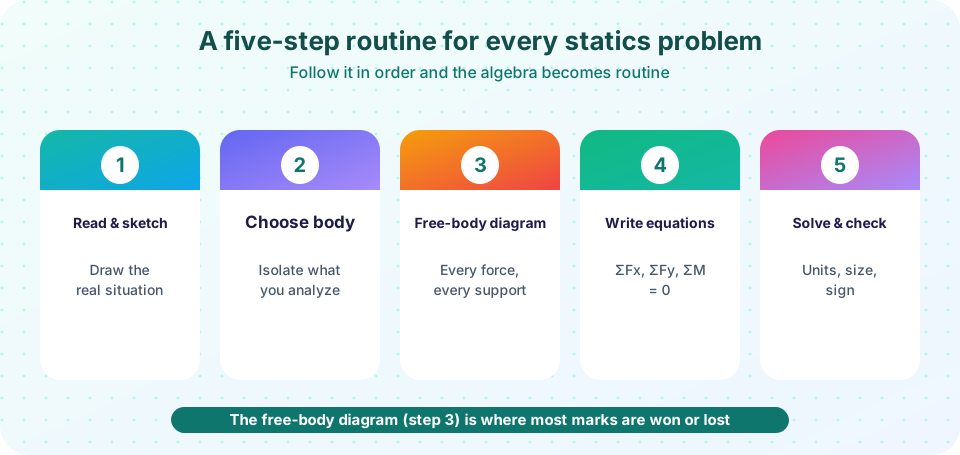
The five steps
Step 1: Read and sketch. Read the whole problem twice. Draw a neat picture with the dimensions and loads. Note what is asked and what is given. Write down assumptions, such as "ignore the weight of the beam" or "frictionless pulley".
Step 2: Choose the body. Decide which object or group of objects you will isolate. You must pick a body where the unknowns appear as external forces. Sometimes the right choice is the whole structure, sometimes a single joint or one member.
Step 3: Draw the free-body diagram. Imagine cutting the body free from everything around it, then replace each thing you removed with the force it applied. Include:
- the applied loads (given),
- the weight of the body if it matters, at its center of gravity,
- a reaction for every support or connection you cut, drawn in its proper direction (see Free-body diagrams and supports for the full list),
- the dimensions and angles you need.
Label every force. If you do not know a direction, guess it. A negative answer later just means the real direction is opposite.
Step 4: Write the equilibrium equations. For a body in a plane, you have three independent equations: ΣFx = 0, ΣFy = 0 and ΣM = 0 about any point. Choose a sign convention (for example up and right positive, counterclockwise positive) and stick to it. Pick a smart moment point: taking moments about a point where an unknown force acts removes that unknown from the equation.
Step 5: Solve and check. Solve for the unknowns. Then check:
- Units: do the answers have the right units?
- Sign and direction: does the result make physical sense?
- A second equation: substitute into an equation you did not use. If you solved with
ΣFyand a moment, check with a moment about a different point. - Magnitude: is the answer plausible? A support cannot carry more than the total load in a simple case like this one.
A full worked example
A horizontal beam AB is 4.0 m long. It rests on a pin at A and a roller at B. A downward load of 900 N acts 1.0 m from A and a downward load of 600 N acts 3.0 m from A. The beam's own weight is negligible. Find the reactions.
Step 1 and 2. Choose the whole beam as the body. The unknowns are the support reactions.
Step 3. The roller can push only perpendicular to its surface, so By is vertical. The pin can push in any direction, so it has components Ax and Ay. All loads are vertical, so we expect Ax = 0, but we keep it in the equations to be safe.
Step 4. Take x to the right, y up, and counterclockwise positive. Sum the moments about A (this eliminates both Ax and Ay):
ΣM_A = 0: By × 4.0 − 900 × 1.0 − 600 × 3.0 = 0
ΣFy = 0: Ay + By − 900 − 600 = 0
ΣFx = 0: Ax = 0
Step 5. From the moment equation: By = (900 + 1800) / 4.0 = 675 N. From the force equation: Ay = 1500 − 675 = 825 N. The result Ax = 0 confirms our expectation.
Check. Take moments about B instead: −Ay × 4.0 + 900 × 3.0 + 600 × 1.0 = −3300 + 2700 + 600 = 0. The check works. Also Ay is larger than By because the heavier load sits closer to A, which is the intuitive result.
Press Run (or Ctrl + Enter) to see the result here.
Program input · what you'd type while the program runs
Type the answers before you press Run, one per line. Each time the program reads a line (with input()), it gets the next line from this box.
Notice the program mirrors the five steps. It solves with one moment equation and one force equation, then checks with a moment about a different point.
Drawing the free-body diagram with code
A good FBD shows every force as an arrow at its point of application. This plot draws the one for the example above.
Press Run (or Ctrl + Enter) to see the result here.
Program input · what you'd type while the program runs
Type the answers before you press Run, one per line. Each time the program reads a line (with input()), it gets the next line from this box.
Common misconceptions
"I can skip the diagram for an easy problem." Skipping it is the most frequent cause of missed forces and wrong signs. Draw it every time.
"The force direction I guessed must be right." It need not be. A negative result means the true direction is opposite your arrow, and the number is still correct.
"A roller supports forces in any direction." A roller pushes only perpendicular to its surface.
Check your understanding
Quick check · 5 questions
of 5 answered You scored / 5 · perfect!
-
1. What is a free-body diagram?
The FBD isolates a body and shows every external force and moment acting on it. -
2. Why take moments about the pin A in the example?
A force through the moment point has zero moment arm, so Ax and Ay do not appear. -
3. In the example, By = 675 N. What is Ay?
From ΣFy = 0: Ay = 900 + 600 − 675 = 825 N. -
4. You guessed a force upward and your answer is negative. What does that mean?
A negative value means the real direction is opposite the guess. -
5. Which is a good way to check a statics answer?
A second independent equation is a strong check on the arithmetic and the setup.
Summary
- Work in five steps: sketch, choose body, draw FBD, write equations, solve and check.
- The FBD replaces every cut support with its reaction forces.
- Take moments about a point where unknowns act to simplify the algebra.
- A negative result only means the force points opposite your guess.
- Always verify with an equation you did not use.
Next: Chapter 1 review
Track your progress
Create a free account to tick off lessons and pick up where you left off on any device.
of Engineering Statics lessons completed