


















Lesson 30 of 47 · Centroids and Distributed Loads
Composite Areas and Bodies
Find the centroid of a T-section, an L-bracket and a plate with a hole by splitting into simple parts and using a table. Includes a reusable Python calculator.
Most real cross-sections are not curves that need integrals. They are T-beams, L-angles, channels and plates with bolt holes. For these, you divide the shape into simple pieces whose areas and centroids you already know, and you combine the pieces with a weighted average. The table method turns the whole calculation into arithmetic.
This is the centroid calculation you will use most often in practice, and it is the first step in finding the neutral axis of a beam in strength of materials.
What you will learn
- Divide a shape into simple parts and tabulate area and centroid for each.
- Apply
x̄ = Σ A_i x_i / Σ A_iand the same forȳ. - Treat holes as negative areas.
- Extend the method to composite wires and volumes.
Key terms
Composite area: a region built from simple parts (rectangles, triangles, circles).
Part centroid (x_i, y_i): the centroid of one simple part, measured from the common reference axes.
Negative area: a hole or cut-out, subtracted in the sums.
Reference axes: the chosen x and y axes; any convenient position works, but all distances must be measured from the same ones.
The formulas
x̄ = (Σ A_i x_i) / (Σ A_i)
ȳ = (Σ A_i y_i) / (Σ A_i)
The method is identical for lines (use lengths L_i), volumes (use volumes V_i) and weights (use W_i, which gives the center of gravity). The recipe:
- Choose reference axes. Put the origin at a corner or on an axis of symmetry to make some distances zero.
- Split the shape into simple parts. Holes count as negative parts.
- Make a table with columns
A_i,x_i,y_i,A_i x_i,A_i y_i. - Add the columns and divide.
Worked example 1: a T-section
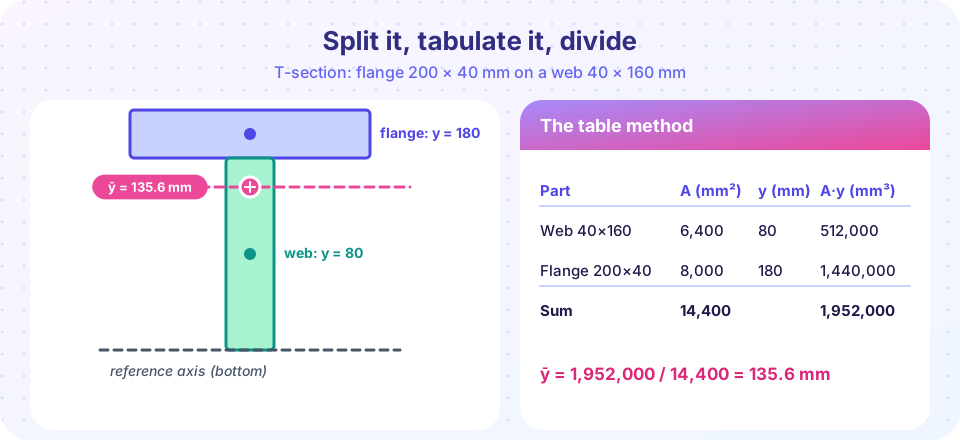
A T-shaped cross-section has a flange 200 mm wide and 40 mm thick sitting on top of a web 40 mm wide and 160 mm tall. Put the reference axis at the bottom of the web. The shape is symmetric, so x̄ lies on the vertical center line and we need only ȳ.
| Part | A_i (mm²) |
y_i (mm) |
A_i y_i (mm³) |
|---|---|---|---|
Web 40 × 160 |
6,400 | 80 | 512,000 |
Flange 200 × 40 |
8,000 | 180 | 1,440,000 |
| Sum | 14,400 | 1,952,000 |
ȳ = 1,952,000 / 14,400 ≈ 135.6 mm above the bottom of the web
The centroid is a little above the middle of the full 200 mm height, because the heavy flange is at the top. In a beam made of this T, the neutral axis passes through this point.
Worked example 2: a plate with a hole
A rectangular plate is 120 mm wide and 80 mm tall, with a circular hole of 40 mm diameter whose center is at (90, 40) mm. Put the origin at the lower left corner.
| Part | A_i (mm²) |
x_i (mm) |
y_i (mm) |
A_i x_i |
|---|---|---|---|---|
Plate 120 × 80 |
9,600 | 60 | 40 | 576,000 |
| Hole, radius 20 | −1,256.6 | 90 | 40 | −113,097 |
| Sum | 8,343.4 | 462,903 |
x̄ = 462,903 / 8,343.4 ≈ 55.5 mm ȳ = 40 mm (by symmetry, the hole is on the mid-height line)
The hole sits to the right of center, so material is removed from the right side and the centroid shifts to the left of the plate's own center (60 mm). That makes sense: remove weight from one side and the balance point moves away from that side.
Worked example 3: a bent wire
The same method works for lines. A wire is bent into an L with a horizontal leg of 300 mm along the x-axis and a vertical leg of 400 mm along the y-axis, both starting at the corner. Treat each leg as a line of length L_i with its centroid at its midpoint:
L1 = 300 at (150, 0)      L2 = 400 at (0, 200)
x̄ = (300×150 + 400×0) / 700 = 64.3 mm
ȳ = (300×0 + 400×200) / 700 = 114.3 mm
Common misconceptions
"Measure each part from its own corner." All x_i and y_i must be measured from one common origin, or the weighted average is meaningless.
"A hole's area is positive because it is a real shape." The hole removes material, so its area enters with a minus sign.
"The centroid of two parts is halfway between their centroids." Only if the parts have equal areas. Otherwise it lies on the line joining them, closer to the bigger part.
Try it
Press Run (or Ctrl + Enter) to see the result here.
Program input · what you'd type while the program runs
Type the answers before you press Run, one per line. Each time the program reads a line (with input()), it gets the next line from this box.
Press Run (or Ctrl + Enter) to see the result here.
Program input · what you'd type while the program runs
Type the answers before you press Run, one per line. Each time the program reads a line (with input()), it gets the next line from this box.
Check your understanding
Quick check · 5 questions
of 5 answered You scored / 5 · perfect!
-
1. In the table method, a circular hole is entered with:
The hole removes material, so it subtracts from both the area and the moment sums. -
2. Two parts have areas 300 mm² and 100 mm² with centroids at y = 10 mm and y = 50 mm. The combined ȳ is:
ȳ = (300×10 + 100×50)/400 = 8000/400 = 20 mm. -
3. All coordinates x_i and y_i must be measured from:
A weighted average of positions only works when every position is measured from the same origin. -
4. A wire is bent into a shape. To find its centroid you weight each segment by its:
For lines, the weights are lengths. -
5. Which shape's centroid can lie outside the material?
A ring's centroid is at the empty center; a thin L's centroid can fall in the corner gap.
Summary
- Break the shape into simple parts, tabulate
A_i,x_i,y_i, and divide the sums. - Holes subtract; all positions share one origin.
- The same recipe finds the centroid of lines and volumes, and the center of gravity of weights.
- Use symmetry to skip a coordinate.
Track your progress
Create a free account to tick off lessons and pick up where you left off on any device.
of Engineering Statics lessons completed