


















Lesson 12 of 47 · Equilibrium of Particles and Bodies
Equilibrium of a particle: cables, rings and springs
Solve particle equilibrium problems: free-body diagram of a ring or joint, ΣFx = 0 and ΣFy = 0, cable tensions, ideal pulleys and springs with worked examples.
The simplest equilibrium problem has one point and several forces: a ring where cables meet, a joint of a truss, a hook holding a load. When the object is small compared with the lengths around it, you can treat it as a particle. All the forces pass through one point, nothing can rotate, and the only requirement is that the forces cancel.
What you will learn
- How to draw the free-body diagram of a joint and write
ΣFx = 0,ΣFy = 0. - How to find cable tensions for a hanging load.
- How ideal pulleys and springs behave in equilibrium problems.
- Why a nearly horizontal cable carries enormous tension.
Key terms
- Tension: the pulling force in a cable or rope. A cable can only pull, never push.
- Ideal pulley: a frictionless, massless pulley; the tension is the same on both sides.
- Spring constant
k: force per unit stretch, in N/m. The spring force isF = k s. - Elongation
s: current length minus unstretched length. - Equilibrant: the force that, added to others, makes the total zero.
The procedure
- Choose the joint (the particle).
- Draw its FBD: every cable, spring or load that touches it becomes a force arrow pointing away from the joint if it pulls on the joint.
- Choose axes to make the geometry simple.
- Write
ΣFx = 0andΣFy = 0, using components. - Solve for at most two unknowns (three in 3D).
- Check by substituting into a rotated equation or a force triangle.
A cable that pulls is drawn pulling on the particle, in the direction away from the particle along the cable. If your answer for a cable tension comes out negative, you have found a mistake: a cable cannot push, so the assumption "all cables taut" fails.
Worked example: a weight on two cables
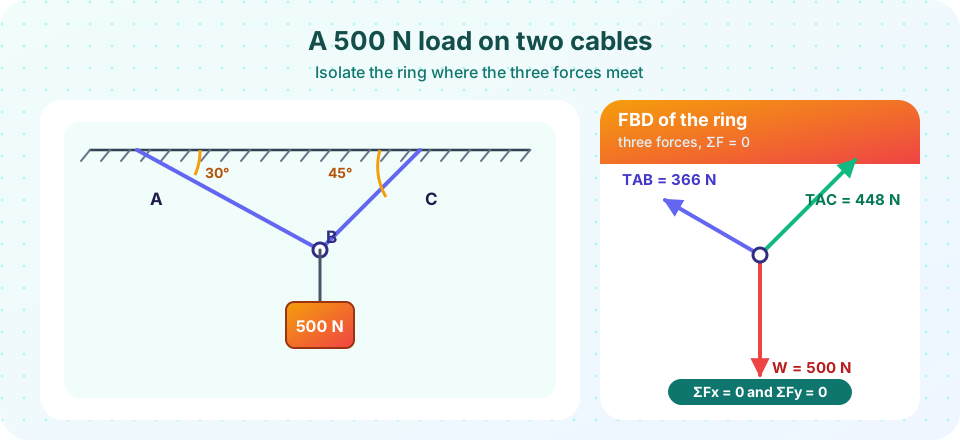
A 500 N weight hangs from ring B. Cable BA runs up to the left at 30° above the horizontal; cable BC runs up to the right at 45° above the horizontal. Find the tensions.
FBD of the ring B: T_AB at 30° above −x, T_AC at 45° above +x, weight 500 N downward.
ΣFx = 0: T_AC cos 45° − T_AB cos 30° = 0
ΣFy = 0: T_AB sin 30° + T_AC sin 45° − 500 = 0
From the first equation, T_AC = T_AB × cos 30° / cos 45° = 1.2247 T_AB. Substituting into the second:
T_AB (0.5 + 1.2247 × 0.7071) = 500, so T_AB (0.5 + 0.8660) = 500 and
T_AB = 366 N, T_AC = 448 N.
Check: T_AB cos 30° = 317.0 N and T_AC cos 45° = 317.0 N, so the horizontal forces cancel. For any two angles, the closed-form solution is T_AB = W cos β / sin(α + β) and T_AC = W cos α / sin(α + β), where α and β are the cable angles from the horizontal.
Why shallow cables carry huge tension
Suppose the load hangs from the middle of a symmetric cable, both halves at angle θ below the horizontal ends. Vertical balance gives 2 T sin θ = W, so T = W / (2 sin θ). As the cable gets flatter, sin θ shrinks and the tension grows without bound. You can never pull a loaded cable perfectly straight, which is why washing lines sag, and why power lines are designed with a deliberate sag.
Press Run (or Ctrl + Enter) to see the result here.
Program input · what you'd type while the program runs
Type the answers before you press Run, one per line. Each time the program reads a line (with input()), it gets the next line from this box.
Pulleys and springs
Ideal pulley. A frictionless, massless pulley only redirects a cable. The tension is the same on both sides, so one cable over a pulley supporting a load W pulls the support with W on each side and the pulley's axle must carry the vector sum of those two pulls.
Spring. A linear spring exerts F = k s, where s is the stretch (or compression) from its unstretched length L0. The spring pulls the particle toward itself when stretched and pushes away when compressed.
Worked example with a spring. A ring supports a 300 N weight on a vertical cable. It is held in place by a cable pulling up and to the right at 30° above the horizontal and by a horizontal spring pulling to the left. The spring has k = 800 N/m and unstretched length 0.50 m. Find the length of the stretched spring.
ΣFy = 0: T sin 30° = 300, so T = 600 N.
ΣFx = 0: T cos 30° = F_spring, so F_spring = 519.6 N.
s = F / k = 519.6 / 800 = 0.650 m, so the length is 0.50 + 0.650 = 1.15 m.
Press Run (or Ctrl + Enter) to see the result here.
Program input · what you'd type while the program runs
Type the answers before you press Run, one per line. Each time the program reads a line (with input()), it gets the next line from this box.
Common misconceptions
"The tensions must be equal because the ring is still." Only if the geometry is symmetric. In the worked example the tensions are 366 N and 448 N.
"The tension in a cable changes where it passes over an ideal pulley." For a frictionless, massless pulley it does not change.
"A spring's force depends on its length." It depends on the change in length from the unstretched length.
Check your understanding
Quick check · 5 questions
of 5 answered You scored / 5 · perfect!
-
1. A 400 N weight hangs from a symmetric two-cable arrangement, each cable 30° above the horizontal. What is the tension in each cable?
2 T sin 30° = 400, so T = 400 N. -
2. A spring with k = 500 N/m and unstretched length 0.20 m is stretched to 0.32 m. What force does it exert?
s = 0.12 m, so F = 500 × 0.12 = 60 N. -
3. What happens to the tension in a loaded cable as it is pulled more nearly horizontal?
T = W / (2 sin θ), which grows as θ → 0. -
4. Which cable result tells you the assumed arrangement is impossible?
A cable cannot push, so a negative tension means the cable would go slack. -
5. In particle equilibrium, how many unknowns can you solve for in a plane?
ΣFx = 0 and ΣFy = 0 give two equations.
Summary
- A particle in equilibrium satisfies
ΣFx = 0andΣFy = 0(plusΣFz = 0in 3D). - Draw cables as forces pulling away from the joint; a cable cannot push.
T = W / (2 sin θ)for a symmetric cable: shallow cables need large tension.- Ideal pulleys keep tension unchanged; springs follow
F = k s.
Track your progress
Create a free account to tick off lessons and pick up where you left off on any device.
of Engineering Statics lessons completed