


















Lesson 20 of 47 · Moments and Couples
Couples: pure rotation
Understand couples: two equal, opposite, parallel forces that give pure rotation. Learn the couple moment F·d, why it is a free vector and how to add couples in 2D and 3D.
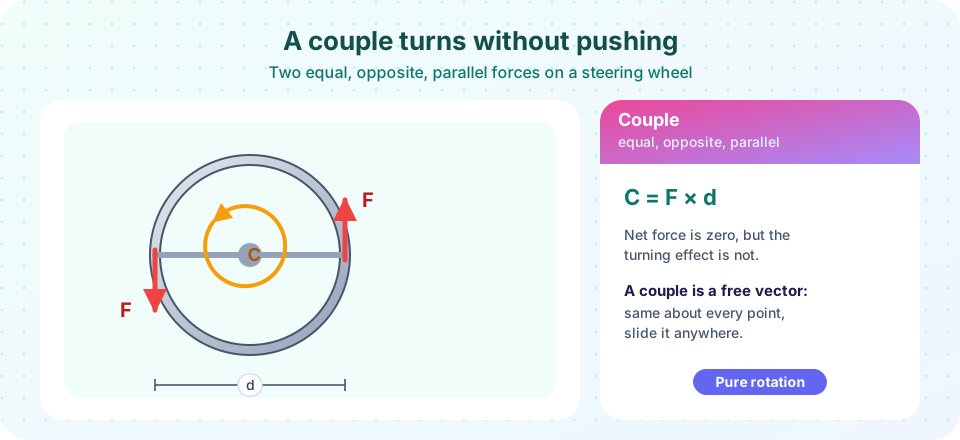
Turn a steering wheel with both hands: one hand pushes up, the other pulls down with the same force. The wheel turns, yet there is no net push on the steering column. Open a faucet with a T-handle, or twist a screwdriver with two fingers. In each case you apply a couple: two equal and opposite forces that do not share a line of action. A couple has no resultant force, only a turning effect, and it has a property that makes it unusually easy to work with.
What you will learn
- What a couple is and how to compute its moment.
- Why the moment of a couple is the same about every point.
- How to replace a couple by an equivalent one, and how to add couples.
- How couples appear as support reactions and as torques in 3D.
Key terms
- Couple: two parallel forces of equal magnitude and opposite sense, separated by a perpendicular distance.
- Couple moment
C:C = F d, wheredis the distance between the force lines. - Free vector: a vector with magnitude and direction but no fixed position; it can be moved anywhere.
- Equivalent couples: couples with the same moment vector; they have identical effects on a rigid body.
- Torque: another word for a moment, used especially for twisting about an axis.
Definition and magnitude
Two forces +F and −F act along parallel lines separated by a perpendicular distance d. Their sum is zero, so a couple never changes the translational motion of a body. Their moment about a point is
C = F d
and its sense is that of the rotation the pair would produce. The steering-wheel couple of two 20 N hand forces 0.36 m apart is 20 × 0.36 = 7.2 N·m.
A couple is a free vector
Take moments about any point O. Let A be a point on the line of +F and B a point on the line of −F. Then
M_O = r_A × F + r_B × (−F) = (r_A − r_B) × F = r_BA × F
where r_BA is the vector from B to A. The position of O has vanished! The moment of a couple is the same about every point. That is why we call it a free vector: a couple's effect on a rigid body depends only on its moment vector (size, direction, sense), not on where it acts.
In practice this means:
- You can slide a couple anywhere in its plane, or to a parallel plane.
- You can rotate the two forces and change
Fanddas long as the productF dand the sense stay the same: a 100 N couple with 0.2 m separation is equivalent to a 40 N couple with 0.5 m separation. - To find the moment a couple contributes to a moment equation, just write
±C; you never need distances to the point you are summing about.
The two individual moments change as you move O, but their sum never does.
Adding couples
Because couples are free vectors, you add them as vectors. In a plane all couple vectors point along the z axis, so you just add signed numbers.
Worked example. Three couples act on a plate in the plane: 40 N × 0.5 m counterclockwise, 25 N × 0.8 m clockwise, 60 N × 0.3 m counterclockwise.
C_total = +20 − 20 + 18 = +18 N·m, counterclockwise.
The plate reacts as if one 18 N·m couple acted on it, wherever the individual forces are drawn.
In three dimensions, a couple has the vector form C = r × F, where r runs from a point on the −F line to a point on the +F line. For forces ±50 k N and r = 0.4 i + 0.3 j m:
C = r × F = (0.4 i + 0.3 j) × 50 k = 20 (i × k) + 15 (j × k) = −20 j + 15 i N·m,
of magnitude 25 N·m (the separation perpendicular to the forces is √(0.4² + 0.3²) = 0.5 m, and 50 × 0.5 = 25).
Press Run (or Ctrl + Enter) to see the result here.
Program input · what you'd type while the program runs
Type the answers before you press Run, one per line. Each time the program reads a line (with input()), it gets the next line from this box.
Couples as reactions and in machines
- A fixed support supplies a couple (a reaction moment) because it prevents rotation. A cantilever wall moment
M_Ais exactly a couple acting on the beam. - Shafts and gears transmit couples. The torque in a car's drive shaft is a couple: forces from the gear teeth on one side, equal and opposite on the other.
- A pipe wrench or tire iron produces a couple on a nut when you pull on one end and the pivot supplies the equal and opposite force at the other point.
A couple differs from a single force in one important way: a single force cannot be replaced by a couple, and a couple cannot be replaced by a force. A couple has no resultant force; a force at a distance always carries a net push. The next lesson shows how to combine them.
Common misconceptions
"A couple pushes the body sideways a little." Its resultant force is exactly zero; it cannot translate the body.
"A couple's moment depends on the point." It does not. This is the key property.
"Two forces that sum to zero are always a couple." Only if their lines of action differ. If they are collinear, there is no moment either.
Check your understanding
Quick check · 5 questions
of 5 answered You scored / 5 · perfect!
-
1. Two forces of 30 N, equal and opposite, act on parallel lines 0.6 m apart. The couple moment is
C = F d = 30 × 0.6 = 18 N·m. -
2. A couple of moment 12 N·m acts on a body. What is its resultant force?
The two forces cancel. -
3. A couple is called a free vector because
Its effect does not depend on where it acts. -
4. Which couple is equivalent to a 100 N couple with 0.2 m separation (same sense)?
100 × 0.2 = 20 N·m, and 40 × 0.5 = 20 N·m. -
5. What does a fixed support supply that a pin does not?
A fixed support prevents rotation, so it supplies a reaction moment.
Summary
- A couple is two equal, opposite, parallel forces; its net force is zero.
C = F d, a free vector: the same about every point and movable anywhere.- Couples add as vectors; in a plane they add as signed numbers.
- Fixed supports and shafts supply and transmit couples.
Track your progress
Create a free account to tick off lessons and pick up where you left off on any device.
of Engineering Statics lessons completed