


















Lesson 33 of 47 · Friction
Friction: The Big Picture
Why a parked car stays put and a ladder does not slip. Chapter 7 overview: dry friction, the friction cone, tipping, belts, wedges and screws.
So far, every surface in this course has been smooth, and every support has been a perfect roller or pin. Real surfaces are rough. That roughness is what lets you walk, lets a ladder lean against a wall, and lets a nut stay tight on a bolt. It is also what makes a heavy crate hard to push. Friction is the force that resists sliding between two surfaces in contact.
In statics we are interested in a specific question: will it slip? You will learn how much friction a contact can supply, how to compute the friction force needed for equilibrium, and how to compare the two.
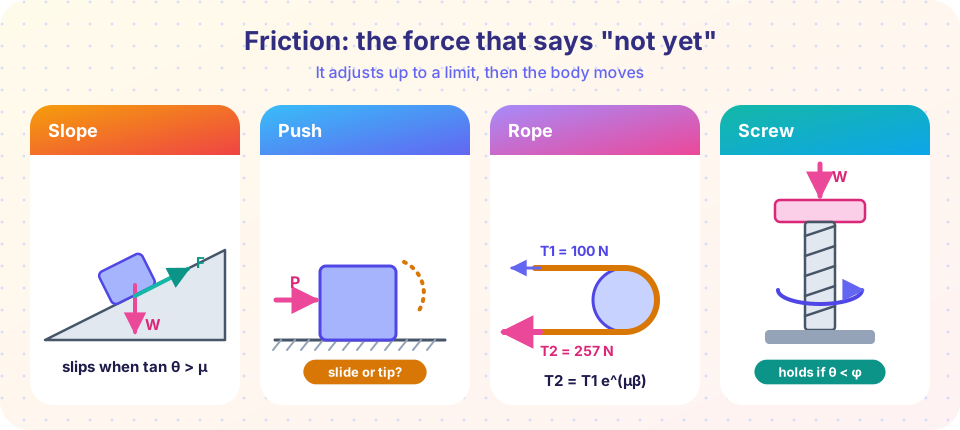
The big picture
- Friction is a reaction. Like a pin reaction, it adjusts to whatever value equilibrium needs, up to a limit.
- The limit is proportional to the normal force.
F_max = μ_s N, with the coefficient of static frictionμ_s. - Past the limit, things move. Then friction becomes kinetic,
F = μ_k N, usually a little smaller. - Problems come in three flavors. Either you know the surface is about to slip (impending motion, so
F = μ_s N), or you check whether friction needed is less than friction available, or you decide whether the object tips before it slips.
Friction resists sliding
Static and kinetic
Three questions
Wedges and belts
What each lesson covers
| Lesson | Key question |
|---|---|
| Dry friction laws | How much friction can a contact give, and how do I use it in equilibrium? |
| Slip or tip? | A crate, a ladder or a wheel: which failure happens first? |
| Belts, wedges and screws | How do friction-based machines multiply force and lock themselves? |
| Chapter review | Do I know when to use F = μ N? |
A first calculation
A 50 kg block rests on a horizontal floor with μ_s = 0.40. Its weight is W = 50 × 9.81 = 490.5 N. On a horizontal floor N = W, so the largest friction force is F_max = 0.40 × 490.5 = 196.2 N. If you push horizontally with 150 N the block does not move and friction is exactly 150 N (not 196.2 N!). If you push with 200 N, the block slides, because the required friction exceeds the available.
Press Run (or Ctrl + Enter) to see the result here.
Program input · what you'd type while the program runs
Type the answers before you press Run, one per line. Each time the program reads a line (with input()), it gets the next line from this box.
Check your understanding
Quick check · 3 questions
of 3 answered You scored / 3 · perfect!
-
1. A block on the floor has N = 200 N and μs = 0.5. The maximum static friction is:
F_max = μs N = 0.5 × 200 = 100 N. -
2. You push a crate with less than the maximum friction. The friction force equals:
Static friction is a reaction: it takes whatever value balances the push, up to the limit. -
3. Which describes kinetic friction compared with static friction?
For most dry surfaces μk is somewhat smaller than μs.
Summary
- Friction is a reaction force along the surface, limited by
μ_s N. - Check: is needed friction less than available friction?
- Beyond the limit, the object slips and friction becomes
μ_k N. - Tipping, belts and wedges are covered in the next lessons.
Next: Dry friction laws
Track your progress
Create a free account to tick off lessons and pick up where you left off on any device.
of Engineering Statics lessons completed