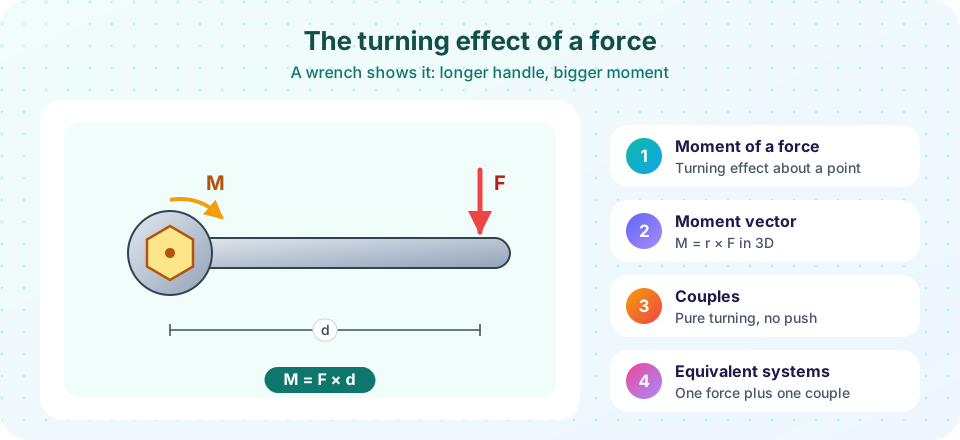
Overview of Chapter 4: how a force turns a body, what a couple is, how moments are computed with scalars and vectors, and how to replace a load system by one force and one couple.
Push a door near its hinge and it barely moves. Push at the handle and it swings easily. The force is the same; the difference is where you push. That "turning effect" is the moment of a force, and it is just as important in statics as the force itself. Moments decide whether a beam rotates, whether a crane tips and how much twist a bolt must carry. In Chapter 3 you used moment equations; this chapter explains them properly.
Caption: the moment of a force is the force multiplied by its perpendicular distance from the turning point.
A doubled handle gives double the moment for the same effort. Now plot the trade-off.
Python
Moment against distance
import numpy as np
import matplotlib.pyplot as plt
plt.rcParams.update({"figure.facecolor":"#f0fdfa","axes.facecolor":"#ffffff","axes.edgecolor":"#99f6e4","axes.spines.top":False,"axes.spines.right":False,"axes.grid":True,"grid.color":"#ccfbf1","axes.prop_cycle": plt.cycler(color=["#6366f1","#ec4899","#f59e0b","#14b8a6","#38bdf8"]),"font.size":12})
d = np.linspace(0,0.8,100)for F in(50,100,200):
plt.plot(d, F * d, linewidth=2.5, label=f"F = {F} N")
plt.axhline(40, color="#ef4444", linestyle="--", linewidth=2)
plt.annotate("40 N·m needed", xy=(0.62,40), xytext=(0.45,100), arrowprops={"arrowstyle":"->","color":"#475569"})
plt.xlabel("Moment arm d (m)")
plt.ylabel("Moment M = F d (N·m)")
plt.title("A longer handle needs less force")
plt.legend()
plt.show()
Press Run (or Ctrl + Enter) to see the result here.
Program input · what you'd type while the program runs
Type the answers before you press Run, one per line. Each time the program reads a line (with input()), it gets the next line from this box.