


















Lesson 10 of 47 · Vectors and Forces
Chapter 2 review: vectors and forces
Review components, resultants, 3D Cartesian vectors, unit vectors, dot and cross products with a one-page summary, a worked problem and a nine-question quiz.
Chapter 2 gave you the language of forces. Before you move on to equilibrium, make sure the five key tools are automatic: components, resultants, unit vectors, the dot product and the cross product.
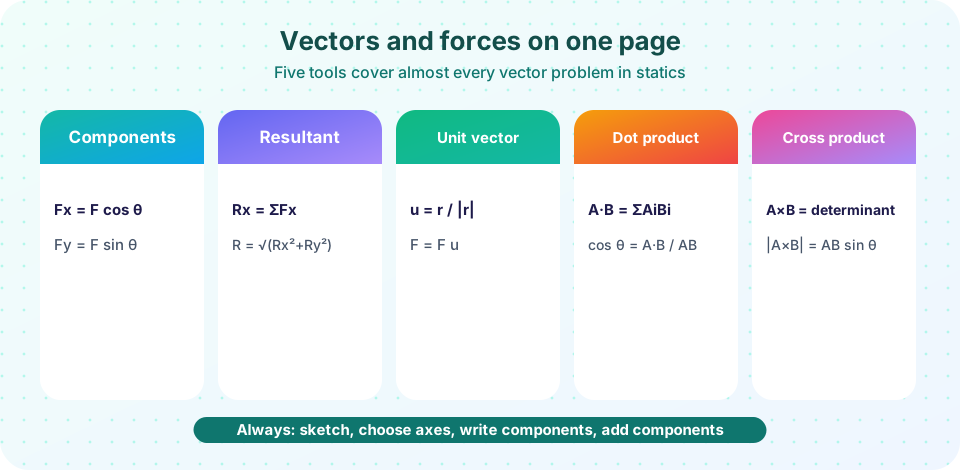
Recap table
| Lesson | Key idea | Core formula |
|---|---|---|
| Forces in two dimensions | Add components, rebuild the resultant | Rx = ΣFx, R = √(Rx² + Ry²) |
| Vectors in three dimensions | Cartesian form, unit vectors, direction cosines | F = F u, cos²α + cos²β + cos²γ = 1 |
| Dot and cross products | Angle and projection; perpendicular vector | A·B = AB cos θ, area = AB sin θ |
A worked problem that uses everything
Two cables are attached to the top of a mast at point A (0, 0, 8) m. Cable 1 runs to the ground at B (6, 0, 0) m with tension 1000 N. Cable 2 runs to the ground at C (0, −4, 0) m with tension 800 N. Find the resultant of the two cable forces on the mast top, and the angle between the cables.
- Position vectors (from A, in the direction the cable pulls A):
r_AB = 6 i + 0 j − 8 k, length 10 m.r_AC = 0 i − 4 j − 8 k, length√80 = 8.944 m. - Forces:
F1 = 1000 × (6 i − 8 k)/10 = 600 i − 800 kN.F2 = 800 × (−4 j − 8 k)/8.944 = −357.8 j − 715.5 kN. - Resultant:
R = 600 i − 357.8 j − 1515.5 kN, magnitude√(360000 + 128000 + 2 296 700) = 1669 N. - Angle between the cables:
cos θ = (r_AB · r_AC) / (|r_AB| |r_AC|) = (0 + 0 + 64) / (10 × 8.944) = 0.7155, soθ = 44.3°.
Press Run (or Ctrl + Enter) to see the result here.
Program input · what you'd type while the program runs
Type the answers before you press Run, one per line. Each time the program reads a line (with input()), it gets the next line from this box.
Check your understanding
Quick check · 9 questions
of 9 answered You scored / 9 · perfect!
-
1. A 500 N force acts at 53.13° above +x (a 3-4-5 triangle). What are its components?
cos 53.13° = 0.6 and sin 53.13° = 0.8, so Fx = 300 N and Fy = 400 N. -
2. The resultant of 6 N and 8 N forces that are perpendicular is
R = √(36 + 64) = 10 N. -
3. r_AB points from A(1, 1, 1) to B(4, 5, 1). Its length is
(3, 4, 0) has length 5. -
4. Which statement about the unit vector u = r / |r| is true?
A unit vector has length one and only gives direction. -
5. i × k equals
k × i = j, so i × k = −j. -
6. Two forces have A·B = 0 and neither is the zero vector. They are
A zero dot product means cos θ = 0, so θ = 90°. -
7. F = 300 i + 400 j (N) and u = j. The component of F along u is
F·j = 400 N. -
8. If the direction angles of a force are 60°, 60° and γ, what is γ (taking the acute value)?
cos²60° + cos²60° = 0.5, so cos²γ = 0.5 and γ = 45°. -
9. Why must you calculate the angle with atan2 or check the quadrant?
A plain arctangent cannot tell a vector from its opposite.
Summary
- Resolve, add components, rebuild: the 2D and 3D resultant procedure.
- Unit vector:
u = r/|r|; force along a line:F = F u. - Dot product for angles and projections; cross product for perpendicular vectors and (soon) moments.
- Check results with magnitude, direction cosines or perpendicularity tests.
Next: Chapter 3 overview: equilibrium of particles and bodies
Track your progress
Create a free account to tick off lessons and pick up where you left off on any device.
of Engineering Statics lessons completed