


















Lesson 15 of 47 · Equilibrium of Particles and Bodies
Equilibrium in three dimensions
Extend equilibrium to three dimensions: six equations, ball-and-socket, hinge and fixed supports, moments from r × F, with a three-support plate and a bracket example.
Real objects are not flat. A table has four legs, a door hangs on two hinges, a crane boom swings sideways as well as up. In three dimensions a body can translate along three axes and rotate about three axes, so there are six equations of equilibrium. The method is the same as in 2D; there is just more bookkeeping, and the cross product from Chapter 2 does the geometry for you.
What you will learn
- The six scalar equations of 3D equilibrium and their vector form.
- The reactions of common 3D supports.
- How to compute moments with
r × Fand sum them about a point. - How to solve a plate on three supports and a fixed bracket.
Key terms
- Ball-and-socket joint: a joint that allows any rotation but no translation; gives 3 force components.
- Hinge: allows rotation about one axis; gives 3 forces and 2 moments.
- Fixed support: blocks everything; gives 3 forces and 3 moments.
- Moment about an axis: the part of a moment vector along that axis.
- Vector equilibrium:
ΣF = 0andΣM_O = 0written as vectors.
The six equations
In vector form: ΣF = 0 and ΣM_O = 0, where O is any point. Each vector equation has three components:
ΣFx = 0, ΣFy = 0, ΣFz = 0, ΣMx = 0, ΣMy = 0, ΣMz = 0
The moment of a force F applied at position r (measured from O to the point of application) is
M_O = r × F
so for a set of forces, ΣM_O = Σ (r_i × F_i) + Σ (couple moments) + reaction moments. Use the determinant from Dot and cross products for each term, or think in scalar terms: a force's moment about the x axis is the product of its perpendicular distance to that axis and the component that tends to rotate about it.
3D supports
| Support | Reaction forces | Reaction moments | Total unknowns |
|---|---|---|---|
| Ball-and-socket | 3 | 0 | 3 |
| Smooth surface or roller | 1 (normal) | 0 | 1 |
| Cable | 1 (along the cable) | 0 | 1 |
| Hinge (axis along z) | 3 | 2 (about x and y) | 5 |
| Fixed support | 3 | 3 | 6 |
A pin-supported object in 2D becomes a hinge in 3D. Usually only five or six unknowns appear in a solvable problem, because the number of unknowns must match the six equations.
Worked example 1: the plate
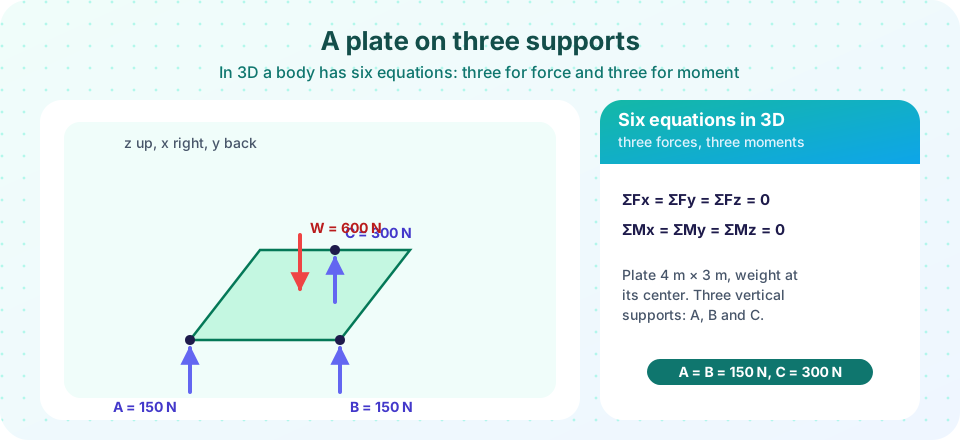
A horizontal rectangular plate is 4 m (along x) by 3 m (along y). Its weight of 600 N acts at its center (2, 1.5). It rests on three vertical supports: A at (0, 0), B at (4, 0) and C at (2, 3).
Only vertical forces act, so ΣFx, ΣFy and ΣMz are automatically satisfied. The remaining three equations are
ΣFz:A + B + C = 600- Moments about the x axis (using y positions):
3 C − 600 × 1.5 = 0, soC = 300 N - Moments about the y axis (using x positions):
4 B + 2 C − 600 × 2 = 0, soB = (1200 − 600)/4 = 150 N
Then A = 600 − 150 − 300 = 150 N. Check with symmetry: the plate and supports are symmetric about x = 2, so A = B.
Try placing the load near the edge between A and C: one of the reactions becomes negative. A support that can only push cannot supply it, so the plate lifts off. This is the 3D version of tipping, and the safe region is the triangle ABC (the support polygon).
Worked example 2: a bracket built into a wall
A horizontal bar 4 m long runs from a wall at O along +x. At its tip A, a load F = 300 j − 1000 k N acts (300 N sideways, 1000 N down). The bar is fixed at O. Find the reactions.
ΣF = 0: the fixed support gives R = −F = −300 j + 1000 k N.
ΣM_O = 0: the load's moment is r × F with r = 4 i:
r × F = 4 i × (300 j − 1000 k) = 1200 k − 4000 (i × k), and i × k = −j, so r × F = 1200 k + 4000 j N·m.
The support moment must cancel it: M_O = −4000 j − 1200 k N·m.
Press Run (or Ctrl + Enter) to see the result here.
Program input · what you'd type while the program runs
Type the answers before you press Run, one per line. Each time the program reads a line (with input()), it gets the next line from this box.
The k component of the moment comes from the sideways force: a 300 N push at 4 m from the wall tries to twist the bar about the vertical axis. The downward load tries to bend it about the y axis. Both are carried by the wall.
Tips for 3D problems
- Draw the FBD in a clear isometric view and label coordinates of every force point.
- Write each force as a vector (use forces along a line for cables).
- Take moments about a point where many unknown forces act. A point on the line between two supports removes two unknowns at once.
- Use scalar moment equations when the geometry is simple, and
r × Fwhen it is not. - Check by summing moments about a different point.
Common misconceptions
"A 3D problem needs a computer." Most textbook cases are solved by hand with a smart moment axis.
"A hinge gives no moment." A hinge gives no moment about its own axis but can give moments about the other two.
"Moments of vertical loads are zero about horizontal axes." A vertical force has a moment about a horizontal axis whenever its line of action does not intersect that axis.
Check your understanding
Quick check · 5 questions
of 5 answered You scored / 5 · perfect!
-
1. How many scalar equilibrium equations does a rigid body in 3D have?
Three force and three moment components. -
2. How many unknowns does a ball-and-socket joint supply?
Three force components and no moments. -
3. r = 2 i m and F = 5 j N. What is r × F?
i × j = k, so 2 × 5 k = 10 k N·m. -
4. In the plate example, what happens if the load moves to a corner far from the support triangle?
Outside the support triangle a one-way support would need to pull; the plate tips. -
5. Which unknown set belongs to a fixed support in 3D?
It blocks all three translations and all three rotations.
Summary
- 3D rigid-body equilibrium:
ΣF = 0andΣM_O = 0, six scalar equations. - Ball-and-socket: 3 forces; hinge: 3 forces + 2 moments; fixed: 3 forces + 3 moments.
- Moments:
M_O = r × F; summed about a convenient point. - A body on unilateral supports stays put only if the load acts inside the support polygon.
Next: Chapter 3 review
Track your progress
Create a free account to tick off lessons and pick up where you left off on any device.
of Engineering Statics lessons completed