


















Lesson 25 of 47 · Trusses and Frames
Method of Sections
Cut a truss in two and use moments to find the force in a single bar without solving every joint. Includes a worked example and a runnable check.
Suppose a bridge inspector asks one question: "How much force is in the top chord at midspan?" The method of joints would make you walk across the whole truss to answer. The method of sections answers in one equation.
Imagine slicing the truss with a straight cut that passes through at most three bars whose forces you do not know. Each side of the cut is now a rigid body in equilibrium, and a rigid body in the plane gives three equations: ΣFx, ΣFy and ΣM. Three equations, three unknown bars.
What you will learn
- Choose a cut that passes through no more than three unknown bars.
- Draw the free body of one side of the cut.
- Pick moment centers that eliminate two unknowns at a time.
- Decide when joints are faster and when sections are faster.
Key terms
Section (cut): an imaginary line through the truss that separates it into two free bodies.
Moment center: the point about which you sum moments; the best choice lies on the lines of action of two unknown forces.
Chord: the top or bottom boundary bars of a truss.
Web member: a diagonal or vertical bar between the chords.
The method in five steps
- Find the support reactions from the whole truss.
- Draw a cut through the bars you care about that crosses at most three bars with unknown force. It need not be a straight line.
- Choose one side as the free body (the one with fewer loads is often easier). Draw the reactions and loads on that side.
- Replace each cut bar by an arrow pulling away from the cut (assume tension).
- Write
ΣM = 0about a point where two cut bars cross, to get the third alone. UseΣFxandΣFyfor the remaining unknowns.
Worked example
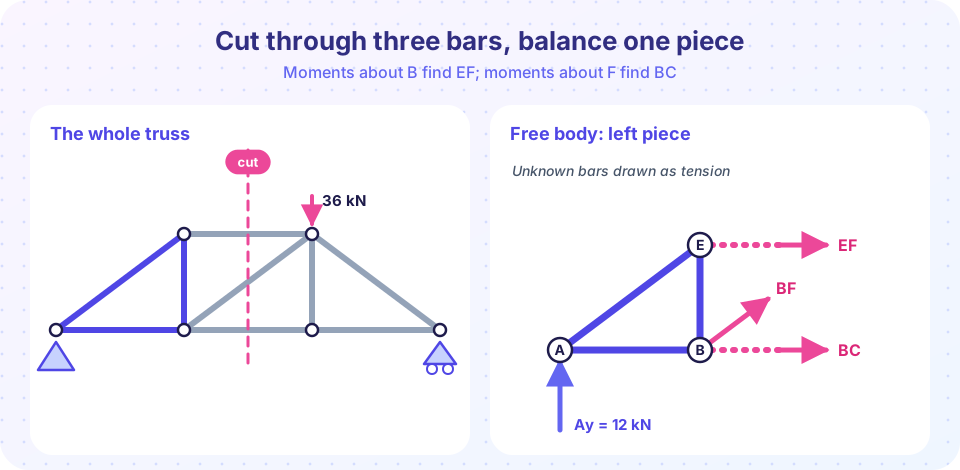
Use the same truss as in the method of joints: pin A at the origin, roller D at x = 12 m, apex joints E (4, 3) and F (8, 3), load 36 kN downward at F. The reactions are Ay = 12 kN and Dy = 24 kN. Find the forces in EF, BF and BC.
Cut between the vertical bars at x = 4 m and x = 8 m. This cuts exactly EF, BF and BC. Keep the left piece, which contains A, B, E and only the reaction Ay = 12 kN (the 36 kN load is on the right).
Bar EF. Take moments about B. Bars BF and BC both pass through B, so they have no moment. The reaction Ay is 4 m to the left of B and acts upward: that is a clockwise moment of 12 × 4 = 48 kN·m. EF acts at height 3 m above B; if it is in tension it pulls the left piece toward the right, which gives a clockwise moment 3 F_EF about B.
ΣM_B = 0: -48 - 3 F_EF = 0 -> F_EF = -16 kN (compression)
(Sign convention here: counterclockwise positive, so both clockwise terms are negative.)
Bar BC. Take moments about F, the point where EF and BF meet. Now Ay is 8 m left and 3 m below F: its moment about F is 12 × 8 = 96 kN·m clockwise. The force BC acts along the bottom line, 3 m below F; tension pulls the piece to the right, giving a counterclockwise moment 3 F_BC.
ΣM_F = 0: -96 + 3 F_BC = 0 -> F_BC = +32 kN (tension)
Bar BF. Now a force balance. BF makes a 3-4-5 angle: its vertical component is (3/5) F_BF.
ΣFy = 0: 12 + (3/5) F_BF = 0 -> F_BF = -20 kN (compression)
These are exactly the values the joint method found. The section method found three bars with three short equations and never touched the other six bars.
How to choose the moment center
The clever part is the choice. Look at the three cut bars and find where two of their lines of action intersect.
| Bar you want | Take moments about | Why it works |
|---|---|---|
| A chord bar (top) | Joint where the other chord and the diagonal meet | The other two bars pass through the point |
| A chord bar (bottom) | The top joint where the other cut bars meet | Same reason |
| A diagonal | The point where the two chords' lines meet (or use ΣFy) |
Chords pass through it; if they are parallel use ΣFy |
When the two chords are parallel, as in most bridges, they never meet, so the diagonal is found with ΣFy = 0 instead.
Choosing joints or sections
- Want all bar forces: use joints (or a computer).
- Want one or two bars, especially in the middle of a long truss: use sections.
- Want to check a joint answer: use a section.
You can mix them: use one section to find a force that unlocks a joint.
Common misconceptions
"The cut line must be straight." It can bend, as long as it separates the truss into two parts and crosses at most three unknown bars.
"I must cut through three bars." You may cut through more, as long as only three have unknown forces after you apply other equations, or you use a clever moment center.
"A moment center must lie on the structure." Any point in the plane works. The best point is the one that kills the most unknowns, even if it is outside the truss.
Try it
Press Run (or Ctrl + Enter) to see the result here.
Program input · what you'd type while the program runs
Type the answers before you press Run, one per line. Each time the program reads a line (with input()), it gets the next line from this box.
Press Run (or Ctrl + Enter) to see the result here.
Program input · what you'd type while the program runs
Type the answers before you press Run, one per line. Each time the program reads a line (with input()), it gets the next line from this box.
Check your understanding
Quick check · 4 questions
of 4 answered You scored / 4 · perfect!
-
1. How many unknown bar forces can a single section solve in the plane?
A rigid body in the plane has three equilibrium equations, so a cut through three unknown bars can be solved. -
2. To find one cut bar directly, you should take moments about:
The other two forces then have zero moment about that point, leaving a one-unknown equation. -
3. Which situation favors the method of sections over the method of joints?
A section reaches a single bar in one or two equations, without solving the joints before it. -
4. In a truss with parallel chords, which equation finds a cut diagonal?
Parallel chords never meet, so there is no good moment point; the vertical force balance gives the diagonal directly.
Summary
- A cut through three unknown bars gives three equations for one free body.
- Pick a moment center where two cut bars meet, so the third stands alone.
- Use sections for a few bars, joints for all of them, and one to check the other.
- Chord force at a section is about the bending moment divided by the truss depth.
Next: Frames and machines
Track your progress
Create a free account to tick off lessons and pick up where you left off on any device.
of Engineering Statics lessons completed