


















Lesson 37 of 47 · Friction
Review: Friction
Chapter 7 in one picture: static and kinetic friction, friction angle, tip versus slip, belts and screws, with a recap table and a nine-question mixed quiz.
Friction problems all follow one pattern: draw the free-body diagram, write equilibrium, then compare the friction you need with the friction you have. This review gathers the tools of the chapter and checks that you can pick the right one.
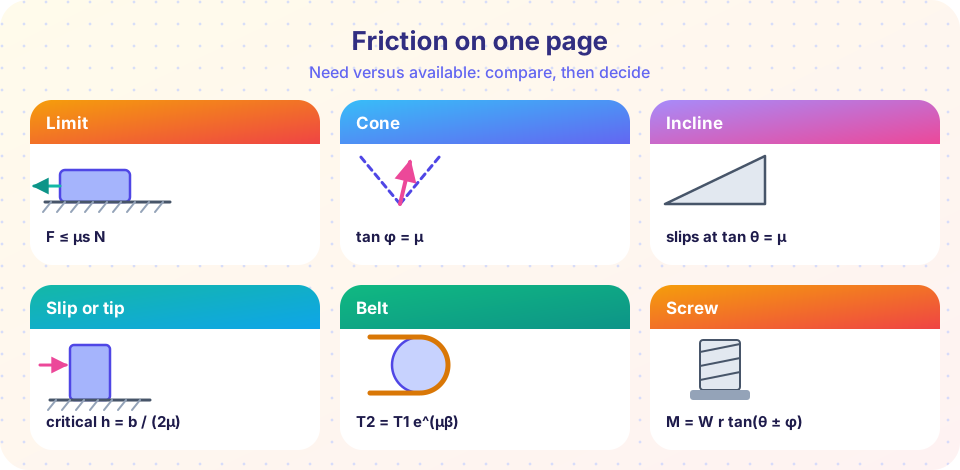
Recap table
| Topic | Result |
|---|---|
| Static friction | F ≤ μ_s N, equality at impending slip |
| Kinetic friction | F = μ_k N, μ_k ≤ μ_s |
| Angle of friction | tan φ = μ |
| Incline, no push | slips when tan θ > μ_s |
| Pull at angle α | P = μ W / (cos α + μ sin α), best at α = φ, P_min = W sin φ |
| Slip vs tip | compare μ W with W (b/2)/h; critical height b/(2 μ) |
| Ladder, smooth wall | tan θ ≥ 1/(2 μ_s) |
| Belt or rope | T2 = T1 e^(μ β), β in radians |
| Screw | raise M = W r tan(θ + φ), lower M = W r tan(θ − φ) |
| Self-locking | θ < φ, efficiency below 50% |
A problem-solving routine
- Draw the free-body diagram with
NandFon every rough contact. Guess the friction direction opposite to the likely motion. - Write
ΣFx,ΣFy,ΣM. - If slipping is impending, use
F = μ_s Nas an extra equation. Otherwise compareFwithμ_s Nafterward. - If more than one failure is possible (slip at several contacts, or slip and tip), assume each in turn and take the smallest load.
Press Run (or Ctrl + Enter) to see the result here.
Program input · what you'd type while the program runs
Type the answers before you press Run, one per line. Each time the program reads a line (with input()), it gets the next line from this box.
Press Run (or Ctrl + Enter) to see the result here.
Program input · what you'd type while the program runs
Type the answers before you press Run, one per line. Each time the program reads a line (with input()), it gets the next line from this box.
Check your understanding
Quick check · 9 questions
of 9 answered You scored / 9 · perfect!
-
1. A 300 N block on a rough horizontal table has μs = 0.4. A 100 N horizontal push is applied. The friction force is:
The block is in equilibrium (100 < 120), so friction equals the push. -
2. A box begins to slide on a plank when it is tilted to 30°. μs is about:
μs = tan 30° = 0.577. -
3. A crate of width 1.0 m is pushed at height 0.8 m on a floor with μs = 0.5. It will:
Critical height b/(2μ) = 1.0 m. The push is lower (0.8 m), so it slides first. -
4. A rope wraps 3/4 turn (β = 1.5π) around a post with μ = 0.2. T2/T1 ≈
e^(0.2 × 4.712) = e^0.942 = 2.57. -
5. A screw jack has θ = 4°, φ = 8°. Is it self-locking?
Lowering torque tan(θ − φ) is negative, so the jack holds its load. -
6. A crate is dragged by a rope inclined at the friction angle. Compared with a horizontal pull the force is:
α = φ minimises P: P_min = W sin φ. -
7. The contact force at impending slip makes an angle with the normal equal to:
By definition, tan φ = F_max / N = μs. -
8. A heavier block of the same material is on the same incline. The critical slip angle:
Weight cancels: tan θ = μs. -
9. For a belt drive, which increases the holding ratio most?
T2/T1 = e^(μβ) depends on μ and β only.
Summary
- Compare needed friction with available friction; use
F = μ_s Nonly at impending slip. - Check every possible failure: slipping at each contact, tipping.
- Belts: exponential in
μβ. Screws and wedges: self-locking whenθ < φ.
Track your progress
Create a free account to tick off lessons and pick up where you left off on any device.
of Engineering Statics lessons completed