


















Lesson 23 of 47 · Trusses and Frames
Trusses and Frames: The Big Picture
See how engineers turn a pile of slender bars into a bridge or a roof. Chapter 5 overview: trusses, joints, sections, frames, machines and what comes next.
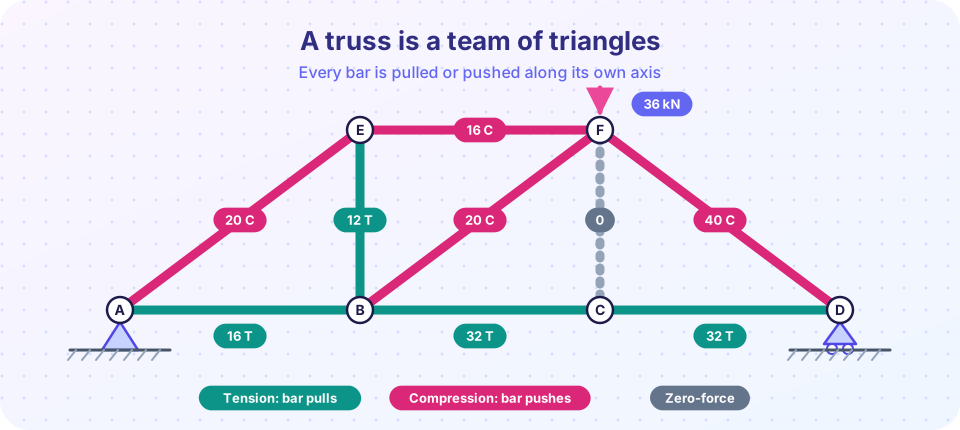
Look up at the roof of a railway station or drive under a steel bridge and you will see triangles everywhere. That is not decoration. A truss is a structure made of straight, slender bars joined at their ends, and the triangle is the one polygon that cannot change shape without changing the length of a side. Once you know that, the whole chapter follows: build a framework out of triangles, load it only at the joints, and every bar ends up carrying a pure pull or a pure push.
This chapter turns that idea into a calculation method. You will find the force in every bar of a truss, decide which bars are stretched and which are squeezed, and then move on to frames and machines, whose parts carry bending as well.
The big picture
Every method in this chapter rests on three simplifications. Learn them now and the rest is bookkeeping.
- Bars are two-force members. A bar is pinned at both ends and carries no load in between, so it can only transmit a force along its own axis.
- Loads act at the joints. Real bridges carry load on a deck, but the deck passes it to the joints through cross-beams. We model it as joint loads.
- Weight is small. Either we ignore the weight of the bars, or we split it half-and-half to the two end joints.
Under these rules, the force in a bar is one number: positive for tension (the bar is being stretched) and negative for compression (it is being squeezed). Your job is to find that number for every bar.
A truss is a team of triangles
Every bar is a two-force member
Method of joints
Method of sections
Frames and machines
What each lesson covers
| Lesson | Question it answers |
|---|---|
| Method of joints | How do I find every bar force by working from pin to pin? |
| Method of sections | How do I get one bar force quickly, without solving the whole truss? |
| Frames and machines | What changes when a member carries loads along its length? |
| Chapter review | Can I put it all together? |
Counting equations: is the truss solvable?
Before you calculate, check that the truss is a good design. Let m be the number of bars, j the number of joints and r the number of support reaction components. Each joint gives two equations (ΣFx = 0, ΣFy = 0), so there are 2j equations and m + r unknowns.
| Condition | Meaning |
|---|---|
m + r = 2j |
Statically determinate: equilibrium alone gives every force |
m + r > 2j |
Statically indeterminate: extra bars or supports, needs deformation analysis |
m + r < 2j |
Unstable: it is a mechanism and will collapse or change shape |
The simplest rigid truss is one triangle: m = 3, j = 3, and with a pin and a roller r = 3, so 3 + 3 = 6 = 2 × 3. Every time you add a new joint you must add two bars: that keeps the count balanced and keeps adding triangles.
Press Run (or Ctrl + Enter) to see the result here.
Program input · what you'd type while the program runs
Type the answers before you press Run, one per line. Each time the program reads a line (with input()), it gets the next line from this box.
Press Run (or Ctrl + Enter) to see the result here.
Program input · what you'd type while the program runs
Type the answers before you press Run, one per line. Each time the program reads a line (with input()), it gets the next line from this box.
Check your understanding
Quick check · 4 questions
of 4 answered You scored / 4 · perfect!
-
1. Why are triangles the basic building block of a truss?
With pinned joints, a triangle is the only polygon whose shape is fixed by its side lengths, so it is rigid. -
2. A bar in a truss is pinned only at its two ends and carries no load between them. What force can it carry?
Two forces in equilibrium must be equal, opposite and collinear, which means they act along the line joining the pins. -
3. A truss has 11 bars, 7 joints and 3 reaction components. What is it?
m + r = 14 and 2j = 14, so the count is balanced: determinate (assuming the bars are arranged sensibly). -
4. What sign convention do we use for bar forces?
We call a stretched bar positive (tension) and a squeezed bar negative (compression).
Summary
- A truss is a set of straight two-force bars joined at pins, loaded at the joints.
- Each bar carries pure tension (+) or compression (−).
m + r = 2jis the test for a determinate truss.- Joints give two equations each; sections give three; frames need every part drawn separately.
Next: Method of joints
Track your progress
Create a free account to tick off lessons and pick up where you left off on any device.
of Engineering Statics lessons completed