


















Lesson 44 of 47 · Projects and Practice
Practice Problem Set
Eleven mixed statics problems on trusses, frames, centroids, distributed loads, friction and beams, with a runnable answer checker and a table of worked results.
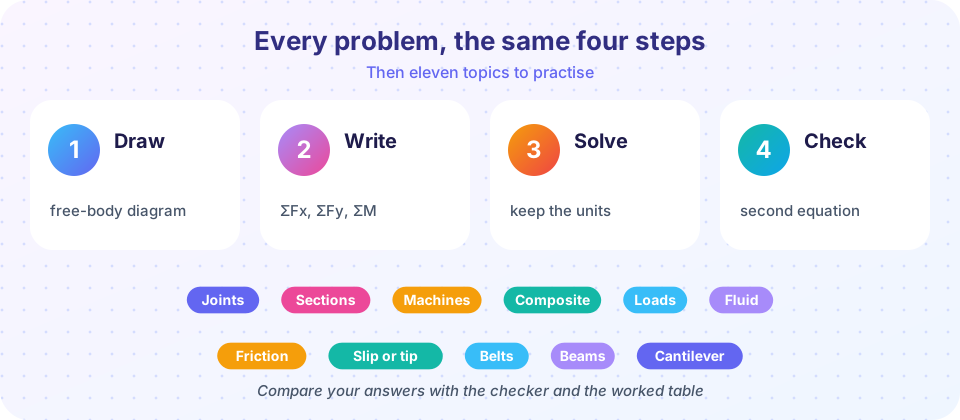
The best way to learn statics is to solve problems with a pencil. This set mixes everything from chapters 5 to 8, in a gentle order. Work each problem by hand first: draw the free-body diagram, write the equations, solve, check the units. Then use the answer checker below to see whether you are close.
How to use this set
Use SI units. Where a coefficient or a constant is needed it is given. Give forces to three significant figures. If you get stuck, reread the lesson named next to the problem.
| # | Topic | Problem |
|---|---|---|
| 1 | Joints | A triangular truss has pin A at (0, 0), roller B at (6, 0) m and apex C at (3, 4) m. A load of 20 kN acts downward at C. Find the force in AC, BC and AB. |
| 2 | Sections | The 12 m truss of the method-of-joints lesson (joints A (0,0), B (4,0), C (8,0), D (12,0), E (4,3), F (8,3); bars AB, BC, CD, AE, EF, FD, BE, CF, BF) is loaded with 36 kN downward at E instead of F. A is a pin, D a roller. Find EF, BF and BC with a section. |
| 3 | Machines | Pliers have handle arms of 140 mm and jaw arms of 35 mm. A hand force of 45 N acts on each handle. Find the grip force and the force on the pivot pin. |
| 4 | Composite areas | An L-shape is made of a 120 × 30 mm rectangle along the bottom and a 30 × 90 mm rectangle standing on its left end. Find the centroid from the lower left corner. |
| 5 | Distributed loads | A load varies linearly from 4 kN/m at the left to 10 kN/m at the right over 5 m. Find the resultant and its distance from the left end. |
| 6 | Fluid pressure | A tank wall 2 m wide holds water 3 m deep (ρ = 1000 kg/m³, g = 9.81 m/s²). Find the resultant force and its height above the base. |
| 7 | Friction | A 200 N block is on a 20° incline with μ_s = 0.30. Does it slide? What minimum force parallel to the slope holds it? |
| 8 | Slip or tip | A crate weighing 600 N is 0.6 m wide, 1.5 m tall, μ_s = 0.45, pushed horizontally at 0.9 m height. Which happens first, and at what push? |
| 9 | Belts | A holding force of 80 N is applied to a rope wrapped 1.5 turns around a post with μ = 0.25. What load can it hold? |
| 10 | Beam diagrams | A 10 m simply supported beam carries 4 kN/m over its whole length plus 20 kN at midspan. Find the reactions and the maximum moment. |
| 11 | Cantilevers | A 2.5 m cantilever carries 6 kN/m and a 5 kN tip load. Find the shear and moment at the wall. |
Try it: the answer checker
Enter your answers in the dictionary, run the code, and the checker marks each one correct if it is within 2%. It also prints the full worked answer for problems you have not attempted.
Press Run (or Ctrl + Enter) to see the result here.
Program input · what you'd type while the program runs
Type the answers before you press Run, one per line. Each time the program reads a line (with input()), it gets the next line from this box.
Press Run (or Ctrl + Enter) to see the result here.
Program input · what you'd type while the program runs
Type the answers before you press Run, one per line. Each time the program reads a line (with input()), it gets the next line from this box.
Worked answers
| # | Answer |
|---|---|
| 1 | AC = BC = 12.5 kN (compression), AB = 7.5 kN (tension) |
| 2 | EF = 32 kN (C), BF = 20 kN (T), BC = 16 kN (T); reactions Ay = 24 kN, Dy = 12 kN |
| 3 | Grip force 45 × 140 / 35 = 180 N; pin force 45 + 180 = 225 N |
| 4 | x̄ = ȳ = 40.7 mm (areas 3,600 and 2,700 mm²) |
| 5 | R = 35 kN, 2.86 m from the left (split into 20 kN at 2.5 m and 15 kN at 3.33 m) |
| 6 | R = 88.3 kN, 1.0 m above the base |
| 7 | tan 20° = 0.364 > 0.30: it slides. Minimum holding force 12.0 N up the slope |
| 8 | Slip needs 270 N, tip needs 200 N: it tips first, at 200 N (critical height 0.3/0.45 = 0.667 m) |
| 9 | 80 × e^(0.25 × 3π) = 80 × 10.55 ≈ 844 N |
| 10 | Reactions 40 kN each; M_max = 50 + 50 = 100 kN·m at midspan |
| 11 | V = 6 × 2.5 + 5 = 20 kN, M = −(18.75 + 12.5) = −31.25 kN·m (hogging) |
If your answer is different
Check these first: sign of the moment arm; units (mm vs m, N vs kN); whether you assumed the right direction for friction; and whether you used the total load or the load per meter. A quick sanity check, such as symmetry, overall equilibrium or a limiting case, catches most errors.
Check your understanding
Quick check · 4 questions
of 4 answered You scored / 4 · perfect!
-
1. In problem 8, the crate tips before it slips because:
Pushing above the critical height makes the tipping push (200 N) smaller than the sliding push (270 N). -
2. What is the first step in nearly every statics problem?
The free-body diagram shows every force and decides which equations to write. -
3. In problem 10, which formula gives the maximum moment of the uniform load alone?
w L² / 8 = 4 × 100 / 8 = 50 kN·m. -
4. A solution gives a negative force in a truss bar when tension was assumed. The bar is in:
A negative result means the bar pushes on the joint, which is compression.
Summary
- Draw, write equations, solve, check: the same four steps for every problem.
- Compare your answers with the checker, then look at the worked table.
- Errors usually come from signs, units or assumptions about direction.
Track your progress
Create a free account to tick off lessons and pick up where you left off on any device.
of Engineering Statics lessons completed