


















Lesson 35 of 47 · Friction
Slip or Tip? Friction Problems with Two Failure Modes
Decide whether a pushed crate slides or tips, and find the safe angle for a leaning ladder. Learn to compare two failure modes in friction equilibrium problems.
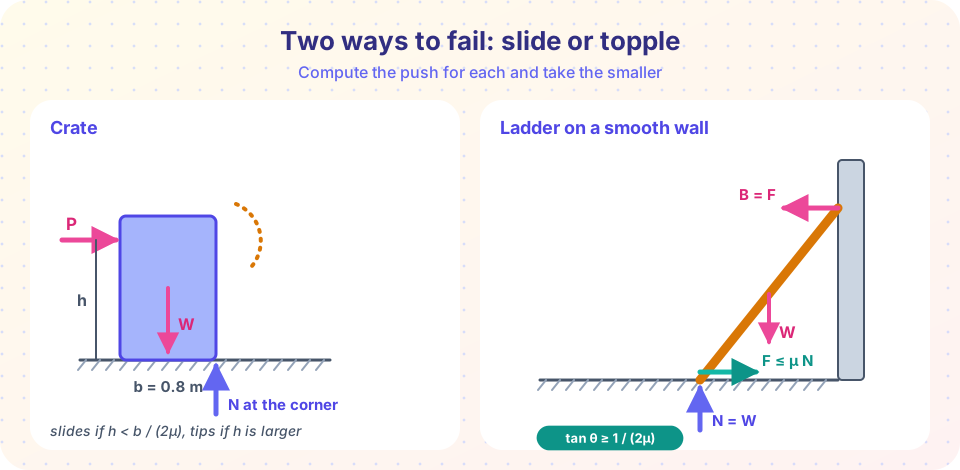
A tall wardrobe being pushed across a floor can do one of two things: slide along the floor, or topple. Which one happens depends on how high you push and how rough the floor is. A ladder leaning on a wall can fail by sliding at the foot, but it will not tip. Real friction problems often hide two possible failures, and you must find which one comes first.
The method is the same every time: compute the load needed to cause each failure and pick the smaller.
What you will learn
- Locate the normal force when a body is about to tip (at the corner).
- Compute the push for slipping and the push for tipping, then compare.
- Find the highest safe push height for a given crate.
- Solve the classic ladder problem for minimum safe angle.
Key terms
Impending slip: friction has reached μ_s N; the body is about to slide.
Impending tip: the normal force has moved to the corner (edge) the body is about to rotate about.
Line of action of N: where the floor's normal force effectively acts; it may sit anywhere within the base, and it reaches the edge at tipping.
Safe height: the maximum push height at which a slide happens before a tip.
Why the normal force moves
On the floor, the contact is spread over the whole base. Its resultant N acts at a point that adjusts to balance the moments. If you push high on a crate, the push tries to rotate it about the bottom edge on the far side from the push. To balance that rotation, the effective position of N slides toward that edge. When it reaches the edge, there is no more room to shift: further push means tipping. The condition for tipping is therefore found by placing N at the corner and taking moments about it.
Worked example 1: a crate
A crate weighs W = 981 N (100 kg), is 0.8 m wide and 1.2 m tall, with its center of gravity at the middle. It is pushed horizontally at height h above the floor. The static coefficient between crate and floor is μ_s = 0.35.
Slipping. Horizontal balance with friction at its limit: P_slip = μ_s N = 0.35 × 981 = 343 N, independent of h.
Tipping. Moments about the corner on the far side (the corner opposite the push, where N acts at the limit):
P × h = W × (width / 2) = 981 × 0.4 = 392.4 N·m
P_tip = 392.4 / h
Now compare:
Push height h |
P_tip (N) |
P_slip (N) |
What happens first |
|---|---|---|---|
| 0.6 m | 654 | 343 | Slides |
| 1.0 m | 392.4 | 343 | Slides |
| 1.143 m | 343 | 343 | Both together |
| 1.2 m | 327 | 343 | Tips |
The critical height is when P_slip = P_tip: μ_s W = W (b/2) / h, so h_crit = b / (2 μ_s) = 0.8 / 0.7 = 1.143 m. Push below that and it slides; above and it tips. This is why moving men push low.
A rule of thumb comes out of the formula: a body slides first if h < b/(2 μ_s). Tall, narrow bodies on rough floors tip.
Worked example 2: the ladder
A uniform ladder of length L and weight W leans against a smooth wall (no friction there) at an angle θ above the horizontal. The floor has μ_s. Find the smallest safe angle.
Unknowns: floor normal N, floor friction F, wall reaction B (horizontal, because the wall is smooth).
ΣFy: N = W
ΣFx: F = B
ΣM about the foot: B × L sinθ = W × (L/2) cosθ   ->   B = W / (2 tanθ)
Since F = B must not exceed μ_s N = μ_s W:
W / (2 tanθ) ≤ μ_s W -> tanθ ≥ 1 / (2 μ_s)
For μ_s = 0.40, tanθ ≥ 1.25, so θ ≥ 51.3°. A flatter ladder slides out from under you. If a person climbs, the center of weight moves up and the safe angle becomes steeper, which is why you lean a ladder steeper when you climb high or put someone at the top. A rule used by trades (about 75° from horizontal, "one out for every four up") is comfortably steeper than the slipping limit for most floors.
Common misconceptions
"If it tips, friction was too low." Tipping is about geometry (push height, base width), not about the coefficient. A very rough floor makes tipping more likely, because slipping is prevented.
"The normal force is always under the center of gravity." Only when there is no horizontal load. A push shifts N toward the edge opposite the push.
"For the ladder, friction at the wall must be included." On a smooth wall it is zero. If the wall also has friction, the safe angle can be a bit smaller; you need both coefficients.
Try it
Press Run (or Ctrl + Enter) to see the result here.
Program input · what you'd type while the program runs
Type the answers before you press Run, one per line. Each time the program reads a line (with input()), it gets the next line from this box.
Press Run (or Ctrl + Enter) to see the result here.
Program input · what you'd type while the program runs
Type the answers before you press Run, one per line. Each time the program reads a line (with input()), it gets the next line from this box.
Check your understanding
Quick check · 5 questions
of 5 answered You scored / 5 · perfect!
-
1. A crate is pushed horizontally at height h. At the tipping limit the normal force acts at:
Just before it tips, the whole floor reaction concentrates at the edge the crate rotates about. -
2. A crate (W = 500 N, width 0.6 m, μs = 0.5) is pushed at h = 0.5 m. It will:
P_slip = 250 N; P_tip = 500 × 0.3 / 0.5 = 300 N. The smaller is slip, so it slides first. -
3. For the ladder against a smooth wall, the minimum angle satisfies:
From B = W/(2 tanθ) ≤ μs W. -
4. A heavier person climbs the ladder to the top. The safe angle from the horizontal:
The weight moves farther out, which increases the wall reaction needed, so the ladder must be steeper to keep friction within μs N. -
5. To make a crate less likely to tip you can:
Lower push height and wider base both raise the push needed to tip.
Summary
- Compute the load for each failure mode and take the smaller.
- At impending tip, put
Nat the pivot corner and take moments about it. - Crate: slides if
h < b/(2 μ_s), tips otherwise. - Ladder with a smooth wall:
tanθ ≥ 1/(2 μ_s).
Next: Belts, wedges and screws
Track your progress
Create a free account to tick off lessons and pick up where you left off on any device.
of Engineering Statics lessons completed