


















Lesson 28 of 47 · Centroids and Distributed Loads
Centroids and Distributed Loads: The Big Picture
Why every beam, dam and wing needs a balance point. Chapter 6 overview: centers of gravity, centroids, composite shapes and replacing distributed loads by one force.
Hold a ruler flat on one finger and slide it until it balances. You have just found its center of gravity. Up to now, we have treated loads as single arrows at single points. Real loads are spread out: the weight of a beam, the pressure of water on a dam, snow on a roof, wind on a sign. To use equilibrium we replace such a spread load by one resultant force at the right position. This chapter teaches you where that position is.
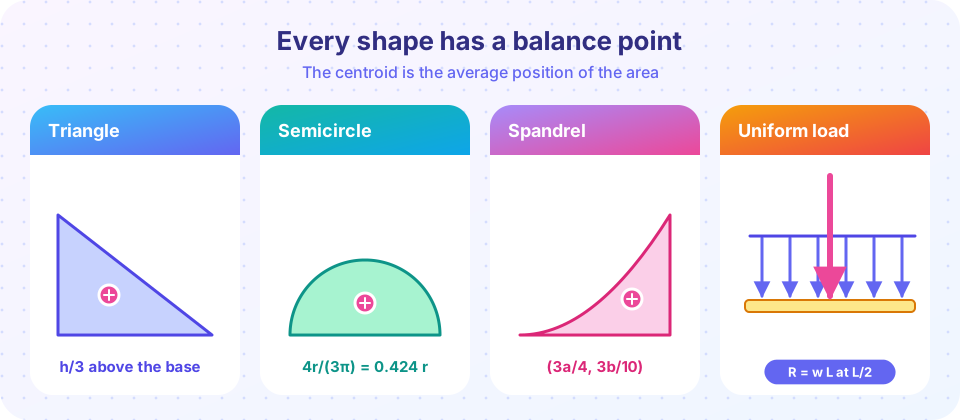
The big picture
There are three connected ideas.
- Center of gravity is the point where the whole weight of a body acts.
- Centroid is the geometric center of a shape: the average position of all its points. For a uniform body in a uniform gravity field, the two coincide.
- A distributed load is replaced by a resultant equal to the area under its load diagram, acting through the centroid of that area.
All three come from one idea: a weighted average of position. If a body is cut into small pieces with positions x_i and weights w_i, the balance point is x̄ = Σ w_i x_i / Σ w_i.
Centroid = average position
Integration for curved shapes
Composite shapes
Distributed loads
Fluid pressure
What each lesson covers
| Lesson | What you can do afterwards |
|---|---|
| Centroids by integration | Derive the centroid of a curved area with strips and memorize the standard ones |
| Composite areas | Find the centroid of an L, T or plate with a hole with a table |
| Distributed loads and fluid pressure | Replace uniform, triangular and hydrostatic loads by a single force |
| Chapter review | Check the whole chapter in one sitting |
A first calculation
Three weights of 2, 3 and 5 N sit on a light rod at x = 0, 1 and 4 m. Where is the balance point? x̄ = (2·0 + 3·1 + 5·4) / (2 + 3 + 5) = 23/10 = 2.3 m. The balance point lies closer to the heavy end, exactly what your finger tells you when you balance a hammer.
Press Run (or Ctrl + Enter) to see the result here.
Program input · what you'd type while the program runs
Type the answers before you press Run, one per line. Each time the program reads a line (with input()), it gets the next line from this box.
Check your understanding
Quick check · 4 questions
of 4 answered You scored / 4 · perfect!
-
1. The centroid of a shape depends on:
A centroid is a purely geometric average of position. Weight enters only for the center of gravity. -
2. A distributed load is replaced by a single force equal to:
The resultant equals the total load, which is the area under the load-intensity diagram. -
3. Weights of 1 N at 0 m and 3 N at 4 m. Where is the balance point?
x̄ = (1×0 + 3×4)/(1+3) = 3 m. -
4. In a uniform gravity field, the center of gravity of a uniform body is at:
When density and gravity are uniform, the weighted average of position reduces to the geometric average.
Summary
- A centroid is the average position of an area, line or volume.
- A distributed load has a resultant equal to the area under its diagram, acting through that area's centroid.
- The weighted-average formula
x̄ = Σ w x / Σ wunderlies every calculation in this chapter.
Next: Centroids by integration
Track your progress
Create a free account to tick off lessons and pick up where you left off on any device.
of Engineering Statics lessons completed