


















Lesson 7 of 47 · Vectors and Forces
Forces in two dimensions: components and resultants
Add forces in a plane with the parallelogram law and with components. Learn Fx and Fy, slope triangles, the resultant magnitude and direction, with worked examples.
When two ropes pull on one ring, the ring responds as if a single force acted on it. That single force is the resultant. Finding resultants is the most frequent small job in statics, and there are two ways to do it: graphically with the parallelogram law, and numerically with components. You will use the component method almost every time, because it scales to any number of forces and to three dimensions.
What you will learn
- How to add two forces with the parallelogram law and the law of cosines.
- How to resolve a force into x and y components, including from a slope triangle.
- How to find the resultant of several forces and its direction angle.
- How to avoid the classic quadrant and angle-measure errors.
Key terms
- Resultant: the single force that has the same effect as a set of forces.
- Component: the part of a force along a chosen axis.
- Resolve: to split a force into components.
- Direction angle: the angle that gives the orientation of a vector, usually measured from the +x axis.
- Concurrent forces: forces whose lines of action meet at one point.
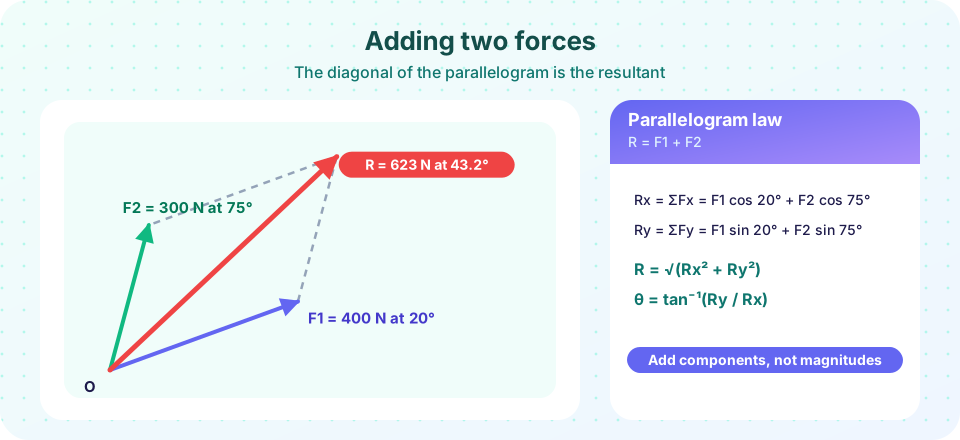
The parallelogram law
If two forces act at the same point, draw them from that point as two sides of a parallelogram. The diagonal from the same point is the resultant R = F1 + F2. Equivalently, place the forces tip to tail; the vector from the first tail to the last tip is the resultant. The order does not matter.
For two forces with angle φ between them, the law of cosines gives the magnitude:
R² = F1² + F2² + 2 F1 F2 cos φ
For F1 = 400 N, F2 = 300 N and φ = 55° (the difference of the angles 75° − 20°), R² = 160000 + 90000 + 2×400×300×0.5736 = 387 664, so R = 623 N. The direction needs the law of sines, which is a clumsy extra step, and the whole method breaks down for three forces. Components are neater.
Components
Choose perpendicular axes x and y and measure the angle θ of a force from the +x axis. Then
Fx = F cos θ and Fy = F sin θ
The signs take care of themselves when θ is measured counterclockwise from +x all the way around: a force at 150° has a negative Fx and positive Fy. If the problem gives an angle from some other reference, draw the triangle and use the sides directly. In a right triangle with the force as hypotenuse, the component next to the angle is F cos, the one opposite is F sin.
Slope triangles
Sometimes a direction is given as a slope, such as "a cable running 5 m horizontally and 12 m vertically". You do not need the angle at all. The cable length is √(5² + 12²) = 13 m, so for a force of 500 N along the cable:
Fx = 500 × 5/13 = 192 N and Fy = 500 × 12/13 = 462 N
Using ratios from the triangle avoids rounding angles and is how most professionals work.
Resultant of several forces
For n concurrent forces, the recipe is:
- Resolve every force into components, respecting signs.
- Add:
Rx = ΣFxandRy = ΣFy. - Magnitude
R = √(Rx² + Ry²). - Direction
θ = tan⁻¹(Ry / Rx), adjusted for the quadrant: ifRx < 0, add 180° (or useatan2).
Worked example. Using the numbers from the picture: F1 = 400 N at 20° and F2 = 300 N at 75°.
Rx = 400 cos 20° + 300 cos 75° = 375.9 + 77.6 = 453.5 NRy = 400 sin 20° + 300 sin 75° = 136.8 + 289.8 = 426.6 NR = √(453.5² + 426.6²) = 622.7 N, so about 623 Nθ = tan⁻¹(426.6 / 453.5) = 43.2°
This agrees with the law of cosines, and it extends to any number of forces without new ideas.
Press Run (or Ctrl + Enter) to see the result here.
Program input · what you'd type while the program runs
Type the answers before you press Run, one per line. Each time the program reads a line (with input()), it gets the next line from this box.
Now see the tip-to-tail picture drawn by code, with the resultant closing the polygon.
Press Run (or Ctrl + Enter) to see the result here.
Program input · what you'd type while the program runs
Type the answers before you press Run, one per line. Each time the program reads a line (with input()), it gets the next line from this box.
Drag F2 to 20° and R reaches 700 N, the plain sum. Drag it to 200° (opposite) and R drops to 100 N. The magnitude of a resultant lies between the difference and the sum of the two forces.
Common misconceptions
"R = F1 + F2 in magnitude." That is true only when the forces point the same way. In general R ≤ F1 + F2.
"tan⁻¹ always gives the right angle." A calculator returns an angle between −90° and 90°. If Rx is negative, you must add 180° or use atan2.
"Fx = F cos θ always." Only when θ is measured from the x axis. If θ is measured from the y axis, the roles of sine and cosine swap.
Check your understanding
Quick check · 5 questions
of 5 answered You scored / 5 · perfect!
-
1. Two forces of 30 N and 40 N act at right angles. What is the magnitude of the resultant?
R = √(30² + 40²) = 50 N. -
2. A 500 N force acts along a line that rises 12 m for every 5 m horizontally. What is its vertical component?
The line has length 13 m, so Fy = 500 × 12/13 = 461.5 N. -
3. Rx = −200 N and Ry = +200 N. Which angle from +x describes R?
The vector points up and left: tan⁻¹(−1) = −45° gives the wrong quadrant, so add 180° to get 135°. -
4. The smallest possible resultant of 400 N and 300 N forces is
When the forces point in opposite directions, R = 400 − 300 = 100 N. -
5. Why are components preferred over the parallelogram law for several forces?
Component addition is systematic and works for any number of forces.
Summary
- The resultant of concurrent forces replaces them:
R = ΣF. - For two forces,
R² = F1² + F2² + 2 F1 F2 cos φ; for any number, add components. Fx = F cos θ,Fy = F sin θwith θ from +x; slope triangles avoid angles.- Use
atan2or adjust the quadrant when finding the direction.
Track your progress
Create a free account to tick off lessons and pick up where you left off on any device.
of Engineering Statics lessons completed