


















Lesson 22 of 47 · Moments and Couples
Chapter 4 review: moments and couples
Review moment of a force, Varignon's theorem, r × F, couples and force-couple systems with a one-page summary, a worked reduction problem and a nine-question quiz.
Moments complete the toolkit of statics. You can now compute the turning effect of any force, recognize a couple, and reduce a whole system of loads to a force and a couple. Together with forces and free-body diagrams from the earlier chapters, this is everything you need for trusses, beams and frames.
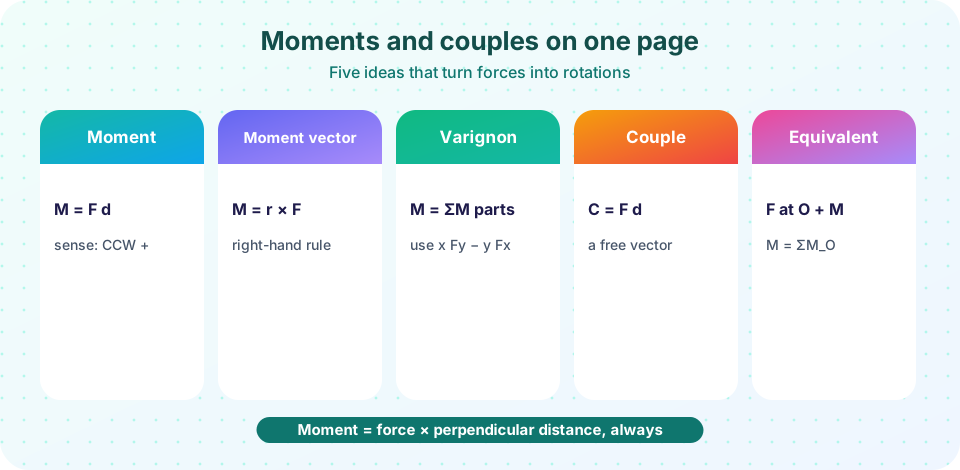
Recap table
| Lesson | Key idea | Core formula |
|---|---|---|
| Moment of a force | Force times perpendicular distance | M = F d, CCW positive |
| Moment vector and Varignon | Components or cross product | M = x Fy − y Fx, M = r × F |
| Couples | Equal, opposite, parallel forces | C = F d, free vector |
| Force-couple systems | Move a force, add a couple | R = ΣF, M_O = Σ r × F + ΣC |
Worked problem: reduce the loads on a plate
A plate carries a 200 N force acting downward at (1, 0) m, a 300 N force acting in the +x direction at (3, 2) m and a 100 N·m counterclockwise couple. Reduce the system to a force and couple at the origin O, and then to a single force.
- Resultant force:
R = (300, −200) N, soR = √(300² + 200²) = 360.6 N, at−33.7°below the +x axis. - Moment about O (counterclockwise positive,
M = x Fy − y Fx):- 200 N force:
1 × (−200) − 0 × 0 = −200 N·m - 300 N force:
3 × 0 − 2 × 300 = −600 N·m - couple:
+100 N·m - total:
M_O = −700 N·m(clockwise).
- 200 N force:
- Single force: the line of action of
Rmust produce the same moment aboutO. Where it crosses the x axis atx_0,x_0 × Ry = −700, sox_0 = −700 / −200 = 3.5 m. The system equals a single 360.6 N force through(3.5, 0), whose perpendicular distance fromOis700 / 360.6 = 1.94 m.
Press Run (or Ctrl + Enter) to see the result here.
Program input · what you'd type while the program runs
Type the answers before you press Run, one per line. Each time the program reads a line (with input()), it gets the next line from this box.
Now practice computing moments by hand. The tool generates a random force and point; compute M = x Fy − y Fx and check yourself.
Check your understanding
Quick check · 9 questions
of 9 answered You scored / 9 · perfect!
-
1. A 40 N force acts perpendicular to a lever arm of 0.5 m. The moment is
M = 40 × 0.5 = 20 N·m. -
2. F = (0, −100) N at (3, 4) m. M_O =
M = x Fy − y Fx = 3 × (−100) − 0 = −300 N·m (clockwise). -
3. Which statement about couples is false?
A couple has no resultant force, so no single force can replace it. -
4. r × F where r = 2 i and F = 5 j gives
i × j = k, so M = 10 k N·m. -
5. A 60 N force is moved 0.5 m sideways to a new line of action. What couple must be added?
C = F d = 60 × 0.5 = 30 N·m. -
6. A system has R = 0 and M_O = 50 N·m. It is equivalent to
No resultant force means the system is a pure couple. -
7. A pivot is at O. A force has its line of action through O. Its moment about O is
The moment arm is zero. -
8. In three dimensions, the moment about an axis with unit vector u is
Project the moment vector onto the axis with a dot product. -
9. Which pair of equal and opposite 50 N forces gives the largest couple?
C = F d grows with the separation: 20 N·m at 0.4 m.
Summary
- Moment
M = F d; with components,M = x Fy − y Fx; in 3D,M = r × F. - A couple is a free vector with no resultant force.
- A force can be moved if you add the couple
r × F. - A planar system reduces to one force (
d = |M|/R), a couple (R = 0) or equilibrium.
Track your progress
Create a free account to tick off lessons and pick up where you left off on any device.
of Engineering Statics lessons completed