


















Lesson 42 of 47 · Internal Forces and Beams
Review: Internal Forces and Beams
Chapter 8 in one picture: N, V and M, sign conventions, equation and area methods, standard beam results, with a recap table and a nine-question mixed quiz.
You can now look inside a beam. This review collects the conventions and shortcuts of chapter 8 on a single page. Learn the two relations, the four standard maxima, and the jump rules, and you will draw most diagrams without a pencil hesitating.
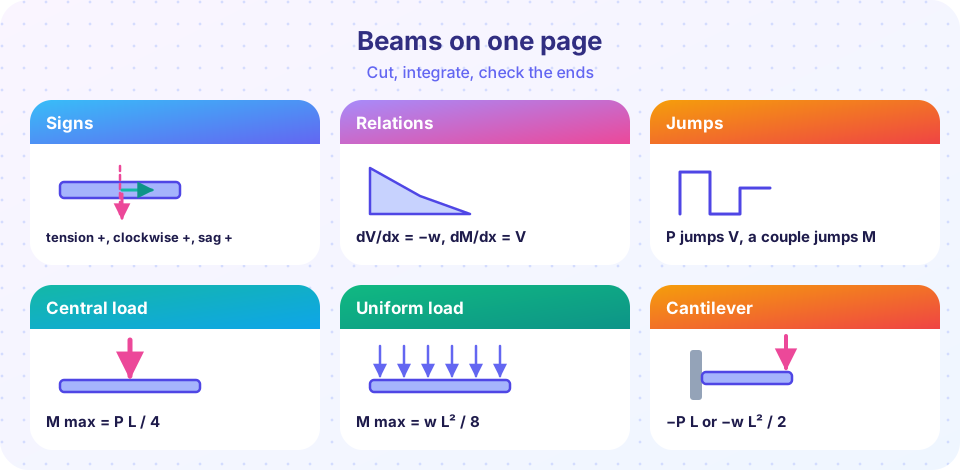
Recap table
| Topic | Result |
|---|---|
| Internal actions | N (tension +), V (clockwise +), M (sagging +) |
| Free body | V = sum of vertical forces on one side; M = their moments about the cut |
| Relations | dV/dx = −w, dM/dx = V |
| Area rules | ΔV = −∫ w dx, ΔM = ∫ V dx |
| Jumps | point load: V jumps; couple: M jumps |
| Maximum moment | where V = 0 or changes sign |
| Simply supported, central point load | M_max = P L / 4 |
| Simply supported, uniform load | M_max = w L² / 8 |
| Cantilever, tip load | M_wall = −P L |
| Cantilever, uniform load | M_wall = −w L² / 2 |
Press Run (or Ctrl + Enter) to see the result here.
Program input · what you'd type while the program runs
Type the answers before you press Run, one per line. Each time the program reads a line (with input()), it gets the next line from this box.
Press Run (or Ctrl + Enter) to see the result here.
Program input · what you'd type while the program runs
Type the answers before you press Run, one per line. Each time the program reads a line (with input()), it gets the next line from this box.
Check your understanding
Quick check · 9 questions
of 9 answered You scored / 9 · perfect!
-
1. A simply supported beam of 4 m carries 10 kN/m uniformly. M_max is:
w L² / 8 = 10 × 16 / 8 = 20 kN·m. -
2. A cantilever of 3 m with a 6 kN tip load. The wall moment is:
M = −P L = −18 kN·m (hogging). -
3. The slope of the moment diagram at a point equals:
dM/dx = V. -
4. Under a triangular load the shear diagram is a:
The load is linear; integrating once gives a parabola for V, and a cubic for M. -
5. A clockwise couple of 10 kN·m is applied at a point. The moment diagram there:
An applied clockwise couple adds to M by its value when reading left to right. -
6. Positive bending moment puts which fibers in tension?
A sagging beam stretches its bottom fibers and compresses its top fibers. -
7. The shear is 0 at x = 2 m and changes from positive to negative there. The moment at x = 2 m is:
dM/dx = V goes from positive to negative, so M peaks. -
8. A simply supported beam has a 6 m span and a 12 kN point load 2 m from A. The reaction at A is:
Ay = 12 × 4 / 6 = 8 kN. -
9. An overhanging beam hogs over the support because:
A downward load on the overhang rotates the beam over the support so the top fibers stretch.
Summary
N,V,Mare found by cutting and equilibrium; signs: tension +, clockwise shear +, sagging +.dV/dx = −w,dM/dx = V: diagrams are successive integrals.- Memorize
PL/4,wL²/8,PL,wL²/2. - Diagrams must close at free ends; overhangs hog.
Track your progress
Create a free account to tick off lessons and pick up where you left off on any device.
of Engineering Statics lessons completed