


















Lesson 21 of 47 · Moments and Couples
Force-couple systems and resultants
Move a force to any point by adding a couple, reduce a system of forces and couples to one resultant force and moment, and locate the single equivalent force with examples.
Real structures carry many loads: a snow load here, a machine there, a wind force on one side. To understand the combined effect, or to apply equilibrium to a body, it helps to replace the whole load system by something simpler. Statics gives a precise recipe. Any system of forces and couples can be replaced by one force and one couple at a chosen point, with exactly the same effect on a rigid body. In a plane it can often be replaced by a single force alone. This lesson shows how.
What you will learn
- How to move a force to a parallel position by adding a couple.
- How to reduce a system to a resultant force
Rand resultant coupleM_O. - How to locate the single resultant force for a planar system.
- What a "wrench" is in three dimensions.
Key terms
- Equivalent systems: two systems that have the same resultant force and the same resultant moment about any point.
- Resultant force
R: the vector sum of all forces,R = ΣF. - Resultant couple
M_O: the sum of the moments of all forces aboutO, plus any couples. - Line of action of the resultant: the line along which a single resultant force would have to act.
- Wrench: a force with a parallel couple along the same axis (3D).
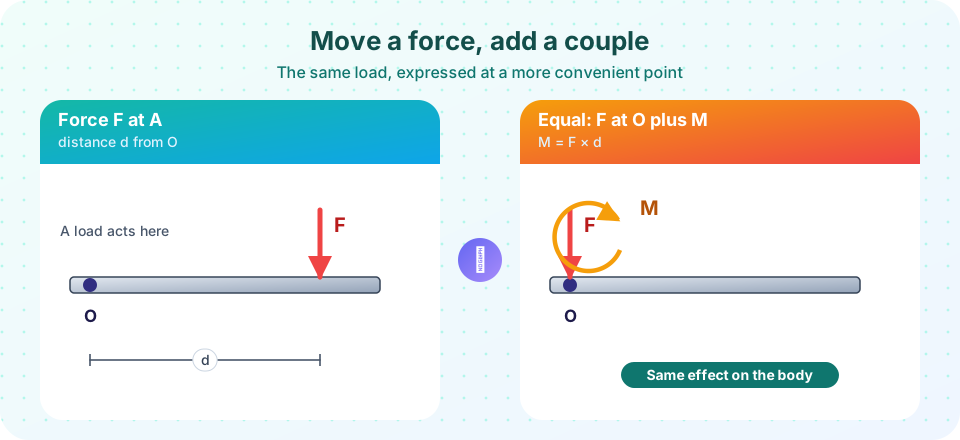
Moving a force to a new point
Suppose a force F acts on a rigid body at a point A, and you would like to apply it at point O instead. Do this in three steps:
- At
O, add two forces,+Fand−F. Together they do nothing (they cancel). - The original
FatAand the new−FatOform a couple with momentM_O = r × F, whererruns fromOtoA. - What remains is the original force now acting at
O(the+F) plus that couple.
A force F at A is equivalent to the same force F at O plus a couple M_O = r × F.
In a plane, the couple magnitude is F d where d is the perpendicular distance from O to the line of action. The sense is the sense in which the original force would turn the body about O.
For example, a 300 N downward load 2 m to the right of O is equivalent to a 300 N downward load at O plus a clockwise couple of 300 × 2 = 600 N·m.
Try different distances in the next demo and notice that the couple scales with d while the force stays the same.
Reducing a system
For many forces F_i at positions r_i and some couples C_j:
R = ΣF_i and M_O = Σ (r_i × F_i) + ΣC_j
This is the force-couple system at O. It is equivalent to the original system. If you choose a different point O′, the resultant force R stays the same but the moment changes by M_O′ = M_O + r × R (where r runs from O′ to O). So R is an invariant of the system and M depends on where you sum it.
Reducing to a single force (planar systems)
In a plane, R lies in the plane and M_O is perpendicular to it, so R · M_O = 0. If R ≠ 0, you can slide R sideways until its own moment about O equals M_O, and then the couple disappears. The line of action of R sits at the perpendicular distance
d = |M_O| / R
from O, on the side that makes the moment of R have the same sense as M_O. If R = 0 but M_O ≠ 0, the system is a pure couple. If both are zero, the system is in equilibrium.
Worked example. A bar has loads: 200 N downward at 1 m from A, 100 N downward at 3 m, 100 N upward at 4 m, and a 60 N·m clockwise couple.
R = −200 − 100 + 100 = −200 N(200 N downward).M_A = 1 × (−200) + 3 × (−100) + 4 × 100 − 60 = −200 − 300 + 400 − 60 = −160 N·m(clockwise).- Position of the single equivalent force:
x × (−200) = −160, sox = 0.8 mfromA.
The whole system is equivalent to a single 200 N downward force acting 0.8 m from A. This is the quantity that later lets you replace a distributed load by one force.
Press Run (or Ctrl + Enter) to see the result here.
Program input · what you'd type while the program runs
Type the answers before you press Run, one per line. Each time the program reads a line (with input()), it gets the next line from this box.
Wrenches in three dimensions
In 3D, R and M_O need not be perpendicular. Split M_O into a part along R and a part across it: M_parallel = (M_O · R / R²) R. The perpendicular part can be removed by moving R sideways, leaving the force R and a couple M_parallel about the same axis: a wrench (like a screwdriver that pushes and twists). Every 3D system reduces to a wrench, a single force, a pure couple or zero.
Press Run (or Ctrl + Enter) to see the result here.
Program input · what you'd type while the program runs
Type the answers before you press Run, one per line. Each time the program reads a line (with input()), it gets the next line from this box.
Common misconceptions
"The resultant force changes if I move the reference point." R = ΣF does not depend on the point; only the moment does.
"Equivalent systems have the same forces." They have the same resultant force and moment, which may come from entirely different forces.
"Moving a force changes its effect." Not if you add the correct couple r × F.
Check your understanding
Quick check · 5 questions
of 5 answered You scored / 5 · perfect!
-
1. A 50 N downward force acts 3 m to the right of O. Replace it by a force at O. The accompanying couple is
The force would turn the body clockwise about O, with moment 50 × 3 = 150 N·m. -
2. R = 120 N and M_O = 300 N·m (planar). At what distance from O does the single equivalent force act?
d = M / R = 300 / 120 = 2.5 m. -
3. When R = 0 and M_O ≠ 0, the system is
No net force but a net moment is exactly a couple. -
4. Which quantity does not depend on the reference point?
R is the vector sum of the forces. -
5. A wrench consists of
A resultant force together with a couple along the same axis.
Summary
- A force at
Aequals the same force atOplus the coupler × F. - Reduction:
R = ΣF,M_O = Σ r × F + Σ C. - In a plane the system is equivalent to one force at
d = |M_O| / R, or a couple (R = 0), or equilibrium. - In 3D, a general system reduces to a wrench.
Next: Chapter 4 review
Track your progress
Create a free account to tick off lessons and pick up where you left off on any device.
of Engineering Statics lessons completed