


















Lesson 34 of 47 · Friction
Dry Friction Laws
Static and kinetic friction, the angle of friction, the friction cone, blocks on inclines and the best angle to pull a crate, with worked numbers and runnable checks.
In the 18th century, Amontons and later Coulomb measured something surprising: the friction between two dry surfaces does not depend much on how large the contact area is. It depends on how hard the surfaces are pressed together. Double the normal force and you double the friction. These observations, known as the laws of dry (Coulomb) friction, are accurate enough for most engineering design.
This lesson turns those laws into equilibrium calculations. The most important idea: friction is not a fixed force. It is a reaction that grows from zero up to a maximum.
What you will learn
- State the laws of dry friction and use
F ≤ μ_s NandF = μ_k N. - Define the angle of friction and the friction cone.
- Solve equilibrium problems with unknown friction (is the body at rest?).
- Solve impending-motion problems (find the force or angle at which it slips).
Key terms
Normal force N: the component of the contact force perpendicular to the surface.
Friction force F: the component along the surface, opposing relative or impending motion.
Coefficient of static friction μ_s: the ratio F_max / N just before slipping.
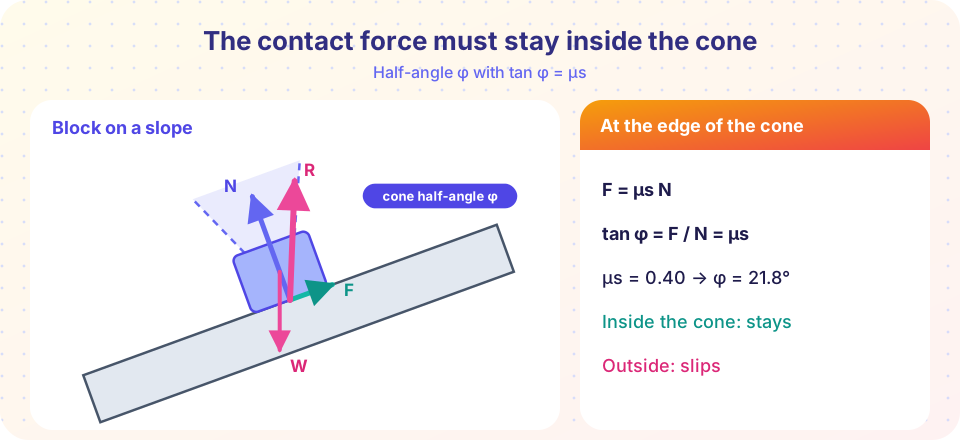
Angle of friction φ_s = arctan μ_s: the angle between the total contact force and the normal at impending slip.
The laws
- The friction force acts along the surface, opposite to the motion or the tendency to move.
- For a body at rest,
F ≤ μ_s N. Equality holds only at impending slip. - Once sliding,
F = μ_k Nwithμ_k ≤ μ_s(usually a little smaller). μdepends on the two materials and their condition (clean, dry, polished, lubricated) but not, to a good approximation, on the contact area or the sliding speed.
Typical orders of magnitude for μ_s of dry surfaces, as a guide only: steel on steel 0.5 to 0.8; wood on wood 0.25 to 0.5; rubber on dry concrete 0.6 to 0.9; ice on ice below 0.1 to 0.3. Real values vary with surface finish, contamination and temperature, so design codes use tested values and large safety factors.
Three kinds of problems
Type 1: slipping is impending. The problem says "about to slip" or "find the minimum coefficient". Use F = μ_s N as an equation.
Type 2: is it in equilibrium? Assume equilibrium, find the friction F and the normal force N needed from the equations of equilibrium, and compare F with μ_s N. If F ≤ μ_s N it stays; if not, it slips and kinetic friction applies.
Type 3: motion is certain. The body slides, so F = μ_k N, and we are into dynamics.
Worked example 1: block on an incline
A block weighing 1000 N rests on a 15° incline, with μ_s = 0.30. Does it stay? What force parallel to the incline is needed to push it up the slope at impending motion?
Resolve along and perpendicular to the incline:
N = W cos 15° = 1000 × 0.9659 = 965.9 N
F needed to hold = W sin 15° = 1000 × 0.2588 = 258.8 N
F available     = μ_s N = 0.30 × 965.9 = 289.8 N
Since 258.8 < 289.8 the block stays at rest. The block would slide if the slope reached arctan 0.30 = 16.7°. The critical angle depends only on μ_s, not on the weight.
To push up the incline, friction acts down the slope, so P = W sin θ + μ_s W cos θ = 258.8 + 289.8 = 548.6 N. Down the slope, with impending downward motion, friction would act up the slope, and the needed pull would be W sin θ − μ_s W cos θ = −31 N: a negative number, because the block is held by friction without help. This is self-locking: the incline angle is smaller than the friction angle.
The friction cone
At impending slip, the total contact force R (the vector sum of N and F) makes an angle φ_s with the normal, where tan φ_s = F_max / N = μ_s. If you draw all the directions the contact force can have, you get a cone around the normal of half-angle φ_s: the friction cone. The contact force must lie inside the cone for equilibrium. This picture is the fastest way to solve problems with three forces: the line of the contact force just has to fall inside the cone.
Worked example 2: the easiest way to drag a crate
You drag a 500 N crate over a floor with μ_s = 0.40 by pulling on a rope inclined at an angle α above the horizontal. At impending slip:
Horizontal: P cos α = μ N
Vertical:   N + P sin α = W   ->   N = W - P sin α
P = μ W / (cos α + μ sin α)
At α = 0, P = 0.4 × 500 = 200 N. Increasing the angle first helps (the vertical component lifts the crate and reduces N) and then hurts. The denominator cos α + μ sin α is largest at tan α = μ, i.e. α = φ. There P_min = W sin φ:
φ = arctan 0.40 = 21.8° P_min = 500 × sin 21.8° = 185.7 N
So pulling at about 22° above horizontal needs 185.7 N rather than 200 N. A small improvement, but it is why towing ropes are not kept perfectly flat.
Common misconceptions
"Friction always equals μ N." Only at impending slip or while sliding. At rest, friction equals the force that balances the push, which may be much smaller.
"A larger contact area means more friction." For dry surfaces, to a good approximation it does not: only the normal force matters.
"The normal force always equals the weight." Only on a horizontal surface with no other vertical forces. On a slope N = W cos θ; with a pull at an angle, N = W − P sin α.
Try it
Press Run (or Ctrl + Enter) to see the result here.
Program input · what you'd type while the program runs
Type the answers before you press Run, one per line. Each time the program reads a line (with input()), it gets the next line from this box.
Press Run (or Ctrl + Enter) to see the result here.
Program input · what you'd type while the program runs
Type the answers before you press Run, one per line. Each time the program reads a line (with input()), it gets the next line from this box.
Check your understanding
Quick check · 5 questions
of 5 answered You scored / 5 · perfect!
-
1. A 200 N block rests on a flat floor with μs = 0.30. A horizontal 40 N push is applied. The friction force is:
The block is in equilibrium (40 < 60), so friction equals the push: 40 N. The 60 N is only the limit. -
2. The angle of friction φ is defined by:
At impending slip, F/N = μs = tan φs. -
3. A plank is slowly tilted. A box starts to slide at 25°. What is μs for this pair?
At impending slip on an incline, tan θ = μs. -
4. A heavier block of the same material on the same incline will slide at:
Weight cancels in tan θ = μs, so the critical angle does not depend on weight. -
5. Which statement about dry friction is correct?
Amontons and Coulomb: F is proportional to N, nearly independent of contact area.
Summary
- Friction is a reaction:
F ≤ μ_s N, equality only at impending slip; sliding givesF = μ_k N. tan φ_s = μ_s; the contact force must lie inside the friction cone.- On an incline slip starts at
tan θ = μ_s, independent of weight. - Best pull angle for a crate:
α = φ, withP_min = W sin φ.
Next: Slip or tip?
Track your progress
Create a free account to tick off lessons and pick up where you left off on any device.
of Engineering Statics lessons completed