


















Lesson 16 of 47 · Equilibrium of Particles and Bodies
Chapter 3 review: equilibrium
Review particle and rigid-body equilibrium, free-body diagrams, supports, three-force members and 3D equilibrium with a worked boom problem and a nine-question quiz.
This chapter turned pictures into equations. You can now take a structure, draw its free-body diagram, count unknowns against equations and solve for reactions and tensions. Use this page to consolidate before moving on to moments.
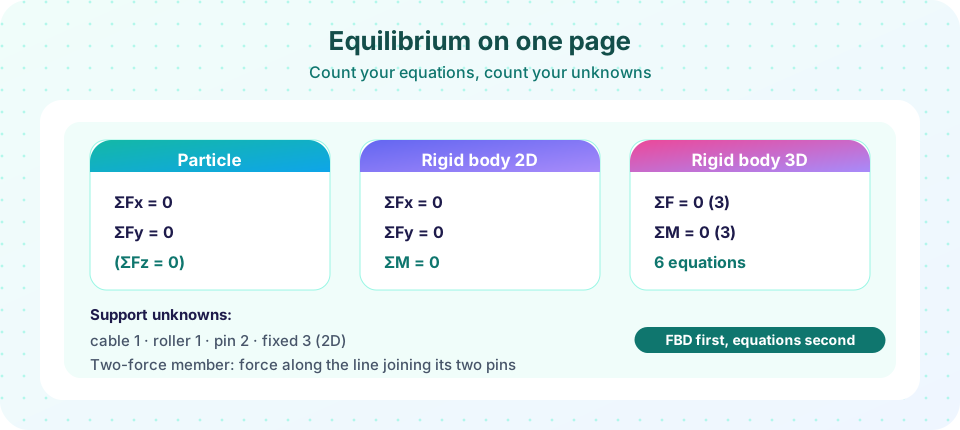
Recap table
| Lesson | Key idea | Remember |
|---|---|---|
| Equilibrium of a particle | ΣFx = 0, ΣFy = 0 at a joint |
Cables pull only; T = W/(2 sin θ) |
| Free-body diagrams and supports | Reaction per blocked motion | Cable 1, roller 1, pin 2, fixed 3 |
| Rigid body in 2D | Three equations, smart moment point | Three-force rule: concurrent lines |
| Three dimensions | Six equations, M = r × F |
Fixed support: 3 forces + 3 moments |
A worked review problem: the boom
A uniform beam AB, 4.0 m long and weighing 400 N, is pinned to a wall at A and held horizontal by a cable attached at B that runs up to the wall at 30° above the horizontal. A 600 N load hangs from B. Find the cable tension and the pin reactions.
- FBD of the beam: weight 400 N at its middle (2.0 m from A), load 600 N at B (4.0 m), cable tension
Tat B (pulling toward the wall and up), pin componentsAxandAyat A. - Moments about A (eliminates
Ax,Ay): the cable's vertical componentT sin 30°acts at 4.0 m and tries to lift the beam:T sin 30° × 4.0 − 400 × 2.0 − 600 × 4.0 = 0, so2.0 T = 3200andT = 1600 N. - Horizontal: the cable pulls toward the wall with
T cos 30° = 1385.6 N, so the pin pushes away from the wall:Ax = 1386 N. - Vertical:
Ay + T sin 30° − 400 − 600 = 0, soAy = 1000 − 800 = 200 N(upward). - Check with moments about B:
−Ay × 4.0 + 400 × 2.0 = −800 + 800 = 0. ✓
Notice the cable carries 1600 N, far more than the 1000 N of total weight, because it works at a shallow angle and a short lever arm compared with the weights.
Press Run (or Ctrl + Enter) to see the result here.
Program input · what you'd type while the program runs
Type the answers before you press Run, one per line. Each time the program reads a line (with input()), it gets the next line from this box.
(The 2D support counts in the calculator apply to 2D problems; use the 3D support table when you pick "Rigid body in 3D".)
Check your understanding
Quick check · 9 questions
of 9 answered You scored / 9 · perfect!
-
1. A particle has three forces: 100 N east, 100 N north and a third force F. For equilibrium, F must be
The sum of the first two is 141 N toward the north-east, so F is the opposite. -
2. Which support has three unknowns in 2D?
A fixed support supplies two force components and a moment. -
3. In the boom problem, why were moments taken about A?
Forces through A have zero moment about A. -
4. A beam is supported only by two vertical rollers. What is wrong?
Both reaction lines are parallel and vertical, so a horizontal force would make the beam slide. -
5. How many equations does 3D rigid body equilibrium offer?
Three force and three moment equations. -
6. A 600 N weight hangs from the midpoint of a cable and each half makes 10° with the horizontal. Tension in each half is about
T = W/(2 sin 10°) = 600 / (2 × 0.1736) = 1728 N. -
7. A force on a rigid body can be moved along its line of action without changing equilibrium. This is
Transmissibility was introduced in Chapter 1. -
8. Three non-parallel forces keep a body in equilibrium. Two of their lines meet at P. The third line must
Otherwise the third force would have a moment about P and nothing could cancel it. -
9. A spring with k = 400 N/m is stretched 0.25 m. The force is
F = k s = 400 × 0.25 = 100 N.
Summary
- Particle:
ΣF = 0; rigid body:ΣF = 0andΣM = 0; 3D doubles the equations. - Draw the FBD with every support reaction before writing equations.
- Take moments where unknowns cross; check with another point.
- Count unknowns; reject improper or redundant constraints.
Track your progress
Create a free account to tick off lessons and pick up where you left off on any device.
of Engineering Statics lessons completed