


















Lesson 45 of 47 · Projects and Practice
Glossary of Statics Terms
A plain-language glossary of more than sixty statics terms, from axial force to zero-force member, with formulas and a searchable flashcard tool.
Statics has a compact vocabulary, but every word has a precise meaning. This glossary gathers the terms used across the course in one place, in alphabetical order, with a short definition and, where useful, the formula or the lesson to read. Use it as a quick reference while you solve problems, and test yourself with the flashcards at the end.
What you will learn
- Read and use the core vocabulary of statics precisely.
- Find the right lesson for a term you have forgotten.
- Distinguish look-alike terms (couple and moment, centroid and center of gravity).
Key terms
Equilibrium: a state in which the resultant force and resultant moment on a body are zero.
Free-body diagram: a sketch of a body isolated from its surroundings with every force on it.
Resultant: the single force (and couple) equivalent to a system of forces.
Reaction: a force a support exerts on a body.
A to F
| Term | Meaning |
|---|---|
| Area rule | The change in shear is minus the area under the load diagram; the change in moment is the area under the shear diagram. |
| Axial force | Internal force along the axis of a member; tension is positive. |
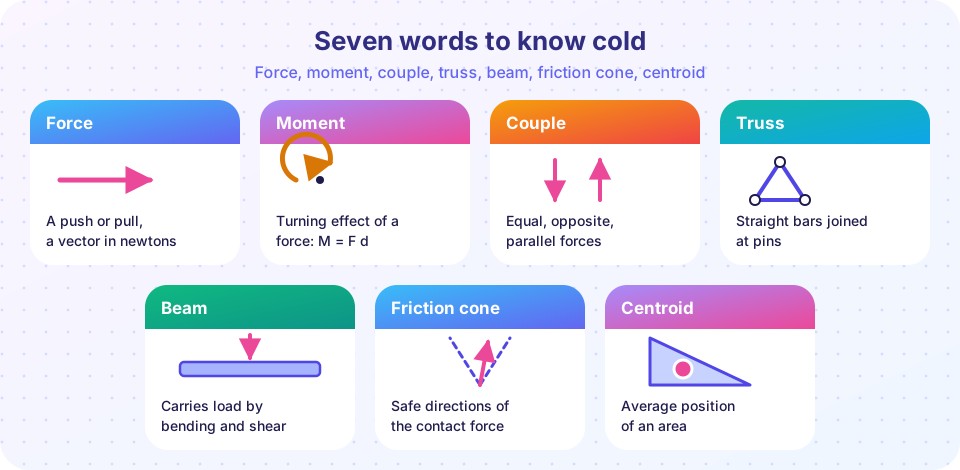
| Beam | A slender member that carries load mainly by bending and shear. |
| Belt friction | Friction between a flexible belt or rope and a drum; T2 = T1 e^(μβ). |
| Bending moment | Internal couple that bends a member; sagging is positive. |
| Cable | A flexible member that carries only tension. |
| Cantilever | A beam fixed at one end and free at the other. |
| Center of gravity | The point where the weight of a body acts. |
| Centroid | The geometric center of an area, line or volume. |
| Chord | The top or bottom bars of a truss. |
| Compression | A squeezing force that shortens a member. |
| Concurrent forces | Forces whose lines of action meet at one point. |
| Couple | Two equal, opposite, parallel forces that produce a pure moment M = F d. |
| Determinate (statically) | Reactions and internal forces can be found from equilibrium alone. |
| Diagram, free-body | See free-body diagram. |
| Distributed load | Load spread over a length or area; replaced by a resultant equal to the area under its diagram. |
| Equilibrium | ΣF = 0 and ΣM = 0. |
| Force | A push or pull, a vector with magnitude, direction and line of action (N). |
| Frame | A structure with multi-force members, designed to stay in place. |
| Free-body diagram | A sketch of a body with all forces and moments acting on it. |
| Friction angle | φ = arctan μ; the half-angle of the friction cone. |
| Friction cone | The cone of directions inside which the contact force must lie for no slip. |
H to P
| Term | Meaning |
|---|---|
| Hogging | Negative bending moment; the beam is concave down. |
| Hydrostatic pressure | p = ρ g h, pressure of a fluid at rest. |
| Impending motion | The state just before slip or tip, when friction is at its maximum. |
| Indeterminate (statically) | More unknowns than equilibrium equations; needs deformation analysis. |
| Inflection point | The point where the bending moment changes sign. |
| Internal force | A force exerted by one part of a body on another across a section. |
| Joint (node) | The pin where truss bars meet. |
| Kinetic friction | Friction during sliding, F = μ_k N. |
| Lead angle | The angle of a screw thread, tan θ = lead / (2π r). |
| Line of action | The line along which a force acts. |
| Load intensity | Force per unit length (kN/m) or per unit area (Pa). |
| Machine | A structure with moving parts that transmits or changes force. |
| Method of joints | Truss analysis by equilibrium of each pin. |
| Method of sections | Truss analysis by cutting the truss and using equilibrium on one part. |
| Moment | The turning effect of a force about a point, M = F d (N·m). |
| Moment arm | The perpendicular distance from the point to the line of action. |
| Multi-force member | A member loaded at three or more points, or with a couple. |
| Normal force | The component of a contact force perpendicular to the surface. |
| Overhang | The part of a beam that extends past a support. |
| Pin | A support or connection that prevents translation but allows rotation. |
| Pressure | Force per unit area (Pa = N/m²). |
R to Z
| Term | Meaning |
|---|---|
| Reaction | The force or moment a support supplies. |
| Resultant | The single force (and couple) equivalent to a system. |
| Rigid body | An idealized body that does not deform. |
| Roller | A support that gives one reaction, perpendicular to the surface. |
| Section | An imaginary cut through a body or truss. |
| Self-locking | A machine that stays put when the effort is removed, because θ < φ. |
| Shear force | Internal force perpendicular to the member axis; clockwise is positive. |
| Slip | Sliding of one surface over another when friction reaches μ_s N. |
| Spandrel | The area between a curve and its axes. |
| Static friction | Friction at rest, F ≤ μ_s N. |
| Superposition | Adding the effects of separate loads. |
| Tension | A pulling force that lengthens a member. |
| Tipping | Rotation of a body about an edge when the normal force reaches the edge. |
| Truss | A structure of straight two-force bars joined at pins and loaded at the joints. |
| Two-force member | A member with forces at two points only; the forces are equal, opposite and collinear. |
| Varignon's theorem | The moment of a force equals the sum of the moments of its components. |
| Warren truss | A truss with parallel chords and diagonals only. |
| Zero-force member | A truss bar that carries no force for a given loading. |
Look-alike terms
| Pair | The difference |
|---|---|
| Moment vs couple | A moment is the turning effect of any force about a point; a couple is a special pair of forces whose only effect is a moment (it is a free vector). |
| Centroid vs center of gravity | The centroid is geometric; the center of gravity includes weight. They coincide in a uniform body in a uniform field. |
| Static vs kinetic friction | Static friction adjusts up to μ_s N; kinetic is μ_k N during sliding. |
| Weight vs mass | Weight is a force (W = m g, in newtons); mass is in kilograms. |
| Tension vs compression | Tension lengthens a bar and pulls on its joints; compression shortens it and pushes. |
Common misconceptions
"Moment and couple are the same." Every couple produces a moment, but not every moment comes from a couple.
"Statically determinate means safe." It only means equilibrium alone can solve it. Safety needs stress, buckling and deflection checks.
"Reactions are loads." Reactions are responses; they adapt to the loads and supports.
Try it
Press Run (or Ctrl + Enter) to see the result here.
Program input · what you'd type while the program runs
Type the answers before you press Run, one per line. Each time the program reads a line (with input()), it gets the next line from this box.
Check your understanding
Quick check · 5 questions
of 5 answered You scored / 5 · perfect!
-
1. Which term describes a pair of equal, opposite, parallel forces?
A couple produces a pure moment with no net force. -
2. A bar that carries a force along its axis only, pinned at both ends, is a:
Two forces in equilibrium must be equal, opposite and along the line between the pins. -
3. A negative bending moment is called:
Hogging bends the beam concave down. -
4. The friction angle φ satisfies:
The friction cone has half-angle φ = arctan μ. -
5. The center of gravity and the centroid of a uniform body in uniform gravity are:
With uniform density and gravity, the weighted average position equals the geometric average.
Summary
- Learn the vocabulary together with its formula: couple
M = F d, friction angletan φ = μ, pressurep = ρ g h. - Separate look-alike pairs: moment and couple, centroid and center of gravity.
- Reactions are responses; loads are given.
Next: Statics cheat sheet
Track your progress
Create a free account to tick off lessons and pick up where you left off on any device.
of Engineering Statics lessons completed