


















Lesson 18 of 47 · Moments and Couples
The moment of a force: arm, sign and tipping
Learn the moment of a force as force times perpendicular distance, how to find the moment arm, use the sign convention and decide when a body tips, with worked examples.
A force can do two things to a rigid body: push it and turn it. The pushing part is described by the force itself. The turning part is described by its moment about a point or an axis. Without moments you cannot say whether a table will tip, how hard a bolt is tightened or how much the wall must resist in a cantilever. This lesson defines the moment for a force in a plane and gives you the habits that make moment problems easy.
What you will learn
- The definition
M = F dand what the moment arm is. - How to choose and apply a sign convention.
- How to find
dwhen the force is inclined. - How to use moments to test tipping.
Key terms
- Moment (torque): the tendency of a force to rotate a body about a point or axis; SI unit N·m.
- Moment arm
d: the perpendicular distance from the point to the line of action of the force. - Line of action: the straight line through the force, extended in both directions.
- Sense: clockwise (CW) or counterclockwise (CCW).
- Overturning moment: a moment that tends to tip a body over an edge.
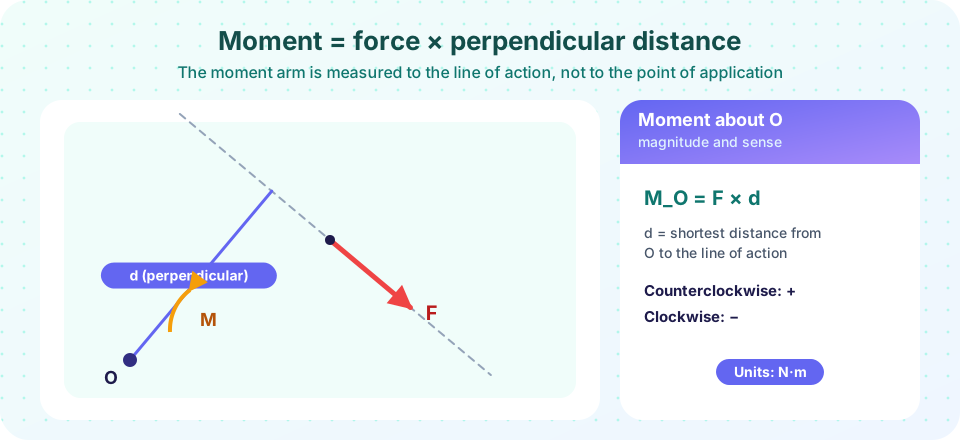
Definition
The moment of a force F about a point O is
M_O = F × d
where d is the perpendicular distance from O to the line of action of F. The unit is the newton meter (N·m). Two facts follow immediately:
- If the line of action passes through
O, thend = 0and the force has no moment aboutO. A door pushed exactly at its hinge does not turn. - The moment depends on the line of action, not on where along that line the force is applied. This is the principle of transmissibility again.
Every moment problem begins with the question: what is the perpendicular distance? Often you can see it. In a door, if you push at right angles to the door, d is simply the distance from the hinge to the handle.
Sign convention
The moment has a sense: it tends to turn the body clockwise or counterclockwise about O. In plane problems the standard choice is counterclockwise positive (the convention that matches the right-hand rule and the x Fy − y Fx formula in the next lesson). Whatever you choose, state it and keep it for the whole problem. The sum ΣM_O then adds positive and negative contributions, and equilibrium means the sum is zero.
Finding the moment arm
Suppose a bar is pinned at O, and a force F = 200 N acts on it at 1.5 m from O, pointing 30° away from the bar's axis. The perpendicular distance from O to the force's line of action is d = 1.5 sin 30° = 0.75 m, so M = 200 × 0.75 = 150 N·m.
There is an equivalent way to see it. Resolve the force into a part along the bar and a part perpendicular to the bar. The along-bar part passes through O and has no moment. The perpendicular part is 200 sin 30° = 100 N acting at 1.5 m, so M = 100 × 1.5 = 150 N·m. Both routes agree. Use whichever is easier: find the perpendicular distance, or resolve the force so one component passes through the point.
Press Run (or Ctrl + Enter) to see the result here.
Program input · what you'd type while the program runs
Type the answers before you press Run, one per line. Each time the program reads a line (with input()), it gets the next line from this box.
Notice the symmetry: 30° and 150° give the same moment, and 0° and 180° give zero because the force then points along the bar.
Summing moments and choosing the point
When several forces act, add their moments about the same point. For equilibrium ΣM = 0. Here the freedom you learned about earlier pays off:
- Choose
Oso that unknown forces pass through it: they drop out. - The result for a body in equilibrium is the same wherever you put
O: if the total moment is zero about one point (and the forces balance), it is zero about every point. - If the forces do not balance, the total moment depends on
O, and it changes linearly as you slide the point along the body.
Press Run (or Ctrl + Enter) to see the result here.
Program input · what you'd type while the program runs
Type the answers before you press Run, one per line. Each time the program reads a line (with input()), it gets the next line from this box.
In the unbalanced case the forces still sum to zero (300 + 300 − 600), yet the moment is 600 N·m wherever you take it. A set of forces with zero sum but nonzero moment is a couple, the subject of a later lesson.
Tipping: overturning against restoring moments
A body on a floor will tip about an edge if the moment tending to overturn it exceeds the moment tending to keep it down (usually its weight).
Worked example. A crate weighing 600 N is 1.2 m wide and 2.0 m tall. Someone pushes horizontally at height h = 1.5 m above the floor. About the bottom front edge (the point it would pivot about), the push gives an overturning moment P × 1.5, and the weight (acting 0.6 m from that edge) gives a restoring moment 600 × 0.6 = 360 N·m. Tipping begins when P × 1.5 = 360, so P = 240 N. Pushing lower, at h = 0.5 m, requires P = 720 N to tip: the crate would slide first unless friction is huge.
Common misconceptions
"The moment arm is the distance to the point where the force is applied." It is the perpendicular distance to the line of action. Only when the force is perpendicular to the line from O do the two coincide.
"A moment has units of force." Its unit is force times length (N·m), which is why it cannot be added to a force.
"Moments only matter for rotating things." Moments matter for anything held still too: the supports must supply moments (or forces with moment arms) that cancel the applied ones.
Check your understanding
Quick check · 5 questions
of 5 answered You scored / 5 · perfect!
-
1. A 150 N force acts perpendicular to a wrench handle 0.30 m from the bolt. What is the moment?
M = 150 × 0.30 = 45 N·m. -
2. A 100 N force acts along a bar, directed straight through the pivot. What is its moment about the pivot?
The line of action passes through the pivot, so d = 0. -
3. A 120 N force acts at 2.0 m from a pivot, at 30° to the bar. The moment about the pivot is
M = 120 × 2.0 × sin 30° = 120 N·m. -
4. A crate (weight 800 N, 1.0 m wide) is pushed horizontally at height 1.0 m. What push starts tipping?
P × 1.0 = 800 × 0.5, so P = 400 N. -
5. Which sign convention does this course use for plane moments?
Counterclockwise is positive, matching the right-hand rule.
Summary
M = F dwithdperpendicular to the line of action; unit N·m.- A force through the point has no moment about it.
- For an inclined force, use
d = r sin θor resolve the force into components. - Tipping begins when overturning moment equals restoring moment about the edge.
Track your progress
Create a free account to tick off lessons and pick up where you left off on any device.
of Engineering Statics lessons completed