


















Lesson 5 of 47 · Getting Started
Chapter 1 review: getting started
Review the foundations of statics: rigid bodies, Newton's laws, SI units, significant figures and the five-step method, with a one-page summary and a 9-question quiz.
You now have the foundations of statics: a model of the world (particles and rigid bodies), a law that governs it (ΣF = 0, ΣM = 0), a system of units (SI) and a routine for solving problems. This review puts them side by side and tests whether they stick.
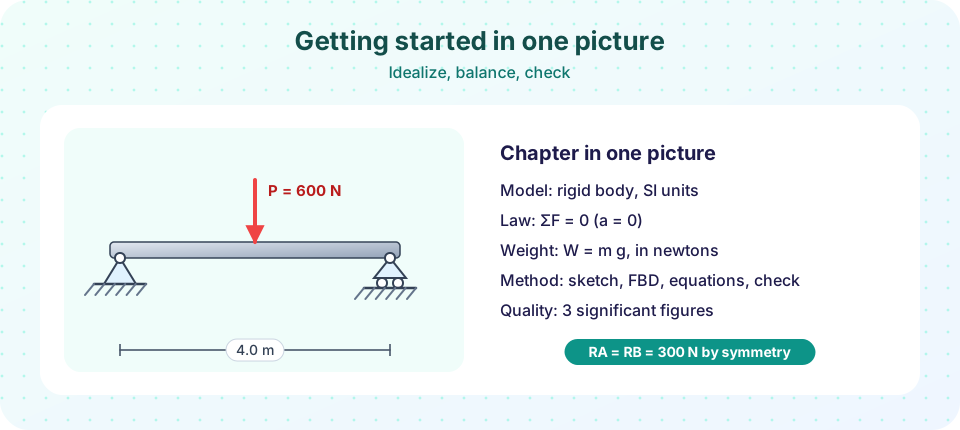
Chapter in one table
| Lesson | Big idea | Formula or rule |
|---|---|---|
| Course map | Statics finds forces in things that stay still | ΣF = 0, ΣM = 0 |
| What statics studies | Model bodies as particles or rigid bodies | Transmissibility: slide along the line of action only |
| Units and accuracy | Use SI, convert early, round late | W = m g, 1 lbf = 4.448 N, 3 s.f. |
| Problem-solving method | Sketch, body, FBD, equations, check | Take moments where unknowns act |
Worked review problem
A uniform 4.0 m plank of mass 20.0 kg lies on supports at its ends. A 40.0 kg child stands 1.0 m from the left end. Find both reactions.
- Weights: the plank weighs
20.0 × 9.81 = 196.2 Nat its center (2.0 m from the left). The child weighs40.0 × 9.81 = 392.4 Nat 1.0 m. - Moments about the left support:
R_right × 4.0 = 196.2 × 2.0 + 392.4 × 1.0 = 784.8, soR_right = 196.2 N. - Vertical balance:
R_left = 196.2 + 392.4 − 196.2 = 392.4 N. - Check: moments about the right support:
−392.4 × 4.0 + 196.2 × 2.0 + 392.4 × 3.0 = −1569.6 + 392.4 + 1177.2 = 0.
Answer: 392 N on the left and 196 N on the right. The structure of this solution is exactly the five-step method.
Press Run (or Ctrl + Enter) to see the result here.
Program input · what you'd type while the program runs
Type the answers before you press Run, one per line. Each time the program reads a line (with input()), it gets the next line from this box.
The table the program prints shows the left support unloading and the right support loading as the child walks across, with the two always adding to the total weight 588.6 N.
Check your understanding
Quick check · 9 questions
of 9 answered You scored / 9 · perfect!
-
1. A body is in static equilibrium. Which statement is always true?
Equilibrium means no acceleration, so the net force and net moment are zero. -
2. Which model is best for finding support reactions of a steel beam?
Small bending does not change the reactions, so the rigid-body model is accurate and simple. -
3. What is 1 N in base units?
From F = m a: kilogram times meter per second squared. -
4. A force can be slid along its line of action on a rigid body because of
Transmissibility says the effect on a rigid body's equilibrium is unchanged. -
5. Which is the weight of a 10.0 kg block on Earth?
W = 10.0 × 9.81 = 98.1 N. -
6. Which quantity cannot be added to a force in newtons?
A moment has different dimensions (force times length). -
7. How should the number 0.0300 be described?
Leading zeros do not count, but 3, 0 and 0 after the decimal point do. -
8. In the five-step method, which step determines which forces you must find?
The FBD shows every external force and reaction, so it defines the unknowns. -
9. In the plank problem the child moves to the right end (x = 4.0 m). What happens to the right reaction?
The child's weight is carried more and more by the right support.
Summary
- Statics models bodies as particles or rigid bodies and demands
ΣF = 0,ΣM = 0. - SI units, weight as
m g, and unit checks prevent most blunders. - Report 3 significant figures; round only at the end.
- The five-step routine, centered on the FBD, solves every problem in this course.
Track your progress
Create a free account to tick off lessons and pick up where you left off on any device.
of Engineering Statics lessons completed