


















Lesson 11 of 47 · Equilibrium of Particles and Bodies
Chapter 3 overview: equilibrium of particles and bodies
Chapter 3 overview: when forces balance, why bodies also need balanced moments, how free-body diagrams and supports work, and what you will solve in 2D and 3D.
Everything so far has been preparation. Chapter 3 is where statics pays off: you will take a structure, draw the forces on it and solve for the unknown reactions and tensions. The key insight is simple. If a body is in equilibrium, nothing can be left over: the forces must cancel, and (for a body with size) the turning effects must cancel too.
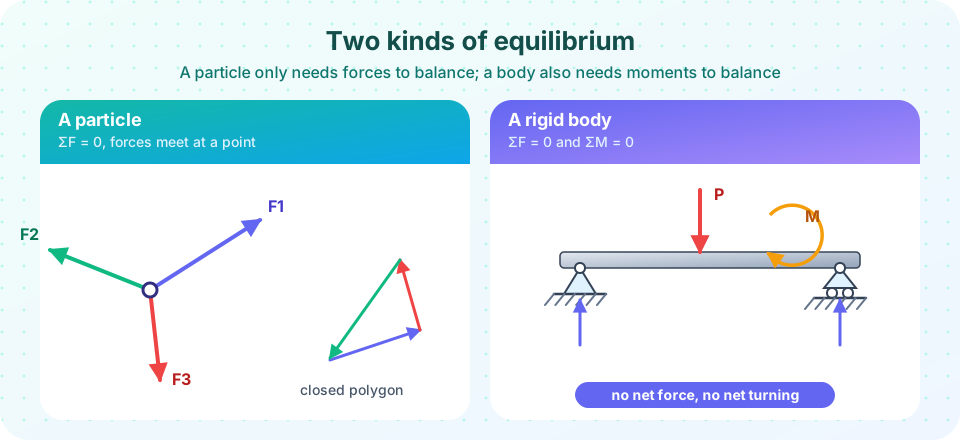
The big picture
Two levels of balance
Draw before you solve
Count equations
Unknowns must not outnumber equations.
A particle has no size, so every force passes through the same point and only translation matters: two equations in a plane, three in space. A rigid body can also rotate, so moments add three more equations in space (only one extra in a plane).
Try it: balance a ring
Forces F1 = 300 N at 30° and F2 = 200 N at 150° pull on a ring. Choose the magnitude and angle of a third force F3 that keeps the ring in equilibrium. The readout shows the leftover (residual) force; aim for zero.
The balancing force is the negative of the sum of the other two. Check it in code.
Press Run (or Ctrl + Enter) to see the result here.
Program input · what you'd type while the program runs
Type the answers before you press Run, one per line. Each time the program reads a line (with input()), it gets the next line from this box.
What each lesson covers
- Equilibrium of a particle: cables, rings, springs and pulleys.
- Free-body diagrams and supports: every support type, two-force members and counting unknowns.
- Equilibrium of a rigid body in 2D: beams, three-force members and choosing a moment point.
- Equilibrium in three dimensions: six equations, 3D supports and plates.
- Chapter 3 review.
Check your understanding
Quick check · 4 questions
of 4 answered You scored / 4 · perfect!
-
1. A particle is in equilibrium. Which statement is correct?
The vector sum of all forces on the particle is zero. -
2. How many independent equilibrium equations does a rigid body in a plane have?
ΣFx = 0, ΣFy = 0 and ΣM = 0. -
3. In a closed force polygon, the forces are
A closed tip-to-tail polygon means the vector sum is zero. -
4. Which problem has six equilibrium equations available?
Three force and three moment equations.
Summary
- Particle equilibrium:
ΣF = 0(2 or 3 equations). - Rigid body:
ΣF = 0andΣM = 0(3 equations in 2D, 6 in 3D). - The free-body diagram turns a picture into equations.
Track your progress
Create a free account to tick off lessons and pick up where you left off on any device.
of Engineering Statics lessons completed