


















Lesson 23 of 50 · Memory Systems
Working Memory
Learn sensory memory, the short-term store, Baddeley and Hitch's working memory model, memory span, chunking and the debate about capacity, with a span demo.
Try to work out 23 times 7 in your head. To do it you must hold the number, perform a step, keep the partial result, and perform the next step. The mental workspace that makes this possible is working memory. It is small, it is easily disrupted, and it is closely tied to how well people reason, read and learn. This lesson follows the idea from the first measurements of very brief memory to the model that dominates the field today.
What you will learn
- What sensory memory is and how Sperling measured it.
- Why psychologists replaced "short-term memory" with working memory.
- The four components of Baddeley's model and the evidence for each.
- What memory span and chunking show, and how big capacity really is.
Key terms
Iconic memory: a very brief visual trace after the stimulus disappears.
Memory span: the longest list a person can repeat back correctly right away.
Chunk: a meaningful unit, such as a word, that can hold several smaller items.
Rehearsal: repeating information to keep it active.
Dual-task method: performing two tasks at once to see which resources they share.
Sensory memory: the fleeting snapshot
George Sperling (1960) flashed a grid of 12 letters, three rows of four, for a fraction of a second. When people were asked to report everything, they recalled about four or five letters. Yet they said they had seen more and that it faded as they tried to report it. So Sperling used a partial report procedure: right after the flash, a tone told them which row to report (high tone for the top row, and so on). With the cue, people could report almost all letters of the cued row, whichever row it was. That means most of the display was available at the moment of the cue, but it faded within roughly a second. This visual trace is iconic memory; its auditory counterpart, echoic memory, lasts a few seconds. Sensory memory is large in capacity and brief in duration, and without attention it is lost.
From short-term memory to working memory
The multi-store model treated short-term memory as a temporary store. Two classic findings supported the idea of a limited store with fast loss. In the Brown-Peterson task (Peterson and Peterson, 1959), people saw a three-letter trigram such as "KQB" and then counted backward by threes. After about 18 seconds only around one in ten trigrams was recalled correctly, showing quick loss when rehearsal is blocked. In the serial position results (see the next lesson), the last items in a list are recalled well immediately but not after a delay.
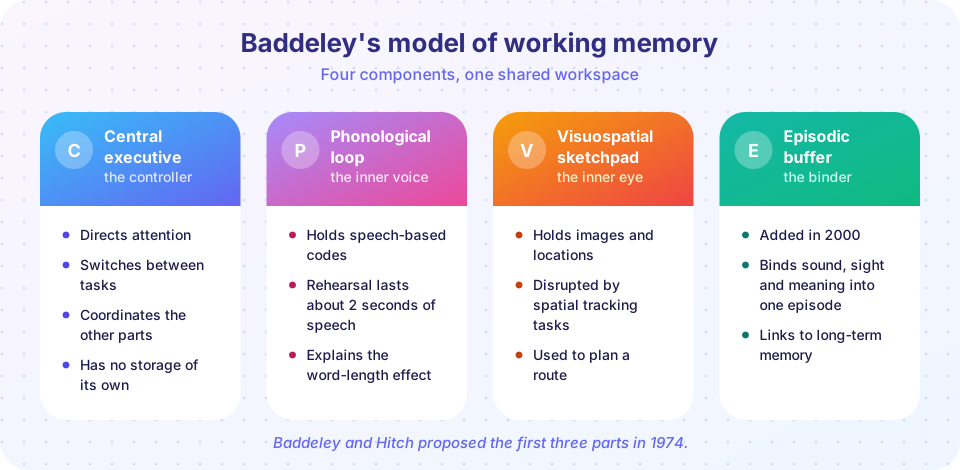
Two observations cracked the simple picture. Patients with severe impairment of short-term span could still learn and reason fairly normally, which is hard to square with a single gateway to long-term memory. And people can hold a digit list while doing a reasoning task with only a modest slowdown. So Baddeley and Hitch (1974) proposed working memory: not just storage, but storage plus processing.
Baddeley's model
- Central executive. An attention controller with no storage of its own. It focuses and divides attention, switches between tasks and links working memory to long-term memory.
- Phonological loop. Holds speech-based information and has a store plus a rehearsal process. Evidence: the phonological similarity effect (lists such as B, C, D, G, P, T are harder than dissimilar letters, because the sounds are confusable; Conrad, 1964), and the word-length effect (Baddeley, Thomson and Buchanan, 1975): people recall roughly as many words as they can say in about two seconds, so short words give a bigger span than long ones. Saying "the, the, the" aloud (articulatory suppression) blocks rehearsal and removes the word-length effect.
- Visuospatial sketchpad. Holds images and spatial layouts. Evidence: tracking a moving spot disrupts a spatial imagery task far more than a verbal task (Brooks, 1968; Baddeley and colleagues), while speaking disrupts verbal tasks. The two subsystems interfere less with each other than with tasks that use the same subsystem.
- Episodic buffer. Added by Baddeley in 2000 to explain how sound, vision and meaning are bound together, and how long-term knowledge helps. It is a limited-capacity store that holds integrated episodes.
The strongest support comes from the dual-task method: two tasks that need the same component collide, while two that need different components do not.
Span, chunking and capacity
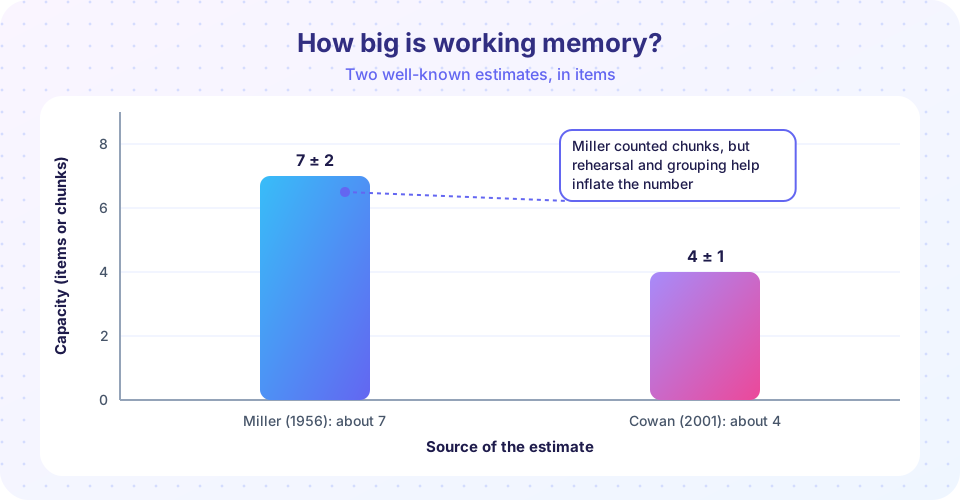
George Miller's 1956 paper "The magical number seven, plus or minus two" summarized spans of about seven items for digits, letters and words, and, importantly, argued that the limit is in chunks. A person who knows that 1492 is a date holds one chunk, not four digits. Chunking is how experts and learners extend working memory without increasing its capacity: the chess chunks of chapter 8 are an example.
Later work argued that seven was too high, because people use rehearsal and long-term knowledge to stretch the span. Nelson Cowan (2001) reviewed studies in which rehearsal and chunking were prevented and concluded that the core capacity is about four chunks (three to five). Other researchers prefer to describe the limit as attention that can be spread thin, not a fixed number of slots, so the number is better read as a rule of thumb than as a physical constant.
Why working memory matters
Individual differences in working memory capacity, measured by tasks such as the reading span (Daneman and Carpenter, 1980: read sentences while remembering the last word of each), predict reading comprehension, following directions and some kinds of reasoning. A modern interpretation, associated with Randall Engle, is that these tasks measure the ability to control attention and keep distractions out as much as raw storage. This is why working memory links this chapter to attention in chapter 3.
Common misconceptions
"Everyone can hold seven items." Seven is the old average for digit span, but it depends on chunking and rehearsal. The core limit is closer to four chunks.
"Short-term memory and working memory are the same." Short-term memory is storage; working memory adds processing and attention control.
"Training working memory makes you smarter." Training improves the trained tasks, but broad transfer to intelligence or schoolwork is weak or absent in most reviews.
Try it
Press Run (or Ctrl + Enter) to see the result here.
Program input · what you'd type while the program runs
Type the answers before you press Run, one per line. Each time the program reads a line (with input()), it gets the next line from this box.
Check your understanding
Quick check · 5 questions
of 5 answered You scored / 5 · perfect!
-
1. In Sperling's partial report procedure, the tone cue after the display showed that
Cued rows could be reported almost perfectly, so much more than four letters was available at the moment of the cue. -
2. The word-length effect is evidence for
Short words fit more into the rehearsal loop, giving a larger span. -
3. Which component was added to Baddeley's model in 2000?
The episodic buffer binds information from different sources and from long-term memory. -
4. Cowan's estimate of about four chunks differs from Miller's seven mainly because
When rehearsal and grouping are blocked, the underlying capacity looks smaller. -
5. Tracking a moving dot disrupts mental imagery more than it disrupts a verbal task. This supports
Interference is greatest when two tasks need the same subsystem.
Summary
- Sensory memory is large but lasts only a fraction of a second to a few seconds.
- Working memory holds and manipulates information; Baddeley's model has an executive, phonological loop, sketchpad and episodic buffer.
- The dual-task method, the phonological similarity effect and the word-length effect support the subsystems.
- Chunking raises what you can hold; the core capacity is about four chunks, though the exact number is debated.
- Working memory capacity predicts comprehension and reasoning, probably because it reflects attention control.
Next: Long-Term Memory Systems
Track your progress
Create a free account to tick off lessons and pick up where you left off on any device.
of Cognitive Psychology lessons completed