


















Lesson 35 of 50 · Reasoning, Judgment and Decision Making
Heuristics and Biases
Study representativeness, availability and anchoring, the Linda problem, base-rate neglect, the cognitive reflection test and the fast-and-frugal reply, with a simulation.
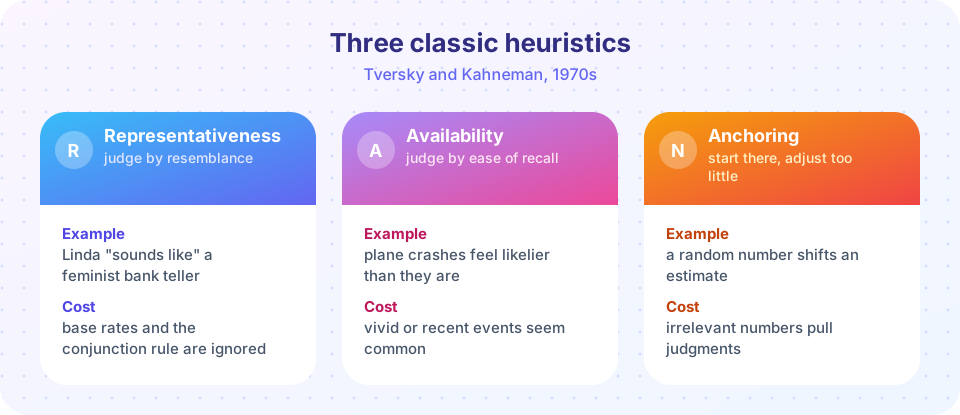
How likely is a plane crash this year? How much should you offer for a used car? Nobody computes the exact answer. We reach for a feeling of how familiar, typical or reasonable the answer seems. In a famous 1974 paper, Amos Tversky and Daniel Kahneman argued that people rely on a small set of heuristics to make such judgments, and that these shortcuts produce predictable errors, called biases. This lesson explains the three classic heuristics and then asks how to interpret the evidence.
What you will learn
- How representativeness, availability and anchoring work and the errors they cause.
- What base-rate neglect and the conjunction fallacy are.
- How the idea of attribute substitution unifies the heuristics.
- How critics read the findings, and what the evidence supports today.
Key terms
Representativeness: judging probability by how well something resembles a category.
Availability: judging frequency or probability by how easily examples come to mind.
Anchoring: starting from an initial value and adjusting insufficiently.
Base rate: how common something is in the population.
Conjunction fallacy: judging a combination of events as more probable than one of its parts.
Representativeness
When asked how likely it is that someone belongs to a category, we judge how much they resemble the typical member. This is useful, but it ignores two things that probability theory requires.
Base rates. In a study by Kahneman and Tversky (1973), people were told that a group contained either 70 engineers and 30 lawyers or the reverse, and were given a description of one person chosen at random, such as a man who is conservative, careful and keen on mathematical puzzles. Their probability estimates followed how much the description resembled an engineer and changed little when the stated base rates were reversed. Ignoring the base rate is called base-rate neglect (we return to its correct treatment in the lesson on Bayes).
The conjunction rule. In the Linda problem (Tversky and Kahneman, 1983), Linda is described as 31, single, outspoken and very bright, with a philosophy degree and a deep concern for discrimination and social justice. Which is more probable: that Linda is a bank teller, or that she is a bank teller and active in the feminist movement? A large majority (about 85 percent in the original study) picked the second, though the set of feminist bank tellers is a subset of all bank tellers, so it cannot be more probable. The description fits the stereotype of a feminist, so the combined statement feels more likely. Researchers have asked whether people misread "probable". Telling people to think in frequencies ("out of 100 women like Linda, how many are...") reduces the error (Hertwig and Gigerenzer, 1999), but does not remove it in every version.
Other effects of representativeness: the gambler's fallacy (after five heads, tails is "due"), insensitivity to sample size (a small hospital is as likely as a large one to have more than 60 percent boys born on a day), and misreading of regression to the mean (a student with an extreme score is likely to be closer to average the next time, and we may invent causes for the change).
Availability
If examples come to mind easily, the event seems frequent. Tversky and Kahneman (1973) asked whether more English words begin with the letter K or have K as the third letter. Most people say the first, but K is more often the third letter. Words are retrieved by their first letters, so those words come to mind more readily. Availability explains why vivid, recent and emotional events loom large. Lichtenstein and colleagues (1978) found that people overestimated deaths from dramatic causes such as tornadoes and accidents and underestimated deaths from common, quiet causes such as stroke or diabetes. Media coverage plays a role. Importantly, the feeling of ease matters as much as the number of examples: people who must list 12 instances of their own assertive behavior find it harder and rate themselves as less assertive than those who list 6 (Schwarz and colleagues, 1991).
Anchoring and adjustment
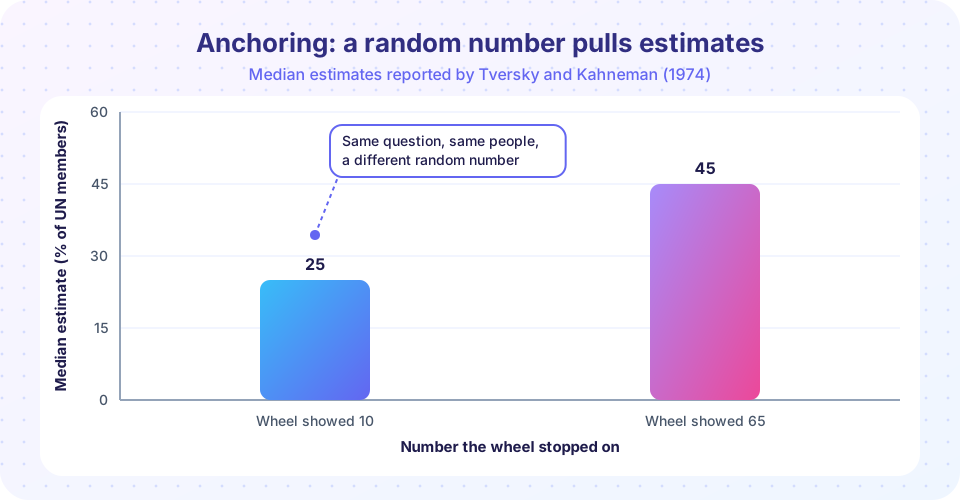
When estimating a number, we start from an available value and adjust, usually not enough. In Tversky and Kahneman's (1974) classic study, a wheel of fortune that was rigged to stop at 10 or at 65 was spun in front of participants, who were then asked whether the percentage of African countries in the United Nations was higher or lower than that number, and then to give their own estimate. The median estimates were 25 for those who saw 10 and 45 for those who saw 65. The anchor was obviously random yet still pulled the answers. Anchoring appears in real settings: in one study, experienced judges' sentencing recommendations were influenced by the roll of a die rigged to produce a high or low number (Englich, Mussweiler and Strack, 2006). Explanations include insufficient adjustment and selective activation of anchor-consistent information; both seem to matter.
One idea behind the heuristics: attribute substitution
Kahneman and Frederick (2002) proposed that all of these involve attribute substitution: when a target question is hard ("How probable is it?"), the mind answers an easier related question ("How much does it resemble? How easily do I recall examples?") and reports the answer as if it answered the original. The classic demonstration is the bat-and-ball problem (Frederick, 2005): a bat and a ball cost $1.10 together and the bat costs $1.00 more than the ball; how much is the ball? Many people answer 10 cents quickly; the correct answer is 5 cents. Performance on such items in the Cognitive Reflection Test correlates with a tendency to override the first impulse.
How should we read the evidence?
The heuristics-and-biases research documented real, replicable patterns, but its interpretation is debated.
- Heuristics are often good. Gerd Gigerenzer and colleagues argue for fast-and-frugal heuristics, such as the recognition heuristic and take-the-best, that ignore most information and still perform well in suitable environments. The match between a heuristic and the structure of the environment is called ecological rationality.
- Format matters. Natural frequencies, clear wording and meaningful context change how well people do.
- Errors are not stupidity. Many biases appear in intelligent people, and the shortcuts are efficient most of the time.
- Expertise helps in some domains. Experts with fast, accurate feedback, such as weather forecasters, are well calibrated; experts in fields with slow, noisy feedback often are not.
A fair summary is that the judgments are ecologically reasonable and systematically fallible.
Common misconceptions
"Heuristics are mistakes." They are shortcuts that usually work; the "bias" is the predictable error in the situations where they do not.
"Knowing about a bias makes you immune." Awareness helps a little, but it does not make the feeling go away. Better methods, such as checking base rates and using checklists, work better than willpower.
"The Linda problem proves people are irrational." It shows a strong pull from similarity, which can be reduced by changes in wording and format.
Try it
Press Run (or Ctrl + Enter) to see the result here.
Program input · what you'd type while the program runs
Type the answers before you press Run, one per line. Each time the program reads a line (with input()), it gets the next line from this box.
Press Run (or Ctrl + Enter) to see the console output here.
No output.
Check your understanding
Quick check · 5 questions
of 5 answered You scored / 5 · perfect!
-
1. The Linda problem demonstrates
People rated 'bank teller and feminist' as more probable than 'bank teller', which violates the conjunction rule. -
2. More English words have K as the third letter than the first letter, yet most people say the opposite because of
Ease of recall is used as a cue for frequency. -
3. In the wheel-of-fortune study, the median estimate was higher after the wheel showed 65 than 10, showing
An obviously random anchor still pulled the answers. -
4. Base-rate neglect is
Descriptions that resemble a category overrule its prior frequency. -
5. Gigerenzer's ecological rationality emphasizes that
Simple rules can be accurate when they fit the environment.
Summary
- Representativeness, availability and anchoring are shortcuts that substitute an easier question for a harder one.
- They produce predictable errors such as base-rate neglect, the conjunction fallacy, overestimating vivid risks and being swayed by random anchors.
- The effects are replicable but depend on format, context and expertise; heuristics are often accurate in the right environment.
- Better methods, not just awareness, reduce bias: check base rates, think in frequencies and consider alternatives.
Next: Logic and Reasoning
Track your progress
Create a free account to tick off lessons and pick up where you left off on any device.
of Cognitive Psychology lessons completed