


















Lesson 3 of 50 · Getting Started
A Short History of Cognitive Psychology
Follow cognitive psychology from Wundt's lab and Ebbinghaus's memory studies through behaviorism, the 1950s revolution and the rise of cognitive neuroscience.
Cognitive psychology looks modern, but its questions are old. People have wondered about memory and attention for thousands of years. What is new is the method: from the late 1800s, researchers began measuring mental events instead of only arguing about them. Then, for about forty years, much of academic psychology decided that the mind should not be studied at all. Understanding why that happened, and why it ended, explains many habits of the field today.
What you will learn
- How early laboratories tried to measure the mind and why introspection failed.
- Why behaviorism rejected mental talk, and what it got right.
- What changed in the 1950s and 1960s (the "cognitive revolution").
- How cognitive neuroscience and modern replication work fit in.
Key terms
Introspection: reporting on your own conscious experience, used as a research method in early psychology.
Behaviorism: the view that psychology should study observable behavior and its causes in the environment, not inner mental states.
Cognitive revolution: the shift from the 1950s onward to studying mental processes using information-processing ideas.
Schema: an organized body of knowledge that guides understanding and remembering.
Cognitive neuroscience: the study of how brain systems support cognition.
Before 1900: measuring the mind
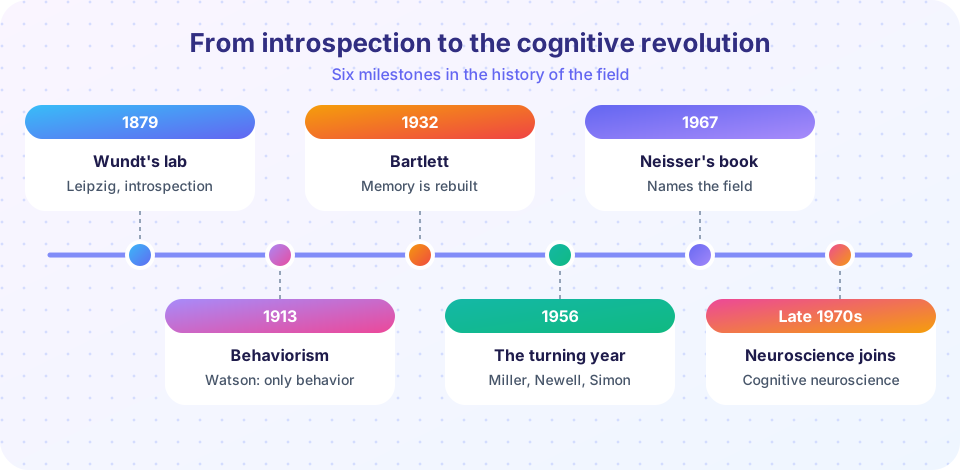
In 1879 Wilhelm Wundt opened a laboratory for experimental psychology in Leipzig, Germany. It is usually treated as the founding of psychology as a separate science. Wundt's students trained to report on sensations in carefully controlled settings, a method called introspection. A trained observer might listen to a metronome and describe how a beat felt as the speed changed.
Introspection had a basic problem: it was private. Two labs trained observers differently and got different answers about, for example, whether thought can occur without any image. There was no way to settle the dispute with a measurement both sides accepted. Introspection also cannot reach the many processes that are unconscious.
Two other early figures took a different route:
- Hermann Ebbinghaus (1885) tested his own memory by learning lists of meaningless syllables such as
ZOKandBIM, and measured how much he forgot after different delays. This gave the first quantitative forgetting curve and showed that memory could be studied with numbers. - William James wrote The Principles of Psychology (1890), with vivid chapters on attention, memory and habit. His remark that everyone knows what attention is, until asked to define it, still fits.
1913-1950s: behaviorism
In 1913 John B. Watson published a paper, later called the behaviorist manifesto, arguing that psychology should be a science of behavior because behavior is the only thing outsiders can observe. B. F. Skinner developed this into a research program built on reinforcement and animal learning. Behaviorism had real strengths: rigorous experimental control, clear measurement and powerful principles of learning that are still used in training and therapy.
The cost was that words like thought, plan and attention became suspect. Not everyone obeyed. Two examples of mind-friendly research from the same period:
- Edward Tolman (1948) showed that rats seemed to learn a layout, which he called a cognitive map, rather than a fixed series of turns.
- Frederic Bartlett (1932) asked British participants to read a Native American folk story, The War of the Ghosts, and retell it later. The retellings became shorter and shifted toward the readers' own expectations. Bartlett concluded that remembering is reconstruction, guided by schemas, not replay of a recording. This idea comes back strongly in Chapter 5.
1940s-1960s: the cognitive revolution
Several developments converged.
War-time problems. In World War II, radar operators and pilots had to monitor many signals and respond fast. Psychologists were asked to improve human performance, and found that "attention" and "capacity" mattered. Donald Broadbent's book Perception and Communication (1958) offered a flow-chart theory of attention that treated people as limited-capacity channels. Colin Cherry's study of the "cocktail party" problem (1953) began modern attention research (Chapter 3).
New ideas from outside psychology. Information theory (Claude Shannon, 1948) gave a way to measure information. Early computers showed that an information-processing system could follow symbols and rules. That made talk about internal representation respectable again.
A turning year, 1956. Several landmark contributions appeared close together:
- George Miller's paper "The Magical Number Seven, Plus or Minus Two" argued that short-term memory holds a limited number of chunks.
- Allen Newell and Herbert Simon presented their Logic Theory Machine, a program that proved theorems, at a symposium on information theory at MIT.
- Noam Chomsky presented work on the mathematical description of language at the same symposium.
- Jerome Bruner, Jacqueline Goodnow and George Austin published A Study of Thinking, about how people form concepts.
A decisive critique. In 1959 Chomsky reviewed Skinner's book Verbal Behavior and argued that a child's ability to produce and understand new sentences could not be explained by reinforcement alone. Many psychologists found this persuasive.
A name and a textbook. In 1967 Ulric Neisser published Cognitive Psychology, giving the field its name and organizing it around the idea that cognition is the transformation of sensory input into knowledge and action.
The "revolution" metaphor is partly a story told later. Many threads existed earlier (Bartlett, Tolman, human factors research), and behaviorist methods, such as careful control and measurement, were kept. A better summary is that psychology regained permission to theorize about internal processes, using publicly measurable evidence.
From the 1970s: new partners and new questions
- Cognitive neuroscience. In the late 1970s Michael Gazzaniga and George Miller are credited with using the name for work that combined cognitive theories with brain evidence. Brain-imaging methods from the 1980s and 1990s, covered in Chapter 2, then expanded it enormously.
- Connectionism. David Rumelhart, James McClelland and colleagues published the Parallel Distributed Processing volumes in 1986, offering neural-network models as an alternative to rule-based symbol systems.
- Judgment and decision making. Daniel Kahneman and Amos Tversky's work from the 1970s showed systematic patterns in human reasoning and was central to Kahneman's 2002 Nobel Memorial Prize in Economic Sciences (Chapter 7).
- Embodied and situated cognition. Some researchers argued that thinking cannot be understood without the body and environment.
- The replication movement. In the 2010s, large projects tried to repeat published psychology findings. A sizable share did not reproduce well in the first large efforts, which led to better habits: larger samples, preregistration and open data. You will see in later chapters that some famous cognitive findings have held up very well, and some have been questioned.
Common misconceptions
"Behaviorists were simply wrong." Their methods and learning principles are still used. What was limited was the ban on explaining behavior by internal processes.
"The computer was the cause of the cognitive revolution." Computers supplied a powerful metaphor and tools, but the research problems (attention, memory, language) and the dissatisfaction with behaviorism came first.
"Introspection is useless." Self-report is still collected today, but it is treated as one more kind of data to be checked against behavior, not as a direct window into the mind.
Try it
Press Run (or Ctrl + Enter) to see the result here.
Program input · what you'd type while the program runs
Type the answers before you press Run, one per line. Each time the program reads a line (with input()), it gets the next line from this box.
Press Run (or Ctrl + Enter) to see the console output here.
No output.
Check your understanding
Quick check · 5 questions
of 5 answered You scored / 5 · perfect!
-
1. Why was introspection abandoned as the main method?
Different labs trained observers differently and got different answers, with no public way to decide between them. -
2. Bartlett's War of the Ghosts study suggested that remembering is
Retellings changed toward the readers' own expectations, so memory is rebuilt rather than replayed. -
3. Which pair best describes influences on the cognitive revolution?
Information theory, early computers, human factors work and critiques such as Chomsky's all contributed. -
4. Which statement about behaviorism is most accurate?
Behaviorism left lasting methods and learning principles; the field outgrew its ban on mental concepts. -
5. Neisser's 1967 book mattered because it
It labeled and organized the new approach as cognitive psychology.
Summary
- Wundt's lab (1879) and Ebbinghaus's memory studies began the measurement of mental events, but introspection was private and unreliable.
- Behaviorism (from 1913) demanded observable evidence, which improved rigor but discouraged talk of internal processes.
- Bartlett and Tolman showed that mental structures (schemas, maps) matter.
- In the 1950s and 1960s information theory, computers, human factors research and critiques of behaviorism produced the cognitive revolution, named by Neisser's 1967 textbook.
- Later partners include cognitive neuroscience, connectionism, decision research and the replication movement.
Track your progress
Create a free account to tick off lessons and pick up where you left off on any device.
of Cognitive Psychology lessons completed