


















Lesson 13 of 50 · Attention
Selective Attention and Filter Theories
Explore the cocktail party effect, dichotic listening, Broadbent's filter, Treisman's attenuation, late selection and Lavie's load theory, plus the Stroop effect.
At a lively party you can follow one friend's voice while a dozen other conversations go on around you. Then someone across the room says your name, and your attention snaps to it, even though you were not "listening". How can the mind both ignore and monitor the same sounds? Solving this puzzle, first described by Colin Cherry in 1953 as the cocktail party problem, started modern attention research and produced a family of theories about where in the mind selection happens.
What you will learn
- How dichotic listening and shadowing experiments work.
- What Cherry, Broadbent, Moray and Treisman found, and what each theory proposes.
- The early versus late selection debate and how load theory reconciles it.
- How the Stroop effect shows the limits of selective control.
Key terms
Dichotic listening: presenting different messages to the two ears at once.
Shadowing: repeating aloud, word by word, a message as you hear it.
Early selection: unattended input is blocked before its meaning is analyzed.
Late selection: all input is analyzed for meaning, and selection happens afterward.
Perceptual load: how much of your perceptual capacity a task uses.
The cocktail party in the lab
Cherry's method was dichotic listening with shadowing. Participants wore headphones with a different message in each ear and repeated aloud the message in one ear (the attended channel) while ignoring the other (the unattended channel). Afterward, he asked what they knew about the ignored message.
What listeners noticed: whether the unattended voice was a man or a woman, whether it was speech or a tone, and sudden changes in pitch. What they missed: the content, the language (even when the voice switched from English to German), and whether the speech was played backward (though a few noticed it was odd). So unattended input receives physical processing but little semantic processing.
Two follow-ups complicated the picture.
- Moray (1959) found that when a participant's own name appeared in the unattended channel, about a third noticed it. Meaning can break through.
- Gray and Wedderburn (1960) and Treisman (1960) showed that when a sentence switched ears midway, participants sometimes followed the meaning across ears, not the ear they were told to follow. This implied that meaning influences selection.
The theories
Broadbent's filter model (1958)
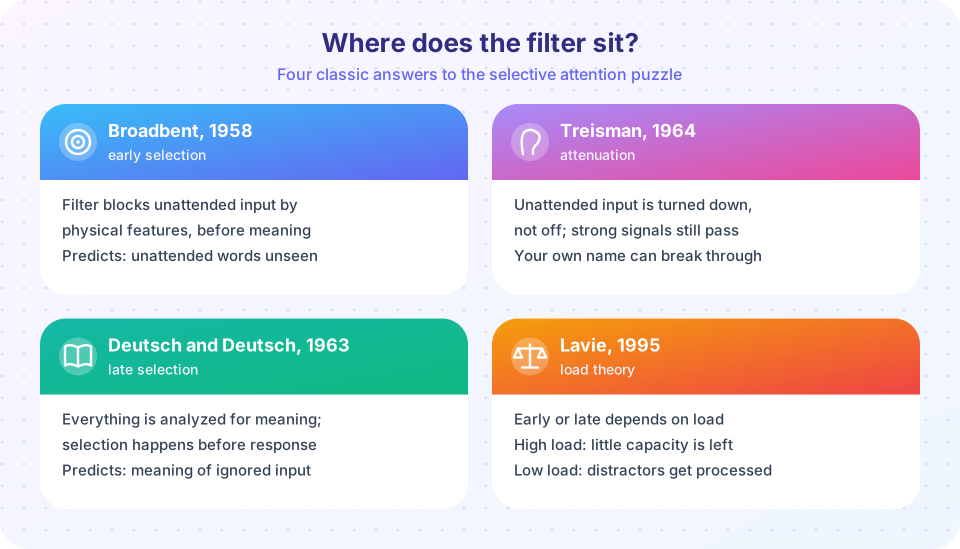
Donald Broadbent proposed that sensory information is held briefly in a store and then passes through a selective filter that lets one channel through based on physical features (location, pitch). The filter protects a limited-capacity processor from overload. Only the selected channel is analyzed for meaning.
- Explains: poor memory for unattended content, noticing physical changes.
- Problem: the own-name effect and the shifts across ears. If meaning is not analyzed, how does the name get through?
Treisman's attenuation model (1964)
Anne Treisman proposed that the filter does not block but attenuates (turns down) the unattended channel. Words are recognized in a "dictionary" in which each word has its own threshold: common or important words (your name, "fire!") have low thresholds, so even a weakened signal can trigger them. Ordinary words have high thresholds and are not detected in the unattended channel.
- Explains: own-name effect, meaning crossing ears when context makes the next word predictable.
- Cost: it is a flexible theory, so it is harder to refute.
Deutsch and Deutsch's late-selection model (1963)
J. Anthony Deutsch and Diana Deutsch proposed that all input is analyzed fully for meaning, and selection takes place later, at the stage of response or memory, based on importance. This explains why meaning of ignored words can matter. It struggles to explain why people remember so little of unattended content and why the processing load of attended tasks seems to limit what happens to the ignored.
Evidence that decides? Mixed results
- Some studies found semantic effects from ignored words: for instance, skin-conductance responses to words previously paired with mild shock, even when the words were in the unattended ear (Corteen and Dunn, 1974). Replications and interpretations varied.
- Brain recordings show that unattended sounds still produce early responses, but responses are larger for attended sounds. Attention amplifies, not just blocks.
Lavie's load theory (1995)
Nilli Lavie proposed a way to reconcile early and late selection: it depends on load.
- Under high perceptual load (a task that uses up perceptual capacity), there is no spare capacity, so irrelevant items are not processed: early-like selection.
- Under low perceptual load, spare capacity spills over to distractors, which are then processed: late-like selection.
- High load on working memory or cognitive control has the opposite effect: with fewer control resources, distractors interfere more.
This fits many findings, such as the observation that people are more distracted by an irrelevant flashing item when the main task is easy. It has been refined and debated, as in what counts as "perceptual load", but it is widely used.
Note also an individual-differences result: people with lower working-memory capacity tend to notice their own name in an ignored channel more often than those with higher capacity, suggesting that good control helps keep the unattended channel out.
Selection by space: the spotlight
Selection is not only about ears. In vision, Michael Posner's cueing studies (1980) showed that a cue pointing to a location speeds responses to targets appearing there and slows them at other locations, even when the eyes stay still. This gave rise to the spotlight metaphor of attention: a region of enhanced processing that can move. Other work shows that attention can also select objects (all parts of the attended object benefit) and features (for example, all red items).
The Stroop effect: control under conflict
In 1935 John Ridley Stroop asked people to name the ink color of words. When the word was a color name printed in a different color (for example, the word RED in blue ink), naming the ink was slower and more error-prone than naming the ink of a neutral patch or of a matching word (RED in red ink). Reading is so practiced that it is automatic: it starts even though you do not want it to, and you must use executive attention to suppress the word. The Stroop effect is among the most reliable findings in psychology, and it has been used to study development, aging, and frontal-lobe function. It illustrates that selection can fail when an unwanted process is automatic.
Common misconceptions
"Attention is a spotlight, and nothing outside it is processed." Unattended items get some processing, particularly when attention is not fully used up. The spotlight metaphor is a simplification.
"Ignoring means you did not hear it." Ignored input can still be partly processed, which is why your name can pop out.
"The early versus late debate has a winner." Current views, such as load theory, say selection is flexible and depends on the task and the person.
Try it
Press Run (or Ctrl + Enter) to see the result here.
Program input · what you'd type while the program runs
Type the answers before you press Run, one per line. Each time the program reads a line (with input()), it gets the next line from this box.
Check your understanding
Quick check · 5 questions
of 5 answered You scored / 5 · perfect!
-
1. In Cherry's shadowing experiments, listeners usually did notice in the unattended ear
Physical features were noticed; meaning and language mostly were not. -
2. Treisman's attenuation theory explains the own-name effect because
A dictionary unit with a low threshold can respond to an attenuated signal. -
3. According to load theory, distractors are processed the MOST when
With low perceptual load, spare capacity spills over to irrelevant items. -
4. The Stroop effect shows that
Because word reading is automatic, it conflicts with color naming and slows responses. -
5. Broadbent's filter model had trouble explaining
A filter that blocks meaning before analysis cannot explain the own-name effect.
Summary
- Cherry's dichotic listening showed that unattended input gets physical but little semantic processing, and Moray showed that meaningful items can break through.
- Broadbent proposed an early filter, Treisman an attenuator with word thresholds, and Deutsch and Deutsch late selection.
- Load theory says selection depends on perceptual load and on cognitive control resources.
- Posner's spotlight and object and feature selection show attention works in space, objects and features.
- The Stroop effect shows the limits of selective control over automatic processes.
Track your progress
Create a free account to tick off lessons and pick up where you left off on any device.
of Cognitive Psychology lessons completed