


















Lesson 45 of 50 · Projects and Practice
Case Studies in Cognitive Psychology
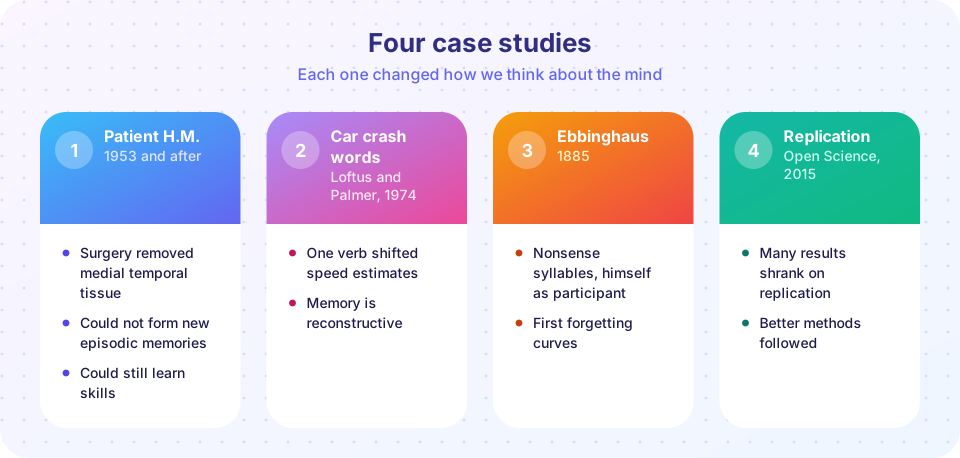
Four case studies that shaped cognitive psychology: patient H.M., the misinformation experiments, Ebbinghaus's forgetting curve and the replication crisis, with simulations of each.
Textbook summaries make findings sound settled. Case studies show how they were actually produced: with a particular person, a particular method and a particular set of limits. This lesson revisits four cases from the course, asks what each one really established, and ends with a lesson about evidence itself: the replication crisis, which changed how psychologists do research.
What you will learn
- How to read a classic study: what was done, what was found, what can be concluded.
- Why single cases, experiments and large-scale replications give different kinds of evidence.
- What the replication crisis is and how it has changed practice.
- How a simulation shows why small studies can mislead.
Key terms
Case study: an in-depth investigation of one person or a few, often after an unusual injury.
Dissociation: one ability is damaged while another is spared, suggesting separate systems.
Replication: repeating a study to see whether the result holds.
Statistical power: the chance that a study will detect a real effect of a given size.
Preregistration: stating the hypotheses and analysis plan before collecting data.
Case 1: Patient H.M. (1953 onward)
What was done. Surgeons removed medial temporal tissue from both sides of Henry Molaison's brain to treat epilepsy. Brenda Milner then tested him for decades, and Suzanne Corkin continued the work until his death in 2008.
What was found. Severe anterograde amnesia for new events and facts, normal digit span, preserved intelligence, and learning of skills such as mirror drawing, with improvement over days despite no memory of practicing.
What it established. A double life for memory: separable systems for declarative memory, short-term storage and skills. Limits. One person, with surgery that also affected tissue beyond the hippocampus, and with a pre-existing neurological history. Single cases cannot give the size or generality of an effect. They are strongest when they show a dissociation that overturns a theory and are later confirmed by other patients and by imaging.
Case 2: Car crash words (1974)
What was done. Loftus and Palmer showed film clips of car accidents and asked about speed using different verbs. A week later, they asked whether participants saw broken glass.
What was found. Estimates varied by verb (for example about 41 mph for "smashed" and 32 mph for "contacted"), and "smashed" participants were more likely to report broken glass that was not there.
What it established. Later information can change reports of an earlier event. Limits. It shows that suggestion influences what people report; whether the original memory is changed, added to or hidden is debated. Laboratory films are less emotional than real accidents. Decades of replications, including with more realistic events, support the basic effect.
Case 3: Ebbinghaus on himself (1885)
What was done. Hermann Ebbinghaus memorized lists of nonsense syllables and measured savings, the percent of the original learning time saved when relearning after different delays.
What was found. As commonly reported, savings were about 58 percent after 20 minutes, 44 percent after an hour, 34 percent after a day, 25 percent after six days and 21 percent after a month. Forgetting was fast and then slow.
What it established. Memory can be studied quantitatively, and forgetting has a regular shape. Limits. One participant who knew the hypothesis, nonsense syllables unlike real learning, and a small data set. Modern studies with many people confirm the shape of the curve.
Case 4: The replication project (2015)
What was done. The Open Science Collaboration, a large group of researchers, attempted to replicate 100 studies published in 2008 in three leading psychology journals, following the original methods as closely as possible, often with larger samples.
What was found. About 97 percent of the original studies reported statistically significant results; about 36 percent of the replications did, and the average effect size in the replications was roughly half of the originals. Cognitive psychology studies replicated at a higher rate than social psychology ones.
What it established. Published results are, on average, overestimates, and some are false positives. Causes include small samples, publication bias (significant results are published, null results are filed away), and flexible analysis choices (p-hacking) that inflate false positives. Limits. A failed replication does not by itself prove that the original was false; the conditions may differ, and the replications themselves have uncertainty.
Changes in practice include larger samples and power analysis, preregistration and registered reports (journals commit to publish based on the method), open data and materials, multi-lab replications ("Many Labs"), and reporting effect sizes and confidence intervals, not just p-values. Findings in this course that rest on many independent replications, such as the testing effect, the spacing effect, the Stroop effect and the existence of distinct memory systems, are on firm ground. Effects that rest on a single small study, especially surprising ones, deserve caution.
Reading a study like a cognitive psychologist
A short checklist for any study you read:
- What exactly was manipulated and measured? (Independent and dependent variables.)
- Who took part, and how many? Small samples give noisy estimates.
- Was there a control or comparison condition?
- How big is the effect, not just whether it is significant?
- Has it been replicated, by different labs and different materials?
- Does the explanation account for the data, or just fit it afterward?
Common misconceptions
"The replication crisis means psychology is not a science." It shows science correcting itself; the reforms have improved reliability, and many findings are solid.
"A significant result means the effect is real and large." It means the data would be unlikely if there were no effect; the effect may be small or a false positive.
"Case studies are worthless." They can be decisive for theory, especially when combined with other evidence.
Try it
Press Run (or Ctrl + Enter) to see the result here.
Program input · what you'd type while the program runs
Type the answers before you press Run, one per line. Each time the program reads a line (with input()), it gets the next line from this box.
Press Run (or Ctrl + Enter) to see the result here.
Program input · what you'd type while the program runs
Type the answers before you press Run, one per line. Each time the program reads a line (with input()), it gets the next line from this box.
Check your understanding
Quick check · 5 questions
of 5 answered You scored / 5 · perfect!
-
1. What is the main strength of H.M.'s case for theory?
Dissociations are strong evidence for separable systems. -
2. Ebbinghaus's savings measure refers to
Savings compares original learning with relearning. -
3. In the 2015 Open Science Collaboration, about how many replications were significant?
About 97% of the originals were significant, versus about 36% of the replications. -
4. In the simulation, the significant small studies overestimated the true effect because
Only studies with large observed effects crossed the threshold with small samples. -
5. Which is a reform that came out of the replication crisis?
Preregistration and registered reports guard against flexible analysis.
Summary
- H.M., Loftus and Palmer, Ebbinghaus and the replication project show different kinds of evidence, each with strengths and limits.
- Single cases can reveal dissociations; experiments can show causal effects; replications test reliability.
- Small, underpowered studies that reach significance overestimate effects; reforms such as larger samples and preregistration improve reliability.
- Findings with many independent replications are the safest to rely on.
Track your progress
Create a free account to tick off lessons and pick up where you left off on any device.
of Cognitive Psychology lessons completed