


















Lesson 12 of 50 · Attention
Chapter 3 Overview: Attention
A map of attention research: selective, divided, sustained and executive attention, why capacity is limited, and what each lesson in this chapter will teach.
Right now your senses are delivering far more than you can use: the feel of your chair, the hum of a fan, the words on this page, your own thoughts. Yet your experience feels orderly, because most of it is quietly left out. Attention is the set of mechanisms that select some information for deeper processing and let you control what you do with it. William James (1890) described it as taking possession of the mind, in clear and vivid form, of one of several possible objects or trains of thought. A century of research has turned that description into precise questions.
What you will learn
- The four main senses in which psychologists use the word "attention".
- Why attention is needed at all (limited capacity).
- What each lesson in this chapter covers.
Why do we need attention?
Two facts drive the research. First, processing capacity is limited: you cannot fully analyze every sight and sound at once. Second, the world is rich: there is always more going on than you can use. A system with limited capacity in a rich world needs a way to select. Attention is the selection system, with additional jobs of keeping a goal active and switching when needed.
The big picture
Selective attention
Choosing what to process
Divided attention
Sharing a limited resource
Sustained attention
Executive attention
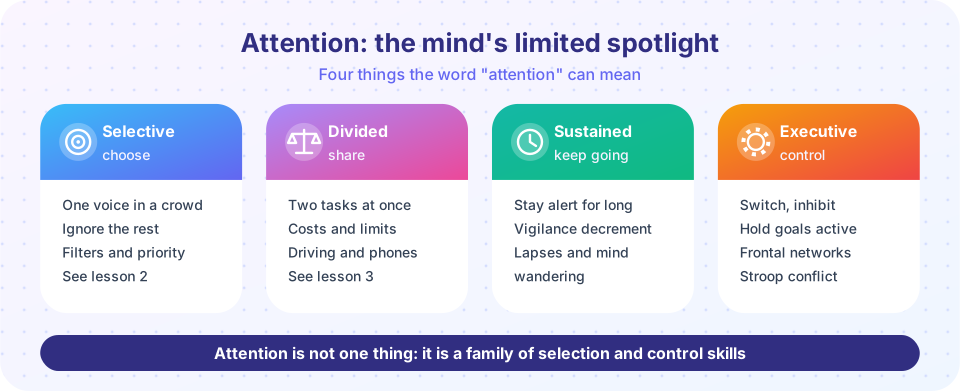
Four senses of "attention"
- Selective attention is choosing some inputs and ignoring others, such as following one conversation at a noisy party.
- Divided attention is performing more than one task, or monitoring more than one source, at once.
- Sustained attention (or vigilance) is staying alert for a long time, such as a lifeguard watching a pool. Performance on such tasks tends to decline within the first half-hour, a pattern called the vigilance decrement, first documented by Norman Mackworth in 1948 with radar-style tasks.
- Executive attention is the control of thought and action: holding a goal, resisting distraction and switching tasks. It is closely tied to working memory and the frontal lobes.
Attention can also be overt, when you move your eyes to look at something, or covert, when you attend to something without moving your eyes (Michael Posner's cueing studies of the 1980s). It can be directed by goals (endogenous, "top-down") or captured by sudden, salient events (exogenous, "bottom-up"), such as a flash or your name being called.
What each lesson covers
| Lesson | What it covers |
|---|---|
| Selective Attention and Filter Theories | Dichotic listening, the cocktail party effect, Broadbent, Treisman, late selection and load theory; the Stroop effect |
| Divided Attention and Multitasking | Dual-task costs, bottleneck and resource theories, practice, and distracted driving |
| Visual Search and Inattentional Blindness | Pop-out and conjunction search, feature integration, and what we fail to see when attention is elsewhere |
| Chapter 3 Review | One-page summary and a ten-question quiz |
Try it
Press Run (or Ctrl + Enter) to see the console output here.
No output.
Check your understanding
Quick check · 3 questions
of 3 answered You scored / 3 · perfect!
-
1. Selective attention is best illustrated by
Selective attention means choosing some inputs and ignoring others. -
2. The vigilance decrement refers to
Mackworth showed that detection falls off over a long period of monitoring. -
3. Covert attention is
Overt attention involves eye movements; covert attention does not.
Summary
- Attention selects among a rich world of inputs because processing capacity is limited.
- Four senses of attention: selective, divided, sustained and executive.
- Attention can be overt or covert, and goal-driven or stimulus-driven.
- The chapter covers filter theories, divided attention and multitasking, and visual search and inattentional blindness.
Track your progress
Create a free account to tick off lessons and pick up where you left off on any device.
of Cognitive Psychology lessons completed