


















Lesson 38 of 50 · Reasoning, Judgment and Decision Making
Decisions and Prospect Theory
Compare expected utility with prospect theory: the Allais paradox, reference points, loss aversion, probability weighting, framing, the endowment effect and defaults and nudges.
Imagine two ways of describing the same medical program: "200 people will be saved" or "400 people will die" out of 600. The facts are identical, but people choose differently depending on the wording. Decision research asks how people actually choose when outcomes are uncertain, how that differs from what a rational calculator would do, and what the differences reveal about the mind. The best-known answer is Daniel Kahneman and Amos Tversky's prospect theory.
What you will learn
- Expected utility theory and the Allais paradox.
- The four ingredients of prospect theory.
- How framing, the endowment effect and defaults show it in action.
- What nudges are, and some caveats about how settled the findings are.
Key terms
Expected value: the sum of each outcome times its probability.
Utility: the subjective value of an outcome.
Reference point: the status quo or expectation against which outcomes are judged as gains or losses.
Loss aversion: losses weigh more heavily than equal gains.
Framing effect: choices change with the wording of equivalent options.
Expected utility and its troubles
A classic normative model says to pick the option with the highest expected utility: multiply the utility of each outcome by its probability and add. Daniel Bernoulli (1738) proposed that utility grows more slowly than money (diminishing marginal utility), which explains why a sure 50 can be preferred to a coin flip for 100 or nothing. John von Neumann and Oskar Morgenstern (1944) gave axioms under which a consistent chooser behaves as if maximizing expected utility.
Maurice Allais (1953) found a pattern of choices that violates these axioms. Consider two choices (amounts in millions):
- Choice 1: A is 1 for sure. B is an 89% chance of 1, a 10% chance of 5, and a 1% chance of nothing.
- Choice 2: C is an 11% chance of 1 and an 89% chance of nothing. D is a 10% chance of 5 and a 90% chance of nothing.
Many people choose A in the first choice and D in the second. But for an expected-utility maximizer, A is better than B exactly when C is better than D, since in both cases the difference reduces to the same quantity 0.11 u(1) − 0.10 u(5) − 0.01 u(0). The common pattern is therefore inconsistent with the theory. The sure thing in A has a special pull, the certainty effect.
Prospect theory
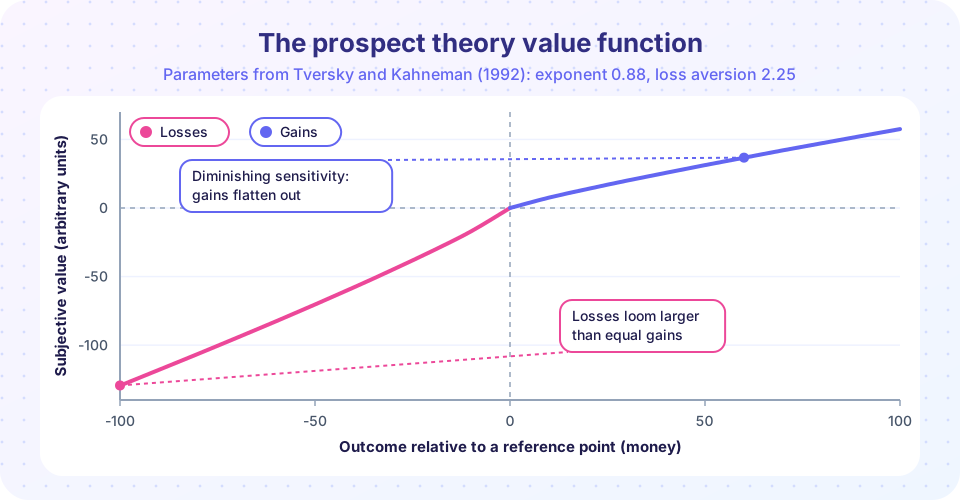
Kahneman and Tversky (1979) proposed prospect theory as a descriptive account with four key features.
- Reference dependence. People evaluate outcomes as gains and losses relative to a reference point (often the status quo), not as final wealth.
- Diminishing sensitivity. The difference between 0 and 100 matters more than between 1,000 and 1,100, for gains and for losses.
- Loss aversion. The value curve is steeper for losses than for gains. In Tversky and Kahneman's (1992) estimates, a loss counts about 2.25 times as much as an equal gain, though estimates vary across studies and contexts.
- Probability weighting. Small probabilities are overweighted and moderate to large probabilities are underweighted, which helps to explain both lottery tickets and insurance and the certainty effect.
These produce a fourfold pattern: risk aversion for likely gains (take the sure thing), risk seeking for likely losses (gamble to avoid a sure loss), risk seeking for unlikely gains (lotteries), and risk aversion for unlikely losses (insurance).
Framing
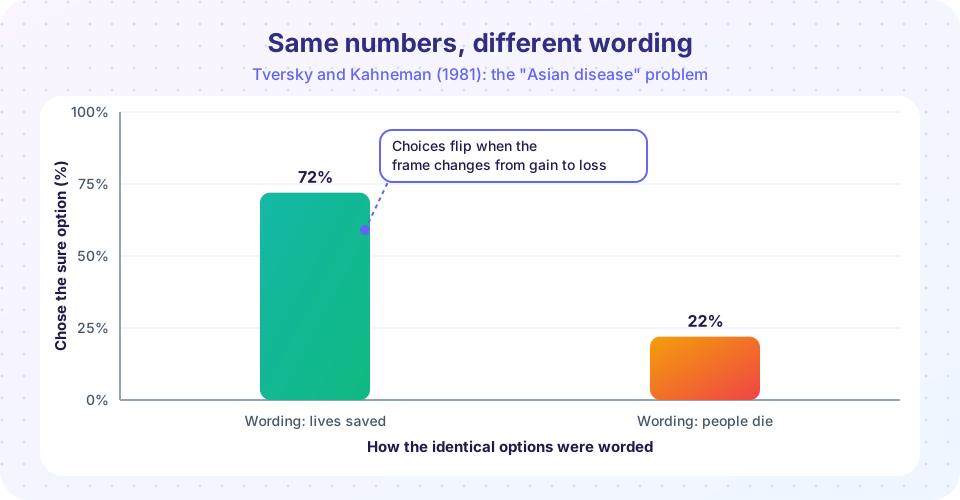
In the Asian disease problem (Tversky and Kahneman, 1981), people imagined that a disease would kill 600 people and chose between programs. In one version: Program A saves 200 people for sure, and Program B has a one-third chance of saving all 600 and a two-thirds chance of saving none. About 72 percent chose A. In the other version: Program C means 400 people will die for sure, and Program D has a one-third chance that nobody dies and two-thirds that all 600 die. About 22 percent chose C. The options are the same, but the wording as lives saved (gains) or lives lost (losses) flips the preference, as prospect theory predicts. Framing effects are reliable in many settings, though their size depends on the wording and on the participants.
Reference points in everyday life
- Endowment effect. Kahneman, Knetsch and Thaler (1990) gave some students a coffee mug and asked what they would sell it for; others were asked what they would pay for it. Owners asked for about twice as much as buyers offered. Having an item shifts the reference point, so giving it up feels like a loss. The effect is smaller for items held for exchange and for experienced traders.
- Status quo bias and defaults. People tend to stick with the default. Johnson and Goldstein (2003) reported that countries where organ donation is the default (people must opt out) have much higher rates of effective consent than countries where people must opt in; they compared rates of about 12 percent in one opt-in country with nearly 100 percent in one opt-out country. Many things differ between countries, so this is suggestive, not a clean experiment, but follow-up studies find that defaults have strong effects on choices such as pension enrollment.
- Sunk costs. Continuing a project because of what has already been spent, though only future costs and benefits should matter.
- Mental accounting (Richard Thaler): people treat money as if it were in separate accounts, so a windfall is spent more freely than earned income.
Nudges and cautions
Richard Thaler and Cass Sunstein (2008) coined nudge for a change in the way choices are presented, such as default enrollment in a savings plan, that steers people without banning options or changing incentives. Used with transparency, nudges can help; critics raise concerns about autonomy and note that effects measured in large studies are sometimes smaller than in early ones.
The field has also seen debates. Not every finding has replicated well. Some "priming" results associated with the same program failed to replicate, and researchers still disagree about how consistent and large loss aversion is across contexts. Prospect theory remains one of the most influential descriptive models and organizes a great deal of evidence, but it is a model, and its details are still being tested. Kahneman won the 2002 Nobel Memorial Prize in economic sciences for this work.
Common misconceptions
"Prospect theory says people are irrational." It describes systematic patterns in how people value outcomes; whether they are "irrational" depends on the standard.
"Loss aversion means people never take risks." It means that losses weigh more than gains; people are risk seeking in some situations, such as when facing a likely loss.
"Nudges always work." Effects vary and depend on context.
Try it
Press Run (or Ctrl + Enter) to see the result here.
Program input · what you'd type while the program runs
Type the answers before you press Run, one per line. Each time the program reads a line (with input()), it gets the next line from this box.
Press Run (or Ctrl + Enter) to see the console output here.
No output.
Check your understanding
Quick check · 5 questions
of 5 answered You scored / 5 · perfect!
-
1. The Allais paradox shows that many people's choices
Choosing A over B but D over C is inconsistent with any expected utility maximizer. -
2. Which is NOT a feature of prospect theory?
Prospect theory evaluates outcomes as gains and losses relative to a reference point, not as final wealth. -
3. In the Asian disease problem, preference for the sure option was higher when the outcomes were described as
About 72% chose the sure option in the lives-saved frame, and 22% in the deaths frame. -
4. The endowment effect is the tendency to
Owners asked for about twice as much as buyers offered in the mug studies. -
5. A nudge is
Defaults are the best-known example.
Summary
- Expected utility theory is a normative standard, and the Allais paradox shows that people violate it.
- Prospect theory describes reference dependence, diminishing sensitivity, loss aversion and probability weighting, giving a fourfold pattern.
- Framing, the endowment effect, defaults and sunk costs reflect reference points and loss aversion; nudges use them.
- Prospect theory is influential but a model, and some effects vary across contexts and studies.
Next: Chapter 7 Review: Reasoning, Judgment and Decision Making
Track your progress
Create a free account to tick off lessons and pick up where you left off on any device.
of Cognitive Psychology lessons completed