


















Lesson 32 of 50 · Knowledge and Language
Producing Language and Thinking in It
Learn how speech is planned: Levelt's model, speech errors, tip-of-the-tongue states; then examine whether language shapes thought through color terms and spatial language.
Speaking looks easy, yet it demands a rapid chain of decisions: what to say, which words, in what order, with which sounds, and which muscles. A fluent speaker produces two to three words a second from a vocabulary of tens of thousands, and makes an error only about once in a thousand words. The errors that do happen are precious data: they are not random, so they reveal the stages of planning. The second half of this lesson turns to a bigger question: if language is so central, does the language you speak shape how you think?
What you will learn
- The stages of speech production in Levelt's model.
- What speech errors, lexical bias and tip-of-the-tongue states reveal.
- The main positions on how language is acquired, in brief.
- What the linguistic relativity hypothesis claims and what the best evidence shows.
Key terms
Lemma: the abstract word entry that carries meaning and grammar, before its sounds are chosen.
Speech error: an unintended slip, such as a sound exchange.
Spoonerism: an exchange of initial sounds between words, such as "a lack of pies" for "a pack of lies".
Linguistic relativity: the idea that the structure of a language can influence thought.
Categorical perception of color: faster discrimination of colors that fall in different named categories.
Planning speech
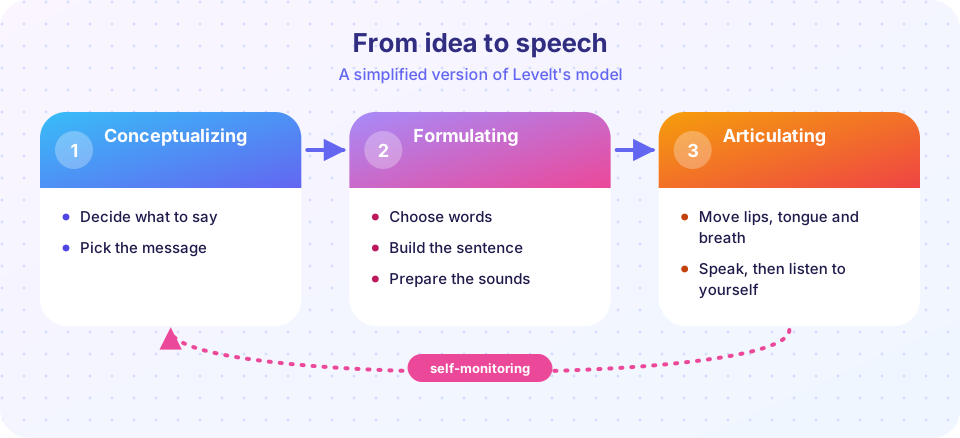
Willem Levelt (1989) described speech production in three broad steps.
- Conceptualizing. Decide what to say and prepare a preverbal message, taking into account the listener.
- Formulating. Select words and arrange them grammatically, then retrieve each word's sounds. Word retrieval is usually described in two steps: first the lemma (meaning and grammar), then the word form (the sounds). This is consistent with the tip-of-the-tongue state, in which you know the meaning and perhaps the first letter or the number of syllables, but cannot retrieve the sounds.
- Articulating. Plan and execute the movements of lips, tongue, jaw and breath.
Speakers also monitor their speech by listening to themselves and sometimes catch an error even before it is spoken. Planning runs ahead of speaking: people plan a phrase or so in advance, and the planning scope depends on difficulty and time pressure.
What speech errors tell us
Victoria Fromkin and others collected thousands of slips of the tongue. They fall into a small number of types:
- Exchanges: "a lack of pies" for "a pack of lies".
- Anticipations: "a reading list" said as "a leading list".
- Perseverations: "pulled a pantrum" for "pulled a tantrum".
- Blends: "splinkle" from "sprinkle" and "splash".
The errors respect structure. Sounds exchange with sounds of the same kind (consonant with consonant, initial with initial), words exchange with words of the same grammatical category, and the slipped words are adjusted to their new place in the sentence (for example, a plural ending stays in its slot while the word it belongs to moves). This shows that sentence frames and sounds are assembled separately. Gary Dell's interactive activation model explains the lexical bias: slips tend to create real words more often than nonwords (Baars, Motley and MacKay, 1975), because activation from the word level feeds back to the sounds. Errors are more frequent under time pressure, fatigue and anxiety.
Language acquisition in brief
Children go from babbling to sentences within about three years. Nativist theories, from Noam Chomsky, argue that humans have innate knowledge of the abstract structure of language and that the input a child hears is too limited to explain the rapid learning (the "poverty of the stimulus" argument). Usage-based theories, such as those of Michael Tomasello, argue that children learn from the input by general learning and social cognition, building from specific constructions to abstract patterns. Evidence includes children's attention to statistical patterns in speech: eight-month-old infants can learn the word boundaries of an artificial language after a few minutes of listening (Saffran, Aslin and Newport, 1996). The debate continues. Research also points to a sensitive period: people who learn a first or second language later in life tend to reach lower final proficiency in grammar and accent, but the age and nature of the cutoff are debated.
Does language shape thought?
The linguistic relativity hypothesis, associated with Edward Sapir and Benjamin Lee Whorf, states that the language we speak influences how we perceive and think. Two versions need to be separated:
- Linguistic determinism (strong): language determines thought, so that speakers cannot think what their language does not express. This is not supported. People can learn and think about concepts their language has no single word for, and infants and animals think without language.
- Linguistic influence (weak): language nudges attention, memory and processing. Evidence for this is real but modest.
Color. Brent Berlin and Paul Kay (1969) argued that languages divide color space in a constrained, universal order of basic terms. Within that framework, language still has effects. Winawer and colleagues (2007) found that Russian speakers, whose language has separate basic terms for light blue (goluboy) and dark blue (siniy), were faster at discriminating two blues that fell on different sides of that boundary than two on the same side. English speakers showed no such pattern. Crucially, the Russian advantage disappeared when the speakers performed a verbal interference task, but not when they performed a spatial one, indicating that language was helping online, not merely changing perception forever.
Space. Stephen Levinson and others have studied communities whose languages use absolute directions (north, south, east, west) instead of left and right. Their speakers tend to keep track of cardinal directions in everyday life and in nonverbal tasks, such as arranging cards, whereas speakers of languages with relative terms usually arrange them left to right. Reviews describe the pattern as robust but also note that culture and environment are confounded with language.
Other domains. Languages differ in grammatical gender, number marking and how they describe events and time, and studies find small, context-dependent effects on attention and memory. A fair summary: language is a tool for thinking that makes certain distinctions easy to notice, to encode and to remember, but it does not imprison the mind.
Common misconceptions
"Eskimo languages have hundreds of words for snow, so their speakers see snow differently." The claim has been greatly exaggerated; and in any case, specialized vocabulary reflects expertise, as with skiers or weather forecasters.
"If a language has no word for something, its speakers cannot think about it." The strong version of Whorf's claim is rejected.
"Speech errors show that the speaker's real feelings leak out." The typical cause is competition between similar items during planning.
Try it
Press Run (or Ctrl + Enter) to see the console output here.
No output.
Press Run (or Ctrl + Enter) to see the result here.
Program input · what you'd type while the program runs
Type the answers before you press Run, one per line. Each time the program reads a line (with input()), it gets the next line from this box.
Check your understanding
Quick check · 5 questions
of 5 answered You scored / 5 · perfect!
-
1. In Levelt's model, which stage comes first?
A message is prepared before words, sounds and movements are planned. -
2. Speech errors such as 'a lack of pies' show that
Slips respect categories such as consonant-for-consonant, indicating separate planning units. -
3. The tip-of-the-tongue state fits the idea that
People know meaning and some features but cannot yet retrieve the sounds. -
4. Winawer et al. (2007) found that Russian speakers' advantage in discriminating blues
This suggests that language was helping online during the task. -
5. Which version of the Sapir-Whorf hypothesis is best supported?
Evidence supports influence, not determinism.
Summary
- Speech production moves from message, to words and sounds, to articulation, with monitoring.
- Slips of the tongue follow rules and reveal separate planning stages, and lexical bias shows interaction between levels.
- Nativist and usage-based theories debate language acquisition; infants use statistical learning.
- Language influences thought modestly (color and space studies), but it does not determine it.
Track your progress
Create a free account to tick off lessons and pick up where you left off on any device.
of Cognitive Psychology lessons completed