


















Lesson 28 of 50 · Knowledge and Language
Chapter 6 Overview: Knowledge and Language
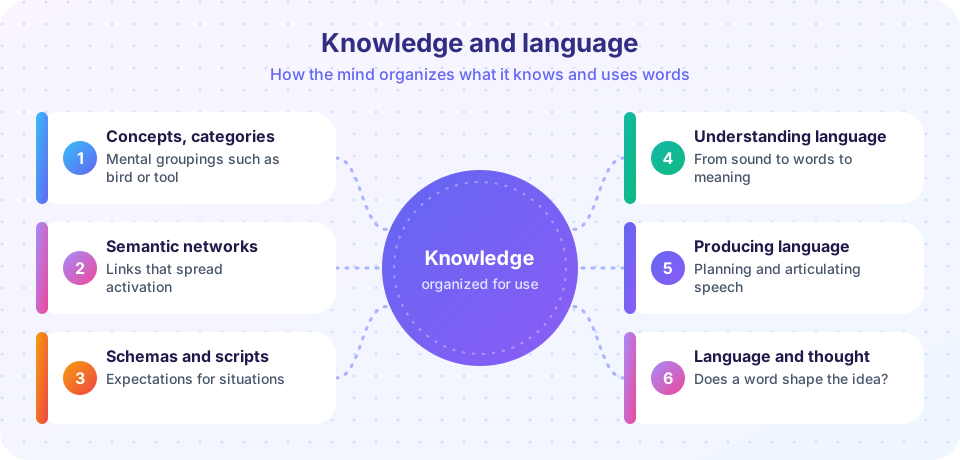
Preview the knowledge and language chapter: concepts and categories, semantic networks, schemas, understanding and producing language, and language and thought.
You know thousands of things: what a bird is, what happens in a restaurant, what the word "bank" can mean. You also use that knowledge at astonishing speed, as when you understand a sentence while it is still being spoken. This chapter asks how knowledge is organized in the mind and how language, the most complex use of that knowledge, is understood and produced. It also asks whether the language you speak shapes the way you think.
What you will learn
- The main ideas about concepts, networks and schemas, and why they matter.
- How the chapter's lessons build from knowledge to language.
- The core puzzle of language: fast, accurate understanding despite ambiguity.
- How knowledge connects to memory, perception and reasoning.
Key terms
Concept: a mental representation of a category, such as "bird".
Semantic memory: general knowledge about the world and word meanings.
Schema: an organized package of knowledge about a kind of situation or object.
Psycholinguistics: the study of how people understand, produce and learn language.
The big picture
Long-term memory (chapter 5) holds facts and meanings, but a list of facts is not knowledge. To think, we need structure: concepts that group things into categories, networks of links that let one idea call up related ones, and schemas that tell us what to expect in a situation. These structures let us go beyond the information given: if you are told that something is a bird, you infer that it probably has feathers and lays eggs, even if you have never seen that particular animal.
Language is where knowledge meets action. Understanding a sentence requires recognizing sounds, retrieving word meanings, working out the grammar and building a picture of what is being described, all within a fraction of a second per word. Producing a sentence runs the process in reverse. Both are astonishingly fast and mostly unconscious, and both rely on all of the structures above. The chapter ends with an old question: does language only express thought, or does it also shape it?
Knowledge needs structure
Concepts
Understanding speech
All four levels run at once.
Producing speech
Language and thought
Influence is real but modest.
What each lesson covers
| Lesson | Central question | Key names |
|---|---|---|
| Concepts and Categories | How do we decide what counts as a bird? | Rosch, Medin, Murphy |
| Semantic Networks and Schemas | How is knowledge linked and used? | Collins and Loftus, Bartlett, Schank and Abelson |
| Understanding Language | How do sounds become meaning? | Liberman, McGurk, Bever, Kutas |
| Producing Language and Thinking in It | How do we speak, and does language shape thought? | Levelt, Whorf, Winawer |
| Chapter Review | Can you connect it all? | all of the above |
How this chapter connects
Knowledge structures are the content of long-term memory from chapter 5, and schemas explain many of the reconstruction errors you met there. Perception (chapter 4) uses knowledge in top-down processing. In chapter 7 you will see that judgments depend on how categories and examples come to mind, and in chapter 8 that experts organize knowledge into richer structures than novices.
Try it
Press Run (or Ctrl + Enter) to see the console output here.
No output.
Check your understanding
Quick check · 4 questions
of 4 answered You scored / 4 · perfect!
-
1. A schema is best described as
Schemas organize expectations, such as what usually happens in a restaurant. -
2. Psycholinguistics studies
It is the cognitive science of language use. -
3. Which is NOT a main aim of this chapter?
This is a science of language, not a language course. -
4. Knowledge structures let us go beyond the information given, for example by
Knowing that something is a bird licenses predictions about it.
Summary
- Knowledge is organized into concepts, networks and schemas that let us predict and infer.
- Language understanding and production draw on all of these structures and run mostly automatically.
- The chapter moves from concepts, through networks and schemas, to language, and ends with language and thought.
Next: Concepts and Categories
Track your progress
Create a free account to tick off lessons and pick up where you left off on any device.
of Cognitive Psychology lessons completed