


















Lesson 16 of 50 · Attention
Chapter 3 Review: Attention
Review selective and divided attention, filter and capacity theories, visual search and inattentional blindness with a summary picture, recap table and ten-question quiz.
Attention is the mind's way of coping with a world that is richer than its capacity. In this chapter you saw it select (filters and load), share (dual tasks and bottlenecks), search (pop-out and conjunctions) and fail (inattentional and change blindness). This page gathers it into one picture and one table, then tests all four lessons.
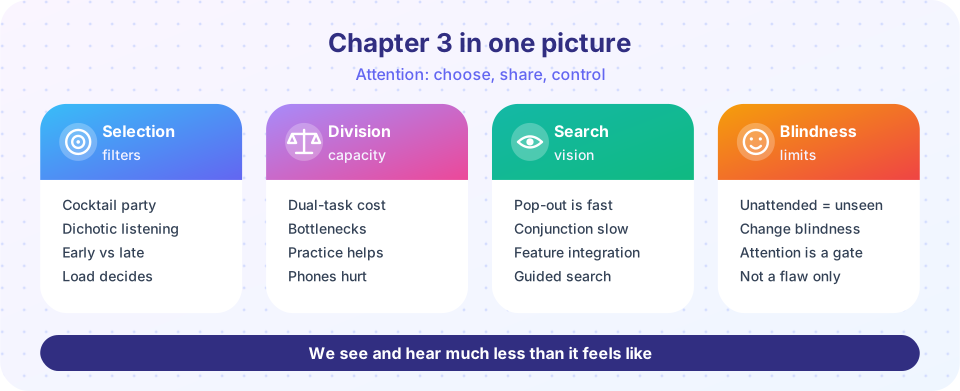
What you will review
- Selective attention theories and the Stroop effect.
- Dual-task costs, bottlenecks and switching.
- Feature and conjunction search, and what attention does for binding.
- Inattentional blindness, change blindness and the attentional blink.
Recap table
| Topic | Key findings | Names |
|---|---|---|
| Dichotic listening | Physical features of the ignored message noticed, meaning mostly not; own name can break through | Cherry 1953; Moray 1959 |
| Early filter | Block unattended input by physical features | Broadbent 1958 |
| Attenuation | Turn down, not off; words have thresholds | Treisman 1964 |
| Late selection | Everything analyzed for meaning; selection after | Deutsch and Deutsch 1963 |
| Load theory | High perceptual load: distractors not processed; high cognitive load: more interference | Lavie 1995 |
| Spotlight, Stroop | Selection by space; automatic reading interferes with naming ink | Posner 1980; Stroop 1935 |
| Dual-task theories | Shared effort, central bottleneck, multiple resources | Kahneman 1973; Pashler 1994; Wickens 2002 |
| Practice and switching | Practice can remove costs; switching has costs | Spelke, Hirst, Neisser 1976; Rogers and Monsell 1995 |
| Visual search | Feature = flat slope; conjunction = steep; guided search; low prevalence misses | Treisman and Gelade 1980; Wolfe |
| Blindness | Unexpected objects missed when attention is elsewhere | Neisser and Becklen 1975; Simons and Chabris 1999; Rensink 1997 |
Try it
Press Run (or Ctrl + Enter) to see the console output here.
No output.
Check your understanding
Quick check · 10 questions
of 10 answered You scored / 10 · perfect!
-
1. Moray (1959) found that listeners sometimes notice their own name in the unattended ear. This is a problem for
If meaning were never analyzed in the unattended channel, your name could not break through. -
2. Load theory predicts that distractors are processed less when
High perceptual load uses up capacity, leaving none for distractors. -
3. The Stroop effect arises because
An automatic process conflicts with the intended one and needs control to suppress. -
4. The central bottleneck account of the PRP effect says that
Perceptual and motor stages can overlap, but the central selection stage is serial. -
5. Which is the best summary of research on talking on a phone while driving?
Simulator studies find similar impairment from both, as the problem is mental. -
6. In feature integration theory, attention is needed to
Features are registered in parallel, but binding them requires attention. -
7. The low-prevalence effect is relevant to
When targets are rare, they are missed more, which affects screening tasks. -
8. Which finding best shows inattentional blindness?
A visible unexpected event is missed because attention is engaged elsewhere. -
9. A switch cost is
Changing the task set takes time and the old set interferes. -
10. The attentional blink shows a limit in
Processing a first target occupies a resource for a few hundred milliseconds.
Summary
- Selection, division, search and blindness are four faces of one limited system.
- Early, attenuated and late filters, with load theory, show selection depends on the task.
- Bottlenecks and resources explain dual-task costs; practice and switching change them.
- We see much less than it seems, and unexpected things can go unseen when attention is elsewhere.
Next: Chapter 4 Overview: Perception and Pattern Recognition
Track your progress
Create a free account to tick off lessons and pick up where you left off on any device.
of Cognitive Psychology lessons completed