


















Lesson 18 of 50 · Perception and Pattern Recognition
Bottom-Up and Top-Down Processing
Compare Gibson's data-driven view with Helmholtz's inference, see how context and expectations shape what we perceive, and test a Bayesian toy model of context.
Read this sentence: "I cdn'uolt blveiee taht I cluod aulaclty uesdnatnrd waht I was rdnaieg." Many people can read it with little trouble, though most of the letters are shuffled. Your visual system did not just measure the shapes on the page; it combined what was there with what it knew about words, grammar and meaning. This lesson is about the two directions of influence in perception, and how psychologists have argued about their relative importance.
What you will learn
- The difference between bottom-up and top-down processing.
- Gibson's direct perception and Helmholtz's unconscious inference.
- Evidence for top-down effects: the word superiority effect, scene context and ambiguity.
- How Bayesian and predictive views unite the two.
Key terms
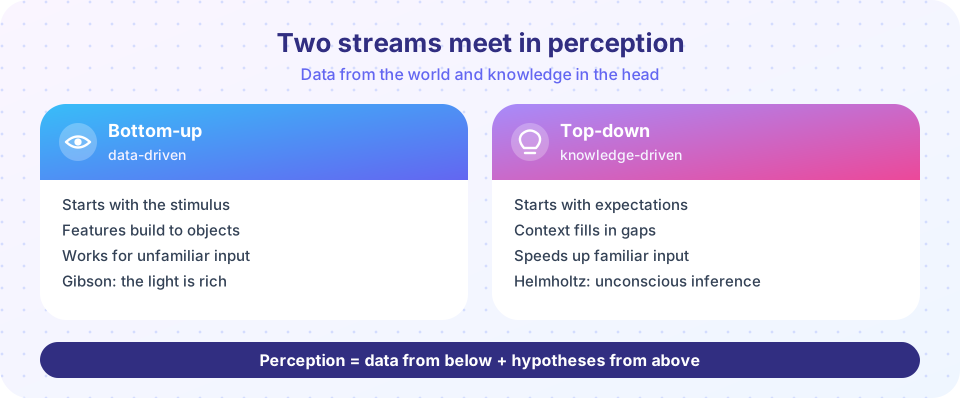
Bottom-up (data-driven) processing: processing that starts from the sensory input and builds upward.
Top-down (knowledge-driven) processing: processing guided by expectations, context and knowledge.
Perceptual set: a readiness to perceive in a certain way because of expectations or goals.
Affordance: in Gibson's theory, an opportunity for action that an object offers.
Unconscious inference: Helmholtz's idea that perception draws conclusions from sensory data using past experience.
Two traditions
Gibson: the stimulus is rich
James J. Gibson (1950, 1979) argued that the light reaching the eyes contains abundant structure, so perception can be direct, without heavy inference. As you move, the surrounding image streams outward in a pattern called optic flow; this pattern specifies your speed and heading directly. A surface texture gradient (texture getting finer with distance) specifies depth. For Gibson, we perceive affordances: a chair affords sitting, a handle affords grasping. Perception serves action, and the right question is "what information is available?" not "what inference is needed?" Gibson's insights are especially strong for movement through the world.
Helmholtz and Gregory: perception as inference
Hermann von Helmholtz (1860s) argued that the retinal image is ambiguous, so the brain must infer what caused it, using knowledge acquired from experience, an unconscious inference. Richard Gregory (1970s) extended this idea, describing perceptions as hypotheses about the world. Evidence for this includes:
- Ambiguous figures that can be seen in two ways (such as the Necker cube), where perception flips without any change in the image.
- Illusions. In the hollow-face illusion, a concave mask of a face looks like a normal convex face, because the brain's expectation that faces bulge outward overrides depth cues.
- Context effects, described below.
Marr: building up
David Marr (1982) gave the most detailed bottom-up theory, describing steps from the image to a 3D model: first a primal sketch of edges and blobs, then a 2.5-D sketch describing surfaces and depth from the viewer's perspective, then an object-centered 3-D model. This was a major influence on computer vision, and showed how much can be computed from the image alone.
Evidence for top-down influence
The word superiority effect. Gerald Reicher (1969) and Daniel Wheeler (1970) showed that a letter is identified more accurately when it is part of a real word than when it appears alone or in a random string. Participants briefly saw either WORD or OWRD, followed by a mask and a choice between two letters (for example D or K) for a position. The result was better for the word, even though the word gives no direct information about which of the two letters appears there (both WORD and WORK are words). This implies that knowledge of words feeds back to the level of letter identification. In 1981, James McClelland and David Rumelhart built an interactive activation model to explain it, with layers of feature, letter and word units that excite each other in both directions.
Scene context. Stephen Palmer (1975) showed a kitchen scene briefly, then a drawing of an object. People were better at naming a loaf of bread than a mailbox in that context. Irving Biederman and colleagues found that objects in an unexpected place or size are recognized less accurately. Context reduces the number of possibilities.
Ambiguity and set. Jerome Bruner and Alvin Minturn (1955) showed that the same ambiguous symbol was seen as the letter B when it appeared in a sequence of letters and as the number 13 when it appeared among numbers. Expectation (perceptual set) resolves ambiguity.
Brain evidence. The visual system has many feedback connections from higher to lower areas, at least as many as feedforward ones. Studies show that expectations can change responses in early visual areas, though how far knowledge changes what we see, as opposed to what we judge or remember, remains debated.
Does expectation really change perception?
A careful skeptic would ask: is it the percept that changes, or only our guess about it afterward? Experiments in the last decades try to separate perception from decision, by using methods in which responses are not influenced by guessing. Some find real effects of expectations on how things look (for example, on contrast), others find that the effects can be attributed to decision. The question is genuinely open.
Putting both together: perception as inference
A modern, mathematical way of combining the traditions is the Bayesian view from the last chapter. The brain combines the likelihood (how well the sensory data fit each possible interpretation) with the prior (how probable each interpretation is beforehand). When the data are clear, the posterior is dominated by the data; when the data are noisy or ambiguous, priors matter more. This explains why context helps most when the input is degraded: reading someone's handwriting, hearing speech in noise, spotting a face in fog.
A related proposal, predictive processing, says the brain constantly generates predictions about the input and uses mismatches (prediction errors) to update its model. It is an influential, still-debated, framework.
Gibson and Helmholtz are best seen as emphasizing different parts of the story: the richness of the information available (Gibson), and the need to interpret it (Helmholtz).
Common misconceptions
"Top-down means imagination and bottom-up means reality." Both are parts of how perception normally works. Top-down processing is usually accurate because our expectations are usually correct.
"Perception is only inference, so it is unreliable." Because expectations reflect real regularities, perception is mostly very reliable. Illusions occur when a regularity is violated.
"Gibson and Helmholtz were enemies; one must be right." Modern accounts take ideas from both.
Try it
Press Run (or Ctrl + Enter) to see the result here.
Program input · what you'd type while the program runs
Type the answers before you press Run, one per line. Each time the program reads a line (with input()), it gets the next line from this box.
Check your understanding
Quick check · 5 questions
of 5 answered You scored / 5 · perfect!
-
1. Gibson's view of perception emphasized that
Gibson argued that optic flow, texture gradients and other structure specify the world directly. -
2. The word superiority effect shows that
Knowledge of words influences letter identification, a top-down effect. -
3. In the hollow-face illusion, a concave mask looks convex because
A strong prior about faces dominates the conflicting depth information. -
4. In the Bayesian view, context helps most when
When the data leave uncertainty, priors have more influence on the posterior. -
5. Which pairing is correct?
Helmholtz proposed unconscious inference; Gregory extended it as hypothesis; Gibson stressed affordances and direct information.
Summary
- Bottom-up processing builds from the stimulus; top-down processing is guided by knowledge and expectation.
- Gibson stressed information in the stimulus and affordances; Helmholtz and Gregory stressed inference.
- Context effects (word superiority, scene context, perceptual set) show top-down influence.
- Bayesian and predictive views unite them: priors matter most when data are ambiguous.
- Whether expectations change perception itself or only judgment is still debated.
Track your progress
Create a free account to tick off lessons and pick up where you left off on any device.
of Cognitive Psychology lessons completed