


















Lesson 5 of 50 · Getting Started
Chapter 1 Review: Getting Started
Review the foundations of cognitive psychology: definition, inference, history and the information-processing approach, with a recap table and a ten-question quiz.
You have now covered the foundations: what cognitive psychology is, how it grew from Wundt's laboratory through behaviorism to the cognitive revolution, and how the information-processing approach frames the mind. This review pulls the chapter together in one picture and one table, then tests you on all of it.
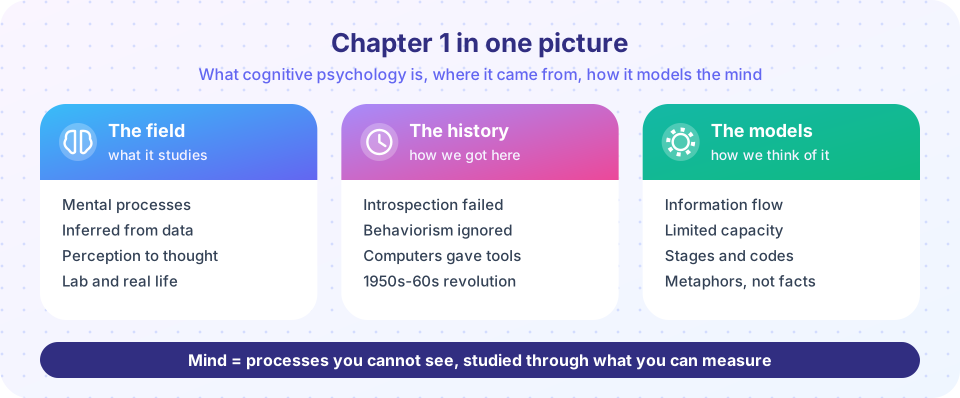
What you will review
- The definition of cognition and why processes are inferred.
- The main steps in the history of the field.
- The information-processing approach and the limits of its metaphors.
Recap table
| Idea | Key points | Names and dates |
|---|---|---|
| Cognitive psychology | Studies perception, attention, memory, language, reasoning and problem solving through behavior and brain data | Neisser's textbook, 1967 |
| Inference | Processes are not seen; theories must make risky, testable predictions | Marr's three levels |
| Early methods | Introspection was private; memory could be measured with numbers | Wundt 1879; Ebbinghaus 1885 |
| Behaviorism | Demanded observable evidence; discouraged mental talk | Watson 1913; Skinner |
| Mind returns | Schemas and cognitive maps; human factors; information theory; computers | Bartlett 1932; Tolman 1948; Broadbent 1958 |
| Turning point | Chunks, symbol-processing programs, a critique of behaviorist language theory | Miller, Newell and Simon 1956; Chomsky 1959 |
| Information processing | Representations, stages, limited capacity, serial vs parallel, top-down and bottom-up | Atkinson and Shiffrin 1968; Donders 1868 |
| Metaphors | Computer metaphor is useful but limited; alternatives exist | Connectionism 1986 |
Try it
Press Run (or Ctrl + Enter) to see the console output here.
No output.
Check your understanding
Quick check · 9 questions
of 9 answered You scored / 9 · perfect!
-
1. Cognitive psychology mainly studies
It studies perception, attention, memory, language, reasoning and similar processes using observable evidence. -
2. A reaction time of 480 ms recorded by a computer is
Measurements by instruments are observed; the processes proposed to explain them are inferred. -
3. In Marr's scheme, a description of neurons that respond to disparity is at the
Implementation concerns how a process is physically realized. -
4. Wundt's lab opened in
Wundt opened his Leipzig laboratory in 1879. -
5. Which finding supported the idea that memory is reconstructive?
Retellings shifted toward participants' own schemas, showing memory is rebuilt. -
6. Which event is most closely tied to 1956?
Several landmark contributions, including Miller's paper and the Newell and Simon program, appeared in 1956. Chomsky's review is 1959, the textbook 1967 and PDP 1986. -
7. If a flat search-time function appears, the safest conclusion is
Different designs can mimic each other, so more experiments are needed. -
8. Which is a limit of the computer metaphor?
Memory is rebuilt and is affected by context and emotion; a stored computer file is not. -
9. Behaviorism's lasting contribution included
Its methods and learning principles remain widely used.
Summary
- Cognition is studied by observing behavior and brain activity and inferring hidden processes.
- The field's history runs from introspection to behaviorism to the information-processing revolution.
- Models are tools for generating testable predictions, and metaphors must be used carefully.
Track your progress
Create a free account to tick off lessons and pick up where you left off on any device.
of Cognitive Psychology lessons completed