


















Lesson 2 of 50 · Getting Started
What Is Cognitive Psychology?
Learn what cognitive psychology studies, why mental processes must be inferred from behavior, and how the field relates to neuroscience, AI and everyday life.
Imagine watching a stranger read a menu. You can see their eyes move and, a moment later, hear their order. You cannot see the recognition of words, the retrieval of what "gluten-free" means, or the weighing of pasta against soup. All of that happens inside the head. Cognitive psychology is the scientific study of those hidden mental processes: how people perceive, attend, remember, understand language, reason, decide and solve problems.
The word cognition comes from the Latin cognoscere, "to get to know". It covers everything the mind does to acquire and use knowledge. In this lesson you will meet the field's basic idea, its main questions, and the central challenge: you can only study a mind from the outside.
What you will learn
- A clear definition of cognition and cognitive psychology.
- Why mental processes are inferred rather than observed.
- The main topics the field covers, and how they connect.
- How cognitive psychology relates to neighboring sciences.
- Where it is used outside the laboratory.
Key terms
Cognition: the mental activities involved in acquiring, storing, transforming and using knowledge.
Mental process: a step the mind carries out on information, such as recognizing a word or retrieving a memory.
Representation: a stand-in inside the mind for something in the world (an image, a word meaning, a rule).
Inference: a conclusion about something unseen, drawn from evidence you can observe.
Behavior: anything a person does that can be measured, such as an answer, a key press or an eye movement.
The central idea: processes you cannot see
Think of a vending machine. You press B4, and a snack drops. You see the input and the output, but not the mechanism. You might guess that the machine contains a motor, a grid of slots and a coin checker. If you press an unlisted button and nothing happens, you learn something more about the logic inside. Cognitive psychologists work like detectives with a very complicated vending machine: they give the mind carefully chosen inputs, measure outputs, and reason about what internal arrangement could produce that pattern.
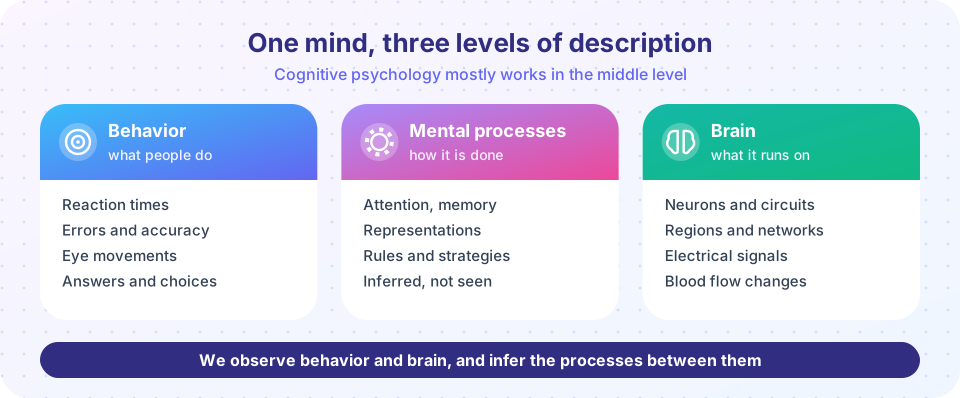
Two kinds of observable evidence are used:
- Behavior. How fast and how accurately people respond; what they remember and forget; where their eyes go; what they choose.
- Brain activity. Electrical signals, blood-flow changes and the effects of brain damage or stimulation. You will study these in Chapter 2.
Everything in between, such as attention filtering, memory search and mental imagery, is inferred. That does not make it unscientific. Physicists also infer things they cannot see directly, such as electrons. What makes inference scientific is that theories must make testable predictions that can turn out wrong.
A worked example: reading a word
In a lexical decision task a person sees a string of letters and presses one key if it is a real word (TABLE) and another if it is not (TABEL). Suppose the average response is faster for common words (HOUSE) than for rare words (HAMLET) when you match for length. What can you infer?
- The speed difference is a fact about behavior.
- A reasonable inference is that mental word entries are not all equally easy to reach: frequent words are accessed faster, as if their entries were "closer to the surface".
- That inference is not yet proven. A rival explanation says rare words are simply less familiar to the visual system. The next experiment is designed to tell them apart.
This pattern, observe, infer, test the inference, runs through the whole course.
The main topics
Cognitive psychology is not one question but a family of related ones:
| Topic | Core question | Chapter |
|---|---|---|
| Attention | How does the mind select what to process? | 3 |
| Perception | How do signals become objects, faces and words? | 4 |
| Memory | How is information held, stored and retrieved? | 5 |
| Knowledge and language | How are meanings organized and communicated? | 6 |
| Reasoning and decisions | How do we draw conclusions and choose? | 7 |
| Problem solving | How do we reach goals in new situations? | 8 |
They are linked. You cannot remember what you never attended to, and you cannot solve a problem you misperceived.
Levels of explanation
The neuroscientist David Marr (1945-1980) proposed that an information-processing system can be explained at three levels:
- Computational level: what problem is being solved, and why? (For example: "judge the distance of an object from the eyes.")
- Algorithmic level: what steps and representations are used? (For example: "compare the two eyes' images and measure the offset.")
- Implementation level: how are the steps physically realized? (For example: "neurons in the visual cortex that respond to disparity.")
A complete explanation of any ability ideally speaks at all three levels. Cognitive psychology concentrates on the middle level, with strong links to the others.
Neighbors and relatives
- Cognitive neuroscience asks where and how mental processes are carried out in the brain (Chapter 2 introduces the methods).
- Cognitive science is the broader, interdisciplinary project that also includes linguistics, philosophy, computer science and anthropology.
- Artificial intelligence builds systems that perform tasks associated with cognition. Ideas travel both ways: models of human memory have inspired computer designs, and computer metaphors have inspired theories of the mind. AI systems may reach the right answer by very different routes than human minds, so success in a task does not by itself show that a program is thinking like a person.
- Social and developmental psychology study how cognition works among people and across the lifespan.
Cognitive psychology in everyday life
- Education: spaced practice and retrieval practice improve learning, and they come from memory research.
- Design and safety: knowing the limits of attention shapes dashboards, warning signs and road rules.
- Law: research on memory errors informs how witnesses are interviewed and how identification lineups are run.
- Health: assessment and rehabilitation after brain injury build on cognitive models.
- Technology: user interfaces work better when they respect working memory limits.
Common misconceptions
"Mental processes are just the brain, so psychology will be replaced by neuroscience." Brain data and cognitive theories answer different questions. Knowing that a region becomes active does not tell you what computation is being done. Most researchers see the fields as partners.
"If it cannot be seen, it cannot be studied." Inference from careful measurement is normal science. The test is whether a theory risks being wrong.
"Cognition means conscious thinking." Most cognitive processes, such as recognizing a face, are fast and unconscious.
Try it
Press Run (or Ctrl + Enter) to see the console output here.
No output.
Press Run (or Ctrl + Enter) to see the result here.
Program input · what you'd type while the program runs
Type the answers before you press Run, one per line. Each time the program reads a line (with input()), it gets the next line from this box.
Check your understanding
Quick check · 5 questions
of 5 answered You scored / 5 · perfect!
-
1. Why are mental processes described as inferred?
Processes such as retrieval or filtering cannot be seen directly; theories about them are tested against observable data. -
2. In Marr's levels, 'what steps and representations are used?' belongs to the
The algorithmic level specifies the procedures and representations; the computational level asks what and why; the implementation level asks how it is physically realized. -
3. Which of these is an observed measurement, not an inference?
A response time is recorded by an instrument. The other statements name processes that are inferred. -
4. Which statement about AI and cognitive psychology is most accurate?
Models and metaphors are shared, but a program can reach the same output by a different route. -
5. A theory in cognitive psychology is scientific mainly because it
Risky, testable predictions separate scientific theories from stories.
Summary
- Cognitive psychology studies how the mind acquires, stores, transforms and uses knowledge.
- Processes are inferred from behavior and brain data, and the inferences are tested.
- Marr's three levels (computational, algorithmic, implementation) show different kinds of explanation.
- The field connects to neuroscience, cognitive science, AI, education, law, health and design.
- Many cognitive processes are fast and unconscious.
Track your progress
Create a free account to tick off lessons and pick up where you left off on any device.
of Cognitive Psychology lessons completed