


















Lesson 40 of 50 · Problem Solving and Expertise
Chapter 8 Overview: Problem Solving and Expertise
Preview the chapter on problem solving: problem spaces, insight, analogy, expertise and deliberate practice, creativity and thinking well, with a roadmap of each lesson.
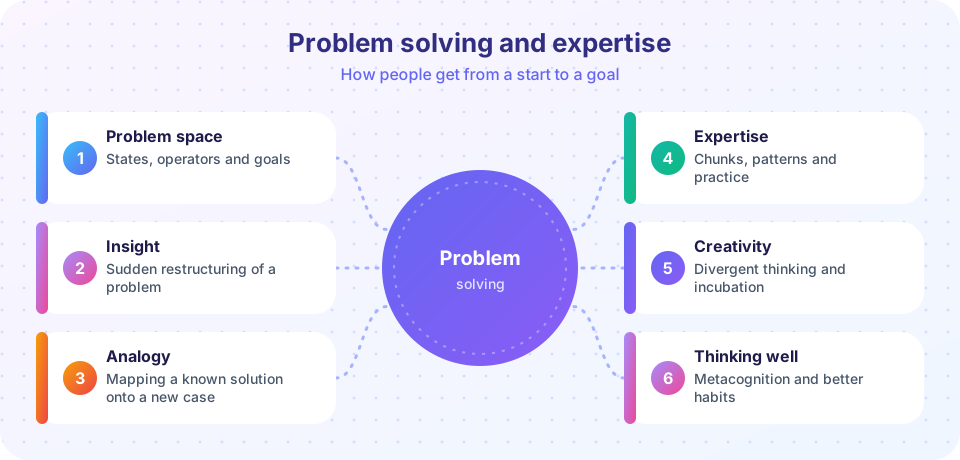
A problem exists when you have a goal and no obvious way to reach it: a proof, a broken engine, a blank page. Humans are unusually good at solving problems, especially new ones, and unusually varied in how well they do it. This chapter asks how people search for solutions, what happens when the answer arrives in a flash, how knowledge turns a beginner into an expert, and what the research says about creativity and about thinking better.
What you will learn
- What a problem space is and how search strategies work in it.
- How insight, analogy and knowledge change what a problem looks like.
- Why experts see differently, and what practice does.
- How the chapter's lessons connect to memory and reasoning.
Key terms
Problem space: the set of states, the operators that move between them, and the goal.
Heuristic search: using rules of thumb to choose promising moves.
Insight: a sudden new way of seeing a problem.
Expertise: consistently superior performance in a domain, built on knowledge and practice.
Metacognition: thinking about your own thinking.
The big picture
Allen Newell and Herbert Simon (1972) described problem solving as search through a problem space. Starting at an initial state, you apply operators (legal moves) to reach a goal state. Because the space is often enormous, solvers use heuristics, such as always reducing the difference between where you are and where you want to be (means-ends analysis). Gestalt psychologists, in contrast, stressed restructuring: some problems are solved not by searching harder but by seeing the problem differently. Both views are needed.
The chapter's second theme is knowledge. Experts do not search more cleverly in general; they know more, organize it better, and recognize patterns in a glance. That connects this chapter to long-term memory and chunking in chapter 5. The final theme is improvement: creativity techniques, practice methods and habits of reflection that help people solve problems better, along with the research on what works and what is hype.
Search in a problem space
Means-ends analysis closes the gap.
Insight
Analogy
Surface features distract.
Expertise
Thinking well
What each lesson covers
| Lesson | Central question | Key names |
|---|---|---|
| Problem-Solving Strategies | How do we search, and when do we suddenly see? | Newell and Simon, Köhler, Duncker, Gick and Holyoak |
| Expertise and Practice | What makes experts different? | de Groot, Chase and Simon, Ericsson |
| Creativity and Thinking Well | Can creative thinking and judgment be improved? | Guilford, Wallas, Diehl and Stroebe |
| Chapter Review | Can you connect it all? | all of the above |
How this chapter connects
Working memory (chapter 5) limits how many subgoals you can hold, and chunking is how experts get around it. Concepts and schemas (chapter 6) determine what a problem looks like to you. Heuristics and biases (chapter 7) reappear as fixation and overconfidence. And chapter 9 uses these ideas for a research project.
Try it
Press Run (or Ctrl + Enter) to see the console output here.
No output.
Check your understanding
Quick check · 4 questions
of 4 answered You scored / 4 · perfect!
-
1. In Newell and Simon's view, solving a problem is
A problem space has an initial state, operators and a goal. -
2. Means-ends analysis is a strategy of
It picks operators that reduce the gap and creates subgoals when needed. -
3. Insight problems are often solved by
The Gestalt view stresses a change of representation. -
4. Expertise depends mostly on
Experts recognize patterns because of structured knowledge.
Summary
- Problem solving can be described as heuristic search through a problem space, and also as restructuring the problem.
- Insight, analogy and knowledge change what a problem looks like.
- Expertise rests on organized knowledge and practice; creativity and reflection can be supported by good methods.
Track your progress
Create a free account to tick off lessons and pick up where you left off on any device.
of Cognitive Psychology lessons completed