


















Lesson 42 of 50 · Problem Solving and Expertise
Expertise and Practice
Learn what separates experts from novices: de Groot and Chase and Simon on chess, chunking, deep problem representation, the power law of practice, deliberate practice and its limits.
Watch a chess master glance at a game in progress and name a strong move in seconds, or a radiologist spot a shadow in a scan, or an experienced driver notice trouble before it happens. We call this expertise. It looks like superior intelligence, but cognitive psychology finds that it is mainly organized knowledge, built over thousands of hours of practice, and that it is far more specific than it looks. This lesson explains how experts differ and what kind of practice produces them.
What you will learn
- What de Groot and Chase and Simon found about chess masters.
- What chunking and pattern recognition explain, and what they do not.
- How experts represent problems differently from novices.
- What the power law of practice and deliberate practice say, and how much debate surrounds them.
Key terms
Expert: someone who consistently performs far above the average in a domain.
Chunk: a familiar pattern stored in memory that acts as a single unit.
Deliberate practice: effortful, focused practice on specific weaknesses, with feedback, often with a teacher.
Automaticity: performing a skill quickly, with little attention.
Power law of practice: performance time falls as a power function of the amount of practice.
What chess masters see
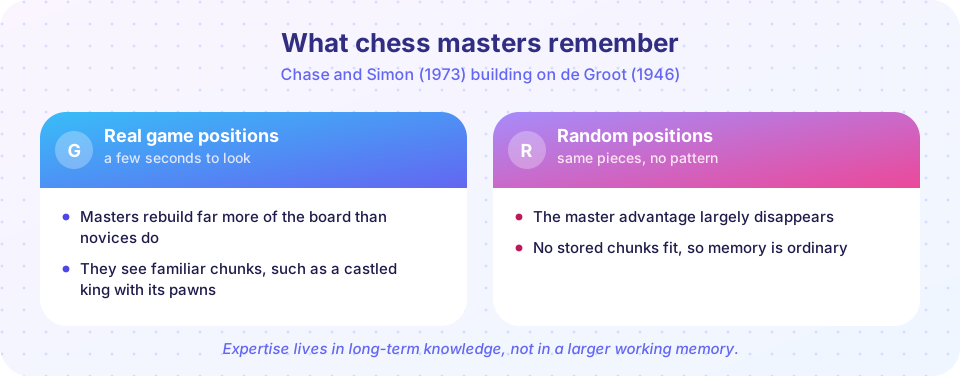
The Dutch psychologist Adriaan de Groot (1946) asked chess players of different strengths to think aloud while choosing a move. Masters did not examine many more moves or look much deeper than weaker players. They tended to find strong candidate moves immediately, apparently by recognizing the position. In a second set of studies, de Groot showed players a game position for a few seconds and asked them to reconstruct it. Masters recalled almost all the pieces, weaker players far fewer.
William Chase and Herbert Simon (1973) added the key control. The same masters were shown random arrangements of the same pieces. Their advantage largely disappeared: recall of random positions was poor for everyone. A bigger memory would help on both kinds of position, so the masters' advantage must lie in stored patterns: familiar configurations of several pieces, such as a castled king with its pawn shield, that can be recalled as single units. Subsequent studies found that masters retain a small advantage even for random positions, probably because some chunks appear by chance, and that the simple "7 chunks" interpretation underestimates how rich the patterns are. Simon and colleagues estimated that a master knows tens of thousands of chunks. Later models (Gobet and Simon's template theory) propose that chunks grow into larger templates with slots for variable information.
The same pattern appears in other fields: expert electronics technicians recall real circuits much better than scrambled ones, programmers recall meaningful code better than shuffled lines, and basketball and football players recall real game plays better than random arrangements. In each case, expert memory is not better in general; it is better for the domain, for meaningful material.
How experts represent problems
Michelene Chi, Paul Feltovich and Robert Glaser (1981) asked physics students at different levels to sort problems into groups. Novices grouped them by surface features (problems with inclined planes, problems with pulleys). Experts grouped them by underlying principles (conservation of energy, Newton's second law). Experts therefore see a problem as an instance of a known type, retrieve a relevant method and often work forward from the givens, whereas novices work backward from the goal by means-ends analysis and by guessing equations. Experts also spend more time on the initial analysis of a hard problem and monitor their own understanding more accurately.
Two caveats. First, expertise is domain-specific: a chess master has no better memory for everyday objects, and training in one skill rarely transfers to unrelated ones. Second, intuition is trustworthy only in some conditions. Kahneman and Klein (2009), after reviewing a long disagreement, concluded that skilled intuition requires a regular environment with learnable cues and many chances to get feedback. Firefighters and chess players fit this description; stock pickers and long-range political forecasters mostly do not.
Practice: the power law and the stages of skill
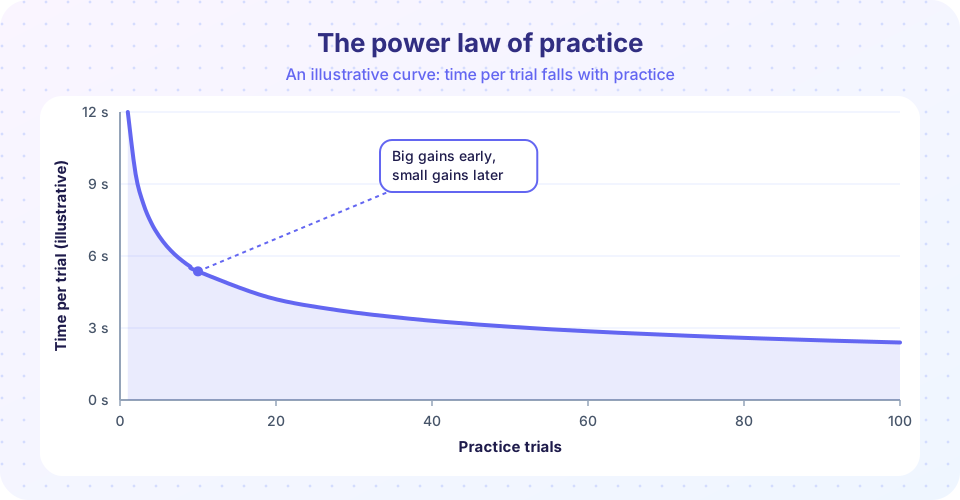
Skill learning follows a recognizable curve. Newell and Rosenbloom (1981) showed that across many tasks, the time to perform a task falls as a power function of the number of practice trials: big improvements at first, then ever smaller ones that continue for a long time. Paul Fitts and Michael Posner (1967) described three stages: a cognitive stage (understanding the task and making many errors), an associative stage (errors fade, steps link together) and an autonomous stage (fast, automatic, little attention). Automaticity is helpful but has a cost: the Stroop effect and slips of action show that automatic processes run even when we do not want them to.
Deliberate practice and its limits
Anders Ericsson, Ralf Krampe and Clemens Tesch-Römer (1993) studied violin students at a Berlin music academy and found that the best students had accumulated more hours of solitary, goal-directed practice by age 20, averaging around 10,000 hours, than students in less advanced groups. They proposed that expert performance is mainly the product of deliberate practice: tasks set slightly beyond your current ability, repeated with immediate feedback and focused attention, not just time spent playing. Chess grandmasters typically needed about a decade of intense study, the so-called ten-year rule (Simon and Chase, 1973).
The popular "10,000-hour rule" oversimplifies. The figure was an average in one study, not a threshold, and individuals differ widely in how many hours they needed. A meta-analysis by Macnamara, Hambrick and Oswald (2014) found that the amount of deliberate practice explained a substantial share of differences in performance in some domains (roughly a quarter in games, about a fifth in music and sport), but much less in education and almost none in professions, once other factors were considered. Ericsson and others challenged how practice was defined and measured in that analysis. The consensus view is that practice is necessary, with a large effect, but not the only factor: starting age, quality of teaching, opportunities, motivation, and possibly aptitudes such as working memory capacity and general ability also contribute.
Practical implications from the research: practice what you cannot yet do, get quick and specific feedback, vary conditions, space your practice (see chapter 5), and take breaks, since sustained deliberate practice is tiring and most people can do only a few hours a day.
Common misconceptions
"Experts have better memory or faster brains." Their advantage is domain-specific knowledge and patterns.
"Ten thousand hours guarantees mastery." It is not a rule, and the hours must be well structured.
"An expert's intuition is always right." It is reliable in regular environments with feedback, much less so elsewhere.
Try it
Press Run (or Ctrl + Enter) to see the console output here.
No output.
Press Run (or Ctrl + Enter) to see the result here.
Program input · what you'd type while the program runs
Type the answers before you press Run, one per line. Each time the program reads a line (with input()), it gets the next line from this box.
Check your understanding
Quick check · 5 questions
of 5 answered You scored / 5 · perfect!
-
1. Chase and Simon (1973) found that master chess players' memory advantage
This shows that expertise depends on stored meaningful patterns. -
2. In Chi, Feltovich and Glaser (1981), experts sorted physics problems by
Novices used surface features and experts used deep structure. -
3. The power law of practice says that performance time
Time falls as a power function of the number of trials. -
4. Which statement about deliberate practice is best supported?
Meta-analyses find large effects in some domains and smaller ones in others. -
5. According to Kahneman and Klein (2009), skilled intuition is trustworthy when the environment is
Without valid cues and feedback, confidence is not a guide to accuracy.
Summary
- Expertise is domain-specific, built from large numbers of meaningful chunks and templates that support pattern recognition.
- Experts represent problems by deep principles, novices by surface features.
- Skill learning follows a power law and passes through cognitive, associative and autonomous stages.
- Deliberate practice is important, but the "10,000 hours" rule is a simplification, and intuition is reliable only in regular, feedback-rich environments.
Track your progress
Create a free account to tick off lessons and pick up where you left off on any device.
of Cognitive Psychology lessons completed