


















Lesson 47 of 50 · Projects and Practice
Practice Set: Mixed Problems
Twelve mixed practice problems on memory, knowledge, language, judgment and problem solving, with worked answers, plus a self-testing routine based on retrieval and spacing.
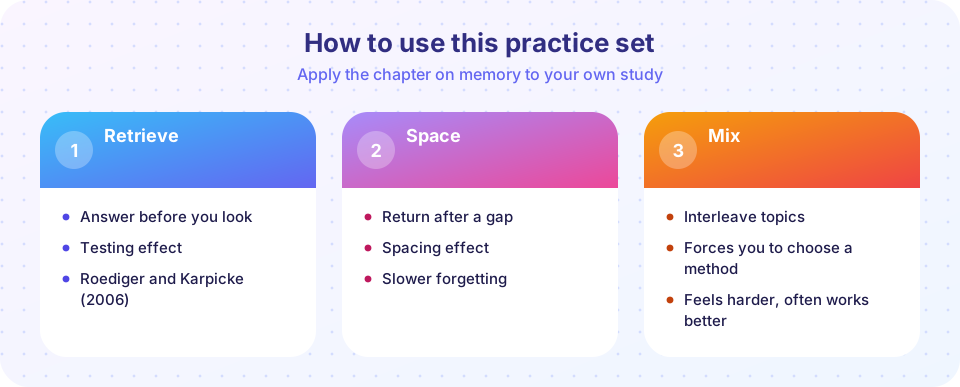
The best way to learn this material is not to reread it but to use it. The twelve problems below mix chapters 5 to 8 on purpose: mixing topics is called interleaving, and it forces you to decide which idea applies, which is the hard part of exams and of real thinking. Attempt each problem before reading its answer, even if you are unsure. Struggling to retrieve an answer is exactly what makes the learning last.
What you will learn
- How to apply memory, language, judgment and problem-solving ideas to new cases.
- How to compute a Bayesian answer from natural frequencies.
- How to use retrieval practice, spacing and interleaving in your own studying.
Key terms
Retrieval practice: recalling information from memory instead of rereading it.
Interleaving: mixing different topics or problem types in one study session.
Desirable difficulty: a learning condition that feels harder and produces better long-term results.
Feedback: information on whether your answer was right, which improves learning.
How to work through the set
- Cover the answers. Write or say your answer in a sentence or two.
- Check, then rate yourself honestly: right, partly right, wrong.
- Return to the problems you missed after one day, then three days, then a week. This spacing is built into the drill below.
- Explain the answers aloud to someone, or to an imaginary student.
The problems
1. Levels of processing. Group A decides whether each word on a list is printed in capital letters; group B decides whether each word is pleasant. Both later recall as many words as they can. Predict the result and name the framework.
Answer. Group B will recall more. The levels-of-processing framework (Craik and Lockhart, 1972) predicts that semantic processing produces stronger traces than structural processing.
2. The serial position curve. After hearing a list of 15 words, people recall them after 30 seconds of counting backward. Which part of the curve changes, and why?
Answer. The recency effect disappears, because the last items were held in short-term memory and the counting displaced them. The primacy effect remains, since early items entered long-term memory.
3. Which memory system? Classify: (a) knowing that Canberra is the capital of Australia, (b) remembering your tenth birthday party, (c) still knowing how to swim after many years, (d) reading a word faster because you saw it earlier.
Answer. (a) semantic, (b) episodic, (c) procedural, (d) priming. The first two are declarative; the last two are nondeclarative.
4. Bayes with natural frequencies. A condition affects 2 percent of a population. A test is positive for 90 percent of people with the condition and for 5 percent of people without it. A person tests positive. What is the chance they have the condition?
Answer. Imagine 1,000 people: 20 have the condition and 18 of them test positive; 980 do not, and 49 of them test positive. So 18 of 67 positives are real, about 27 percent.
5. A spam filter. Thirty percent of an inbox is spam. The word "winner" appears in 60 percent of spam and 5 percent of legitimate email. If a message contains "winner", what is the probability it is spam?
Answer. Out of 1,000 messages, 300 are spam and 180 contain the word; 700 are legitimate and 35 contain it. So 180 of 215, about 84 percent.
6. A Wason variant. Four envelopes lie on a desk: one sealed, one open, one with a 50-cent stamp, one with a 40-cent stamp. The rule: "If an envelope is sealed, it must have a 50-cent stamp." Which must you turn over?
Answer. The sealed envelope (it might have the wrong stamp) and the 40-cent envelope (it might be sealed). The open one and the 50-cent one cannot break the rule.
7. Prospect theory. Choose: (a) a sure gain of $500, or a 50 percent chance of $1,000; and (b) a sure loss of $500, or a 50 percent chance of losing $1,000. What pattern does prospect theory predict?
Answer. Risk aversion for gains (most prefer the sure $500) and risk seeking for losses (most prefer the gamble), because of diminishing sensitivity on both sides and the reference point at zero.
8. Designing an anchoring study. How would you test whether a random number affects estimates of the height of a tall building?
Answer. Randomly assign people to see a low or a high random number (for example from a wheel), then ask for an estimate. Compare the group means. Random assignment, an irrelevant anchor and the same question for everyone make the anchor the only difference.
9. Tower of Hanoi. How many moves does a 6-disk puzzle need at minimum, and why can hill climbing fail?
Answer. 2⁶ − 1 = 63. Hill climbing fails because some necessary moves temporarily take you farther from the goal state.
10. Chess memory. Explain why masters recall real positions better than novices, but not random positions.
Answer. Masters have stored many meaningful chunks of pieces. Real positions contain those chunks, so recall is efficient; random positions contain few familiar patterns, so working memory is equally limited for everyone (Chase and Simon, 1973).
11. Parsing. Why is "The old man the boats" hard to read at first, and how is it resolved?
Answer. Readers take "old" as an adjective and "man" as a noun, which leaves no verb. The sentence is understood when "old" is read as a noun (the old people) and "man" as a verb: the old people operate the boats. It is a garden path sentence that shows incremental parsing.
12. Concepts. A new item resembles one specific stored example very closely but is unlike the category average. Which theory of concepts predicts that it will be classified like that example?
Answer. The exemplar view. A prototype model would use similarity to the average and might classify it differently.
Try it
Press Run (or Ctrl + Enter) to see the result here.
Program input · what you'd type while the program runs
Type the answers before you press Run, one per line. Each time the program reads a line (with input()), it gets the next line from this box.
Press Run (or Ctrl + Enter) to see the console output here.
No output.
Check your understanding
Quick check · 4 questions
of 4 answered You scored / 4 · perfect!
-
1. Which study habit is best supported by the memory research in this course?
The testing and spacing effects give better long-term retention than rereading and massing. -
2. Interleaving means
It forces you to select the right strategy for each problem. -
3. A test with 90% sensitivity and 5% false positives for a 2% prevalence condition gives a positive predictive value of about
18 true positives out of 67 positives is about 27 percent. -
4. Why does retrieving an answer before checking it help learning?
Retrieval is itself a learning event, as the testing effect shows.
Summary
- Mixed practice with retrieval, spacing and interleaving is the most effective way to learn this material.
- The problems apply levels of processing, memory systems, Bayes' rule, the Wason task, prospect theory, problem solving, expertise, parsing and concepts.
- Natural frequencies make Bayesian answers easy to check.
- Return to missed problems after growing gaps.
Next: Glossary of Key Terms
Track your progress
Create a free account to tick off lessons and pick up where you left off on any device.
of Cognitive Psychology lessons completed