


















Lesson 41 of 50 · Problem Solving and Expertise
Problem-Solving Strategies
Learn problem spaces, means-ends analysis and the Tower of Hanoi, insight and functional fixedness, the candle and nine-dot problems, and analogy with Gick and Holyoak.
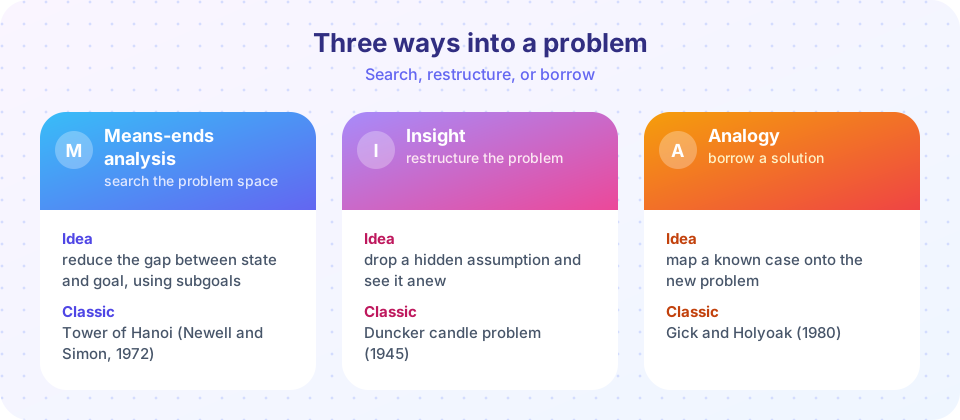
Two people face the same puzzle. One tries move after move and gets slowly closer. The other stares, stalls, and then suddenly sees the trick. Cognitive psychologists have studied both patterns, which look like opposites but turn out to be partners. This lesson covers the three big ideas about solving problems: search, restructuring and analogy.
What you will learn
- How to describe a problem as states, operators and a goal, and why the space can explode.
- How means-ends analysis and subgoals work, using the Tower of Hanoi.
- What insight, fixation and functional fixedness are, with Duncker's and Köhler's studies.
- Why analogies help only when you notice the match.
Key terms
Operator: a legal move that changes the problem state.
Subgoal: an intermediate goal that moves you toward the main goal.
Functional fixedness: seeing an object only in its usual role.
Mental set: a habit of using a method that worked before.
Analogical transfer: using the solution of a known problem to solve a new one.
Search in a problem space
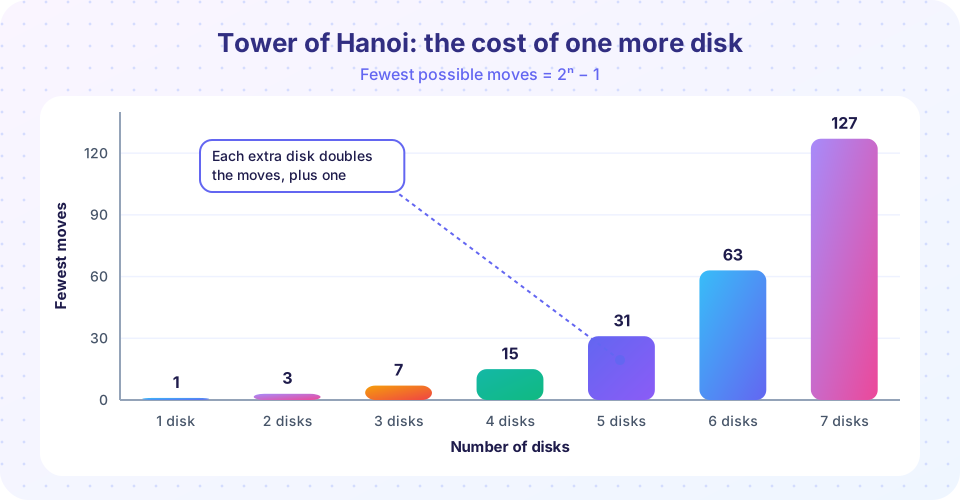
Newell and Simon showed that a problem can be described by an initial state, a goal state, a set of operators and constraints. In the Tower of Hanoi, three pegs hold disks of different sizes; the goal is to move the stack from the first peg to the third, moving one disk at a time and never placing a larger disk on a smaller one. With n disks there are 3ⁿ legal arrangements, and the fewest moves needed is 2ⁿ − 1, so each extra disk doubles the work plus one.
A solver cannot try every path, so heuristics guide the search:
- Hill climbing: choose the move that looks closest to the goal. It fails when you must first move away from the goal (as in Hanoi, where you must move a small disk to an apparently unhelpful peg).
- Means-ends analysis: compare the current state with the goal, find the biggest difference, and pick an operator that reduces it; if it cannot be applied yet, make removing the obstacle a subgoal. To move the largest disk you first need the smaller disks out of the way, which is a subgoal, and the recursion solves the puzzle. Newell and Simon's General Problem Solver was built around this idea.
- Working backward, decomposition into smaller problems, and drawing a picture are other general methods. The mathematician George Pólya's four steps (understand the problem, devise a plan, carry it out, look back) summarize good practice.
Working memory limits what can be done. People solving Hanoi often lose track of subgoals, and tasks that need many subgoals are harder even when the rules are simple. Changing the surface story (an "isomorph" with monsters passing globes instead of disks moving on pegs) can change difficulty dramatically, so how a problem is represented matters.
Insight and restructuring
Wolfgang Köhler (1925) watched chimpanzees on Tenerife solve problems such as reaching a banana beyond the bars. After a pause, the famous chimp Sultan joined two sticks to make a longer one. Gestalt psychologists called this insight: a sudden restructuring of the problem. In studies of "feelings of warmth", Metcalfe and Wiebe (1987) found that people solving algebra problems felt steadily closer to the answer, whereas for insight problems their warmth ratings stayed low until just before the answer, which then arrived suddenly.
A modern account proposes that people form an initial representation and use their past experience to constrain it. This creates an impasse if the representation is wrong. Breaking out requires relaxing a constraint or chunk decomposition (Stellan Ohlsson's representational change theory). Brain studies find distinct activity just before insight solutions, though the details are still being worked out.
Two obstacles to insight:
- Functional fixedness. In Karl Duncker's (1945) candle problem, people were given a candle, matches and a box of thumbtacks and asked to fix the candle to a wall so that wax would not drip on the table. The solution is to tack the box to the wall and set the candle on it. Few people thought of it when the tacks were inside the box (so the box seemed to be a container), and more did when the box was empty (Glucksberg, 1962).
- Mental set. Abraham Luchins (1942) had people solve water-jar problems with the same complex method over and over; they kept using it even when a simpler solution existed.
The popular advice to "think outside the box" comes from the nine-dot problem, where the answer requires lines that extend outside the square of dots. Experiments suggest that telling people to go outside the box helps less than expected, because the difficulty is in finding which lines to draw, not merely in lifting the constraint (Weisberg and Alba, 1981).
Analogy
Many problems can be solved by recalling a similar one. Gick and Holyoak (1980) gave people Duncker's radiation problem: a patient has an inoperable tumor, and a ray strong enough to destroy it would also destroy healthy tissue on its way. First, some read a story about a general who divides his army into small groups that converge on a fortress from different directions, a perfect analogy (converge several weak rays on the tumor). Few people used the story spontaneously, around one in ten, but after being told that the story was relevant, most (roughly three in four) produced the convergence solution. The knowledge was available but not noticed. People are driven by surface similarity when retrieving, but structure when mapping. Learning from several examples that share a structure, and comparing them, improves transfer (Gick and Holyoak, 1983).
Common misconceptions
"Insight is magic." Insight comes after unconscious work and depends on prior knowledge and effort; it is a change of representation.
"Creative people never fixate." Everyone is fixated by habits and by obvious uses of objects.
"You should think outside the box." The slogan is vague; the useful step is to identify which assumption is blocking you and to try alternatives.
Try it
Press Run (or Ctrl + Enter) to see the result here.
Program input · what you'd type while the program runs
Type the answers before you press Run, one per line. Each time the program reads a line (with input()), it gets the next line from this box.
Check your understanding
Quick check · 5 questions
of 5 answered You scored / 5 · perfect!
-
1. The fewest moves needed to solve the Tower of Hanoi with 6 disks is
2^6 - 1 = 63. -
2. Means-ends analysis works by
It is a general heuristic used in Newell and Simon's General Problem Solver. -
3. In the candle problem, functional fixedness leads people to see the box of tacks as
The box's usual function hides its use as a shelf. -
4. In Gick and Holyoak's (1980) study, few people used the fortress story spontaneously, which shows that
After a hint to use the story, many more produced the convergence solution. -
5. Metcalfe and Wiebe (1987) found that for insight problems, warmth ratings
Algebra problems showed incremental progress; insight problems did not.
Summary
- Problems can be described as states, operators and goals; the space grows quickly, so heuristics such as means-ends analysis guide the search.
- Insight is a restructuring of the problem, and fixation (functional fixedness and set) delays it.
- Analogy helps when you notice the structural match, which often needs a cue or comparison of examples.
- Good habits, such as Pólya's steps, drawing a diagram and decomposition, support both search and restructuring.
Next: Expertise and Practice
Track your progress
Create a free account to tick off lessons and pick up where you left off on any device.
of Cognitive Psychology lessons completed