


















Lesson 29 of 50 · Knowledge and Language
Concepts and Categories
Compare the classical, prototype, exemplar and theory-based views of concepts, with Rosch's typicality and basic-level findings and a family resemblance simulation.
Is a penguin a bird? Of course, but it feels like a worse example than a robin. Is an olive a fruit? Is a game anything you can define? Everyday categories seem simple until you try to say exactly what puts something inside or outside them. Cognitive psychologists use this puzzle to ask how the mind represents concepts, and the answers shape theories of learning, language and reasoning.
What you will learn
- Why the classical view of concepts fails for most everyday categories.
- How prototype, exemplar and theory-based accounts differ, and what evidence favors each.
- What typicality effects and family resemblance are.
- What the basic level of categorization is and why it is special.
Key terms
Category: a set of things treated as alike; the concept is the mental representation of it.
Typicality: how good an example an item is of its category.
Prototype: an average or best example that summarizes a category.
Exemplar: a stored memory of a specific instance.
Family resemblance: items share overlapping features without any single feature shared by all.
The classical view and its troubles
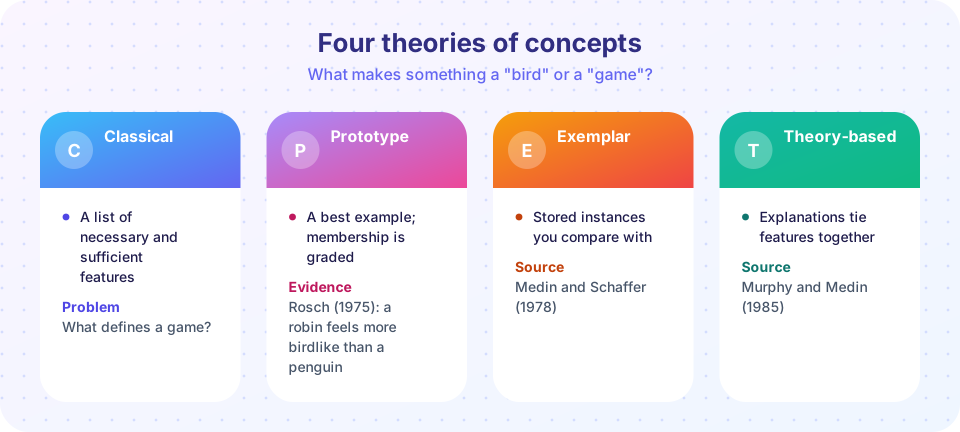
The oldest view says a concept is a definition: a list of features that are individually necessary and jointly sufficient. A bachelor is an unmarried adult male; a triangle has three straight sides. This works for some technical concepts but fails for most everyday ones. Ludwig Wittgenstein asked what all games have in common. Chess, tag, solitaire, football and a child's make-believe share no single feature, yet we classify them all as games; they are linked by overlapping similarities, a family resemblance. Other problems:
- Typicality effects. Members are not equal. People rate a robin as a better bird than a penguin (Rosch, 1975), they name robins first when asked for birds, and they verify "a robin is a bird" faster than "a chicken is a bird" (Rips, Shoben and Smith, 1973). A definition has no way to produce graded membership.
- Fuzzy boundaries. People disagree about whether an olive is a fruit, and the same person may change their mind across occasions (McCloskey and Glucksberg, 1978).
- Unclear items. Is a doorknob a piece of furniture? Is a rug?
Prototype view
Eleanor Rosch proposed that a concept is represented by a prototype, a summary of the most typical features of the category (or a best example), and that membership depends on similarity to it. Rosch and Mervis (1975) showed that the best examples of a category share the most features with other members and the fewest with members of other categories, which is just what family resemblance predicts. The prototype view explains typicality effects, fuzzy boundaries and fast classification of typical items. It has trouble with the fact that people also know a category's variability and correlations (small birds tend to sing; large ones tend not to), information that a single average discards.
Exemplar view
According to the exemplar view, a concept is just the set of remembered instances. To categorize a new item, compare it with stored examples and see which category's members it resembles most (Medin and Schaffer, 1978; Nosofsky, 1986). Exemplar models capture variability and correlated features naturally, and they predict that a new item very similar to a specific stored case is classified like that case, even when it is atypical. Experiments often find that exemplar models fit data from artificial categories better than prototype models, while real-world categories may use both: prototypes for large, well-learned categories and exemplars for rare or complex ones. Humans probably use several strategies.
Theory-based view
Similarity alone cannot explain everything. Gregory Murphy and Douglas Medin (1985) argued that concepts are embedded in theories about the world. A man jumping into a swimming pool fully clothed at a party does not share surface features with other things we call "drunk", yet we classify him as drunk because the theory explains the behavior. Children treat a raccoon that has been dyed and altered to look like a skunk as still a raccoon, reflecting an assumption about hidden essences (Keil, 1989). Lawrence Barsalou (1983) showed that people also build ad hoc categories on the fly, such as "things to take out of a burning house", which hang together by goal and not by similarity. Theories supply the why behind features.
The basic level
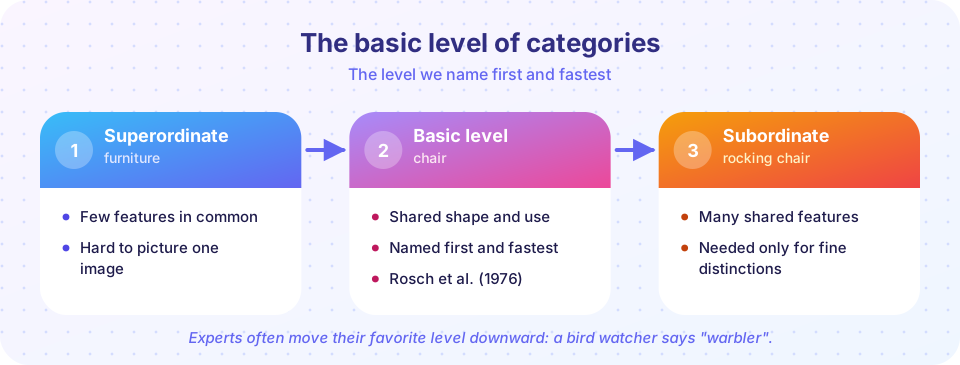
Categories exist at several levels of abstraction: furniture (superordinate), chair (basic), rocking chair (subordinate). Rosch and colleagues (1976) found that the basic level is special. People list the most features for basic-level categories, name objects at that level first, and categorize fastest at that level. Members share a similar overall shape and a common way of being used (all chairs are sat on), and we have a single image for "chair" but not for "furniture". Knowledge and expertise change the picture: a bird watcher's basic level is closer to the specific species, while novices say "bird" or "tree".
Why categories matter
Categories let us infer (it is a bird, so it likely lays eggs), communicate and economize memory. They also have social effects: categorizing people leads to stereotypes, which are overgeneralized category knowledge. Concepts are also flexible: context can shift what a word means, as when "fish" suggests a trout in a stream and a goldfish in a bowl.
Common misconceptions
"Every category has a clear definition." Most everyday categories have graded membership and fuzzy edges.
"The prototype is an actual object stored in memory." The prototype is a summary; it may never correspond to any single instance.
"One theory of concepts must be right." Evidence suggests that people flexibly use prototypes, exemplars and theories depending on the category and task.
Try it
Press Run (or Ctrl + Enter) to see the console output here.
No output.
Press Run (or Ctrl + Enter) to see the result here.
Program input · what you'd type while the program runs
Type the answers before you press Run, one per line. Each time the program reads a line (with input()), it gets the next line from this box.
Check your understanding
Quick check · 5 questions
of 5 answered You scored / 5 · perfect!
-
1. Which finding is hardest for the classical view to explain?
Graded typicality contradicts the idea that all members meet the same defining conditions equally. -
2. In the exemplar view, a new item is categorized by
Exemplar models compare the item with remembered examples. -
3. Murphy and Medin (1985) argued that concepts are also shaped by
The drunk-in-the-pool example shows that explanations, not similarity, link instances. -
4. The basic level of categorization is typically
Rosch et al. (1976) found that the basic level is the most informative and efficient. -
5. Family resemblance means that category members
Wittgenstein's games and Rosch and Mervis's work illustrate this.
Summary
- The classical definitional view fails for most everyday categories; typicality and fuzzy boundaries are the evidence.
- Prototype, exemplar and theory-based views each capture something, and people likely use several strategies.
- The basic level is the most informative and efficient level of categorization.
- Concepts support inference, communication and memory economy, and they are flexible.
Track your progress
Create a free account to tick off lessons and pick up where you left off on any device.
of Cognitive Psychology lessons completed