


















Lesson 4 of 50 · Getting Started
The Information-Processing View
Understand the information-processing approach: stages, limited capacity, serial and parallel processing, the computer metaphor, and where the metaphor falls short.
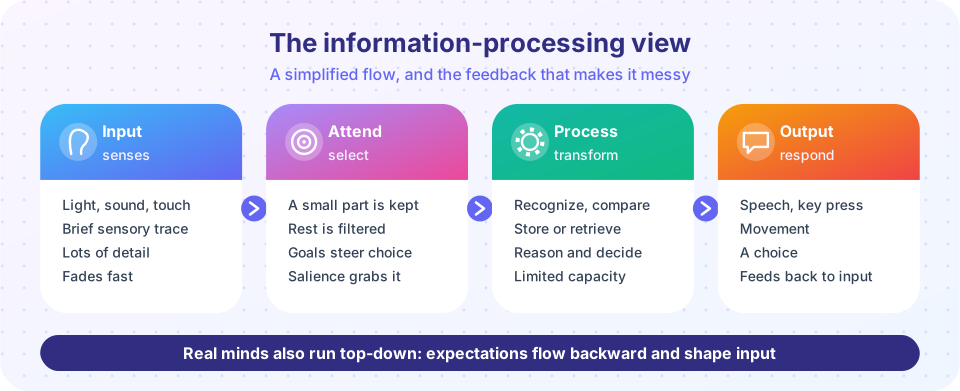
The most influential idea in cognitive psychology is that the mind can be understood as a system that takes in information, transforms it through a series of steps and produces a response. This is the information-processing approach. It does not say that the brain is a computer. It says that an abstract description in terms of inputs, stages, stores and outputs is a useful way to ask precise questions, and to design experiments that could prove the description wrong.
What you will learn
- The main ideas of the information-processing approach: representation, stages and limited capacity.
- The difference between serial and parallel processing.
- How the multi-store model of memory illustrates the approach.
- Why the computer metaphor is helpful and where it misleads.
Key terms
Information-processing approach: describing cognition as the flow and transformation of information through stages.
Capacity: the amount of information that can be processed at once at some stage.
Serial processing: steps happen one after another. Parallel processing: several happen at the same time.
Bottleneck: a stage where processing must narrow, so later items wait.
Top-down processing: processing driven by knowledge and expectations. Bottom-up: driven by the incoming data.
The core assumptions
- The mind represents information. To recognize your friend, the mind needs some internal stand-in for her face, voice and name. Theories propose what these representations are like (images, words, features, patterns of activity in a network).
- Processing takes time and happens in stages. A response is the end of a chain: detect, identify, decide, execute. Different experimental manipulations may affect different stages.
- Capacity is limited. Not everything can be processed at once, which is why attention and memory limits are central topics.
- Processes can be studied independently of the person's personality, at least as a first approximation. This lets a lab experiment with students say something general about cognition.
A classic example: the multi-store model
In 1968 Richard Atkinson and Richard Shiffrin proposed a model with three kinds of memory store:
- Sensory memory: a very brief, detailed trace of the senses.
- Short-term store: a small, temporary workspace.
- Long-term store: a large, lasting store.
Information flows from sensory memory to short-term store if attended, and to long-term store with rehearsal and encoding. The model was a clear target: because it made specific predictions (for example, about the effects of rehearsal and delay), later experiments could show where it was right and where it needed to be replaced. Chapter 5 follows that story, including Alan Baddeley and Graham Hitch's 1974 working-memory model, which broke the single short-term store into parts.
Serial and parallel processing
Suppose you search a list of 10 words for a target word. Two basic designs are possible:
- Serial: check word 1, then word 2, and so on. Total time grows steadily with list length.
- Parallel: check all ten at once. Time is roughly constant, unless capacity runs out.
Behavior can tell these designs apart only under certain assumptions. A flat relation between time and list length suggests parallel processing, but a very fast serial scan can look similar. This warning matters for every theory in the course: different internal designs can produce identical behavior, a problem called model mimicry. The solution is to find an experiment where the two designs predict different results.
Stages in series. Franciscus Donders, a Dutch physician, proposed in 1868 that you can time a mental step by subtracting the time of a simple task from the time of a harder one that adds the step. For example, subtracting the time to press one key when a light appears from the time to choose between two keys gives an estimate of the time to choose. The method, called the subtractive method, was one of the first for measuring mental events. Its main weakness is the assumption that you can add or remove a stage without changing the others (Chapter 2 revisits this).
Top-down and bottom-up
The flow diagram suggests data moving from left to right. But reading a smudged word in a familiar sentence shows that expectations work backward: you identify the word partly because of the context. Real cognition mixes bottom-up (stimulus-driven) and top-down (knowledge-driven) processing. You will see this in detail in Chapter 4.
The computer metaphor: use and limits
Computers are a helpful way to think because they make us ask: what is stored, in what format, and how is it retrieved? But a careful scientist remembers the limits:
| Computer | Human mind |
|---|---|
| Fast, exact memory; forgets only if corrupted | Memory is reconstructive and subject to interference |
| Mostly serial instruction execution | Massive parallelism in the brain |
| Does exactly what the program says | Is shaped by emotion, motivation, fatigue and context |
| Software is separate from hardware | Brain structure and function are tightly entangled |
| Has no body | Cognition is closely tied to action and the body |
Other metaphors have been used before and since: a switchboard, a hydraulic system, a library, a network of neurons, a Bayesian predictor. Each highlights some features and hides others. Treat metaphors as tools to generate hypotheses, not as claims about what the mind is made of.
A good test of a metaphor is whether it generates a prediction you did not already believe. "The mind is like a library" leads to the question of how we find a book, which led to research on retrieval cues. That is a productive metaphor.
Alternatives and extensions
- Connectionism replaces step-by-step symbol manipulation with networks of simple units whose activity spreads in parallel. Knowledge is stored in connection strengths, not explicit rules.
- Embodied and situated approaches say cognition is shaped by the body and environment, so you cannot study the head in isolation.
- Predictive processing proposes that the brain constantly predicts its input and learns from prediction errors. This brings top-down processing to the center.
- Dynamical systems approaches emphasize continuous change over time instead of discrete stages.
These do not simply discard information processing; they argue over what the processing is like.
Common misconceptions
"Cognitive psychologists say the brain is a computer." Most treat computation as a way to describe functions, not as a claim about the physical brain, and many reject the metaphor's details.
"The stage diagram is how the mind is actually wired." Boxes and arrows are hypotheses about functional organization. They do not claim that there is a separate place in the head for each box.
"If two models predict the same behavior, one must be wrong." Both might fit. This is why researchers look for experiments that separate them.
Try it
Press Run (or Ctrl + Enter) to see the result here.
Program input · what you'd type while the program runs
Type the answers before you press Run, one per line. Each time the program reads a line (with input()), it gets the next line from this box.
Check your understanding
Quick check · 5 questions
of 5 answered You scored / 5 · perfect!
-
1. Which is a core assumption of the information-processing approach?
The approach describes cognition as the transformation of represented information through stages that have limits. -
2. In the multi-store model, information moves from sensory memory to the short-term store mainly through
Attended information is passed on from sensory memory; rehearsal and encoding then move it to long-term storage. -
3. If a search time stays the same whatever the list length, this suggests
A flat function fits parallel processing, but a very fast serial scan can look similar, a case of model mimicry. -
4. Which is a limitation of the computer metaphor?
Human memory is rebuilt and shaped by context and emotion, differing from exact computer storage. -
5. Donders's subtractive method estimates the time of a mental stage by
The difference in times between two tasks that differ by one stage is taken as the stage's duration.
Summary
- The information-processing view describes cognition as represented information moving through stages with limited capacity.
- Multi-store and working-memory models are examples that made testable predictions.
- Serial and parallel designs can sometimes mimic each other; clever experiments separate them.
- Top-down knowledge and bottom-up data both shape what we perceive and remember.
- The computer is a useful but imperfect metaphor; connectionist, embodied, predictive and dynamical views extend or challenge it.
Next: Chapter 1 Review
Track your progress
Create a free account to tick off lessons and pick up where you left off on any device.
of Cognitive Psychology lessons completed