


















Lesson 30 of 50 · Knowledge and Language
Semantic Networks and Schemas
Learn Collins and Quillian's hierarchy, spreading activation and semantic priming, plus Bartlett's schemas, scripts and how expectations fill gaps and distort memory.
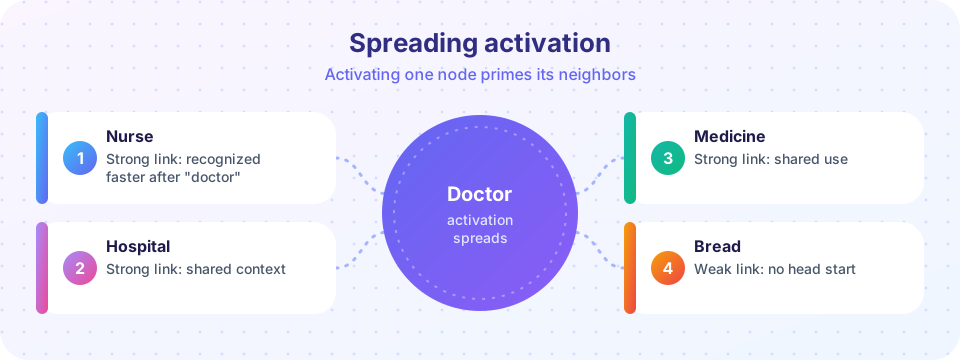
Say the word "doctor" and, a moment later, the word "nurse" is easier to read than it would be after "butter". Read that someone "paid the bill" and you automatically assume they also ate a meal. The first example shows how meanings are linked to each other; the second shows how knowledge about whole situations fills in what a text leaves out. This lesson covers both: semantic networks and schemas.
What you will learn
- How semantic memory was modeled as a hierarchical network and what that model got wrong.
- What spreading activation and semantic priming are, and how they are measured.
- What schemas and scripts are, and how they help and distort understanding and memory.
- How to read the classic experiments of Bartlett, Bransford and Johnson, and Brewer and Treyens.
Key terms
Semantic network: a model in which concepts are nodes and meanings are links between them.
Spreading activation: activating a node sends activation to connected nodes, with weaker effects at greater distance.
Semantic priming: faster processing of a word after a related word.
Lexical decision: deciding quickly whether a letter string is a real word.
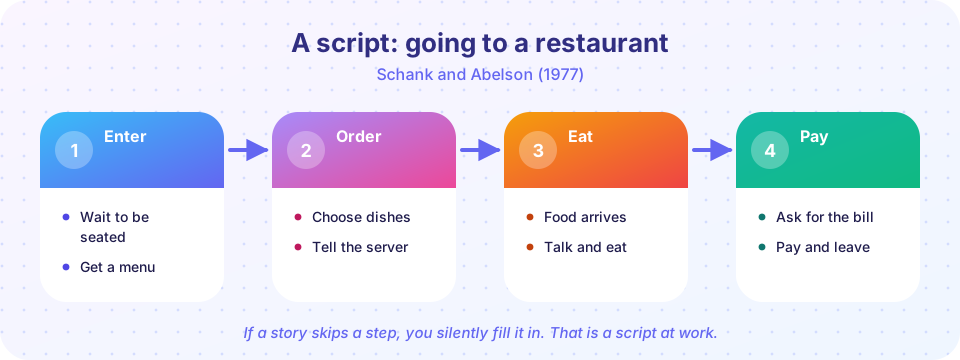
Script: a schema for a routine sequence of events.
Hierarchical networks
Allan Collins and Ross Quillian (1969) proposed that knowledge is stored in a hierarchy, with properties stored at the highest level where they apply. "Canary" links to "bird", which links to "animal". "Can sing" is stored with canary, "has wings" with bird, and "has skin" with animal, a form of cognitive economy. They predicted that verifying "A canary can sing" would be quicker than "A canary has wings" and quicker still than "A canary has skin", because more links must be traversed. The sentence verification times increased in roughly this order.
The model ran into problems. Typical members are verified faster than atypical ones at the same level ("a robin is a bird" beats "a penguin is a bird"), which a pure hierarchy cannot explain; some effects of "distance" were due to familiarity of the facts; and some facts are stored redundantly, as "canaries are yellow" and "canaries have feathers" would be if they are used often.
Spreading activation
Collins and Loftus (1975) replaced the strict hierarchy with a looser network in which the links vary in strength and activation spreads from an activated node to neighbors, with strength falling off with distance and over time. The evidence comes from priming. In a lexical decision task (Meyer and Schvaneveldt, 1971), people decide whether strings like "nurse" or "narse" are words. Responses to "nurse" were faster when the preceding string was a related word like "doctor" than an unrelated word like "bread". Activation of "doctor" spread to "nurse" and gave it a head start.
Priming can occur automatically and very quickly, even when the prime is flashed so briefly that people do not report seeing it (though researchers debate the strength of such effects). A second kind of effect is slower and strategic: if you expect related words, you can prepare for them. Neely (1977) separated the two by manipulating the delay and expectations. Network models are used in many areas, from modeling word meaning to explaining why a memory cue calls up related memories. Modern accounts also use distributed representations, in which a concept is a pattern of activation across many units (connectionist or neural network models), which explains graded similarity naturally.
Schemas: knowledge about situations
A schema is an organized body of knowledge about a kind of object, person or situation. Frederic Bartlett (1932) used the term for the knowledge that shapes how we take in and remember events. In "The War of the Ghosts" study, British participants read a Native American story containing unfamiliar details and retold it after delays. Retellings became shorter, details changed to fit Western conventions, and rationalizations were added. Bartlett concluded that remembering is an act of reconstruction guided by schemas. His method was informal, and later critics noted the loose instructions, but later controlled studies confirmed that prior knowledge shapes what is recalled.
Two classic experiments show how schemas work.
- Understanding. Bransford and Johnson (1972) gave people a bewildering paragraph ("First you arrange things into different groups... ") that was hard to understand and remember, unless people were told beforehand that it was about washing clothes. The title activated the right schema and comprehension and recall improved a great deal; the same title after reading did not help.
- Memory. Brewer and Treyens (1981) had people wait briefly in a graduate student's office and then, without warning, recall what they had seen. People recalled schema-consistent objects such as a desk and a chair, and some recalled objects that were not there, such as books. Objects that did not fit, such as a skull, were sometimes remembered as well, because surprising items attract attention.
Schemas improve understanding and memory, allow inference and save effort, but they also cause errors of distortion and intrusion. A theme running through this chapter and the last is that memory and knowledge are intertwined.
Scripts
Roger Schank and Robert Abelson (1977) described a script as a schema for a stereotyped sequence of events, such as going to a restaurant: enter, be seated, order, eat, pay, leave. Scripts allow us to understand stories that omit steps. Bower, Black and Turner (1979) found that people agree on the main events of common scripts, and that after reading a story people often falsely recognize script-consistent actions that the story never mentioned. Scripts vary with culture and experience: a restaurant script differs between a fast-food counter and a formal dinner.
Common misconceptions
"Schemas make us inaccurate." They usually make us accurate and efficient; the errors are the price of a mostly useful system.
"Semantic priming means you are being controlled by words." Priming effects are typically small and short-lived, and they reflect how activation spreads, not mind control.
"Bartlett proved memory is wrong most of the time." He showed that recall is reconstructive and shaped by knowledge, which includes both accurate inference and distortion.
Try it
Press Run (or Ctrl + Enter) to see the result here.
Program input · what you'd type while the program runs
Type the answers before you press Run, one per line. Each time the program reads a line (with input()), it gets the next line from this box.
Press Run (or Ctrl + Enter) to see the console output here.
No output.
Check your understanding
Quick check · 5 questions
of 5 answered You scored / 5 · perfect!
-
1. Collins and Quillian's hierarchical model predicted that verifying 'A canary has skin' would be
Properties stored higher in the hierarchy require more steps to reach. -
2. In the lexical decision task, 'nurse' is recognized faster after 'doctor' because
Semantic priming reflects spreading activation between related concepts. -
3. In Bransford and Johnson's (1972) study, a title helped understanding only when it was given
The schema must be active during comprehension to organize the input. -
4. Brewer and Treyens (1981) found that people sometimes recalled books in an office that had none, which shows
Expectations about offices added likely objects to memory. -
5. A script is
Scripts organize knowledge of events such as visiting a restaurant.
Summary
- Semantic memory can be modeled as a network; the hierarchical version was refined into spreading activation with links of varying strength.
- Semantic priming in lexical decision tasks is the main evidence for spreading activation.
- Schemas and scripts organize knowledge about situations, improving understanding and inference.
- The same schemas can distort memory by adding expected details, which supports a reconstructive view.
Next: Understanding Language
Track your progress
Create a free account to tick off lessons and pick up where you left off on any device.
of Cognitive Psychology lessons completed