


















Lesson 26 of 50 · Memory Systems
Forgetting and False Memory
Understand why we forget and how memories get distorted: Ebbinghaus's curve, interference, cue failure, misinformation, false memories, flashbulb memories and eyewitness limits.
Forgetting feels like a defect, but it is also useful. A mind that held every parking space you ever used would struggle to find today's. Cognitive psychologists want to know how forgetting works, and why memory sometimes goes beyond forgetting to produce confident, detailed, wrong memories. The answers matter for classrooms and courtrooms alike.
What you will learn
- What Ebbinghaus measured and the shape of the forgetting curve.
- The main explanations of forgetting: decay, interference, cue failure and motivated forgetting.
- How suggestion, imagination and expectation produce false memories.
- Why flashbulb memories and eyewitness confidence deserve caution.
Key terms
Savings: the reduction in time needed to relearn material, a sensitive measure of memory.
Proactive interference: old learning disrupts new learning.
Retroactive interference: new learning disrupts memory for old learning.
Misinformation effect: later information changes memory for an earlier event.
Source monitoring: judging where a memory came from.
Ebbinghaus and the shape of forgetting
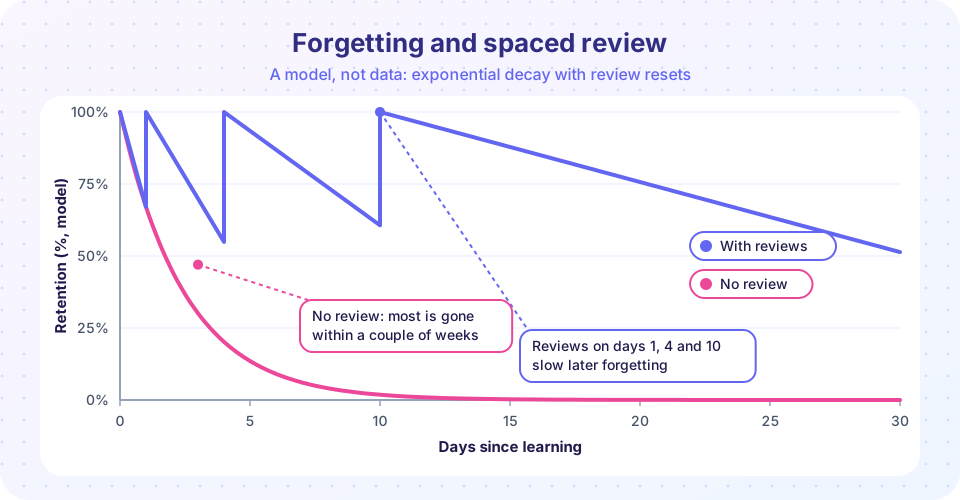
In the 1880s Hermann Ebbinghaus served as his own participant. He memorized lists of nonsense syllables (such as "DAX" and "BOK") so that prior knowledge could not help, and measured how much effort he saved when he relearned a list after a delay. His 1885 results showed rapid loss at first and slower loss later: most of the forgetting happens soon. Modern studies of everyday memory find the same general shape, although the exact curve depends on the material, the learner and how well it was learned. The curve in the picture above is a model, not Ebbinghaus's data, and its details are invented to show the principle: loss is steep early, and review resets and slows it.
Why do we forget?
Several mechanisms contribute, and they are not mutually exclusive.
- Decay. Traces might fade simply with time. This is hard to test, because time is always filled with other events. Jenkins and Dallenbach (1924) found that people retained more nonsense syllables over a night of sleep than over the same hours awake, which suggests that less new input means less interference, not that time itself does the damage.
- Interference. Similar memories compete. In proactive interference, learning French vocabulary after Spanish vocabulary makes the French harder to learn. In retroactive interference, learning the French makes the Spanish harder to recall. Interference is a major cause of everyday forgetting, such as mixing up the passwords you use most often.
- Cue-dependent forgetting. Tulving and Pearlstone (1966) had people learn lists of words in categories. When they were asked to recall freely, they produced fewer words than when they were given category names as cues. The memories were available but not accessible. This echoes encoding specificity (see the previous lesson).
- Motivated forgetting. Anderson and Green (2001) developed the think/no-think task: people learned word pairs and then repeatedly tried not to think of the second word when they saw the first. Later recall of those words was lower than for a control set, suggesting that suppression can reduce access. Researchers continue to debate how large and general the effect is. A related finding is retrieval-induced forgetting (Anderson, Bjork and Bjork, 1994): practicing some items from a category makes related, unpracticed items harder to recall.
A different lesson from clinical and everyday life is that forgetting is not the opposite of learning but part of it. Interference and selective retrieval help the system keep what is useful accessible.
Memory as reconstruction
In 1932 Frederic Bartlett asked English participants to read a Native American folktale, "The War of the Ghosts", and to recall it repeatedly over weeks. Their recalls became shorter and more conventional: unfamiliar elements were dropped or changed to fit the readers' own cultural expectations. This is the foundation of the reconstructive view, developed in the next chapter on schemas.
The misinformation effect. Elizabeth Loftus and John Palmer (1974) showed people films of car crashes and asked how fast the cars were going when they "smashed", "collided", "bumped", "hit" or "contacted" each other. Speed estimates rose with the intensity of the verb: about 41 miles per hour for "smashed" and about 32 for "contacted". A week later, people who had heard "smashed" were more likely to say they remembered seeing broken glass, although there was none in the film.
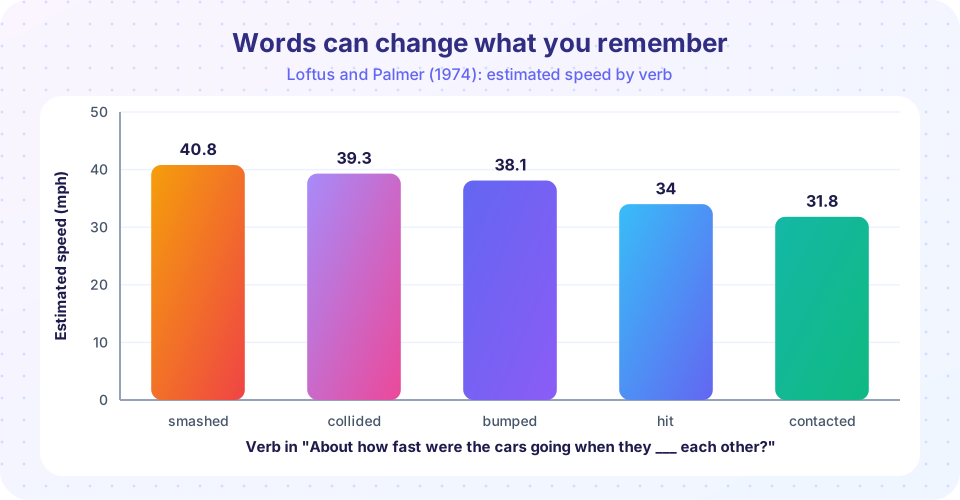
There is debate about how misinformation works: it may add to the memory, may replace it, or may just influence what people report. But the effect is robust and appears in many studies.
Implanting whole events. In the "lost in the mall" study (Loftus and Pickrell, 1995), adult participants were given short descriptions of childhood events by a family member, three true and one false (being lost in a shopping mall at about age five). About a quarter accepted the false event as remembered at least in part. Later research has shown that many people can be led to believe in or remember false events, with varying rates. Ethical and methodological limits mean results are interpreted carefully, and not all false belief is the same as false vivid recollection.
False memory in the lab. In the DRM procedure (Deese, 1959; Roediger and McDermott, 1995), people study a list of words all related to an unlisted word, the critical lure, such as bed, rest, tired, dream, wake and snore for "sleep". In a later memory test, people often report that "sleep" was on the list, and they frequently do so with confidence, sometimes about as often as for words that really were presented. The mind stores the gist and fills in what fits.
Source monitoring. Many false memories are errors of source: you really did think of, hear about or imagine the event, but you attribute it to direct experience (Marcia Johnson). Imagining an event repeatedly can inflate confidence that it happened, a result known as imagination inflation.
Flashbulb memories and eyewitnesses
Flashbulb memories are vivid, detailed memories of learning about a dramatic event. Roger Brown and James Kulik (1977) proposed that they are special, like a photograph. Later work does not support that. After the 1986 Challenger shuttle explosion, Ulric Neisser and Nicole Harsch asked students to write down how they had heard about it, then asked again two and a half years later. Many accounts had changed substantially, about a quarter were wrong on every key detail, yet confidence was high. Studies of September 11 memories (Talarico and Rubin, 2003) found similar patterns: ordinary and flashbulb memories lose detail at similar rates, but flashbulb memories keep their vividness and confidence. The feeling of remembering outlasts the accuracy.
Eyewitness memory is the area where these findings matter most. Witness confidence immediately after a clean first identification can be informative, but confidence rises after feedback ("good, you identified the suspect"), and it can be inflated later in court. Wrongful convictions have often involved mistaken eyewitness identification. Modern guidelines recommend recording confidence at the first identification, using unbiased lineups, avoiding feedback and warning that the culprit may not be present.
Common misconceptions
"A vivid, confident memory must be accurate." Vividness and confidence track accuracy only loosely, especially after time and repeated telling.
"Memories are stored like recordings and recalled by playing them back." Evidence supports reconstruction from fragments, knowledge and expectations.
"Hypnosis or 'recovering' memories makes recall more accurate." These methods can raise confidence while adding errors. Clinical and legal questions about trauma memory are complex and need specialist, evidence-based care; this lesson gives educational information only.
Try it
Press Run (or Ctrl + Enter) to see the result here.
Program input · what you'd type while the program runs
Type the answers before you press Run, one per line. Each time the program reads a line (with input()), it gets the next line from this box.
Check your understanding
Quick check · 5 questions
of 5 answered You scored / 5 · perfect!
-
1. Ebbinghaus's savings measure is the
Savings compares original learning time with relearning time. -
2. Tulving and Pearlstone (1966) showed that forgetting can be due to
Cues revealed that items that seemed forgotten were still stored. -
3. Loftus and Palmer (1974) found that speed estimates were higher when the verb was
Stronger verbs led to higher estimates, and later to more reports of broken glass. -
4. In the DRM procedure, people often falsely recall the critical lure because
Related words activate the lure, and source monitoring fails to tag it as unpresented. -
5. Neisser and Harsch's Challenger study showed that flashbulb memories
Accuracy declined, but participants remained confident, so confidence is not a reliable guide.
Summary
- Forgetting is steep at first and slower later; interference, cue failure and perhaps motivated forgetting explain much of it.
- Remembering is reconstructive, so suggestion and imagination can alter or even create memories.
- Misinformation, DRM lists and "lost in the mall" show how gist, expectation and source errors produce false memories.
- Confidence and vividness, including in flashbulb and eyewitness memories, are imperfect guides to accuracy.
Track your progress
Create a free account to tick off lessons and pick up where you left off on any device.
of Cognitive Psychology lessons completed