


















Lesson 14 of 50 · Attention
Divided Attention and Multitasking
Why doing two things at once costs performance: bottleneck and resource theories, practice and automaticity, task switching, and what research says about driving and phones.
Most people believe they can handle two things at once, especially familiar ones: talking while walking, listening to music while writing. Sometimes that is true. But when both tasks need real thought, performance on at least one of them usually drops. Research on divided attention asks when and why. The answers matter for safety (driving, medicine, aviation), learning (studying with a phone nearby) and for our understanding of what limited capacity really means.
What you will learn
- What a dual-task cost is and how it is measured.
- Three explanations: shared capacity, a central bottleneck and multiple resources.
- How practice and automaticity reduce interference.
- What task switching costs and why "multitasking" is mostly rapid switching.
- What research has found about distracted driving, and its limits.
Key terms
Dual-task cost: the drop in performance when two tasks are done together compared with each alone.
Psychological refractory period (PRP): the delay in responding to a second task when it arrives soon after the first.
Central bottleneck: a stage, usually response selection, that can handle only one task at a time.
Automaticity: processing that is fast, effortless and hard to stop after much practice.
Switch cost: the extra time and errors when changing from one task to another.
Measuring interference
The basic method is simple. Measure performance on task A alone, on task B alone, and on both together. The difference is the dual-task cost. A large cost suggests the tasks compete for something. No cost suggests they use separate mechanisms, or that practice has made one task cheap.
The type of the tasks matters. Walking and chatting is usually easy; mental arithmetic and chatting is not. Two tasks that both need to look at the same place, or both need to speak, collide for obvious physical reasons; the interesting question is why interference appears even when they use different senses and different responses.
Explanation 1: shared capacity
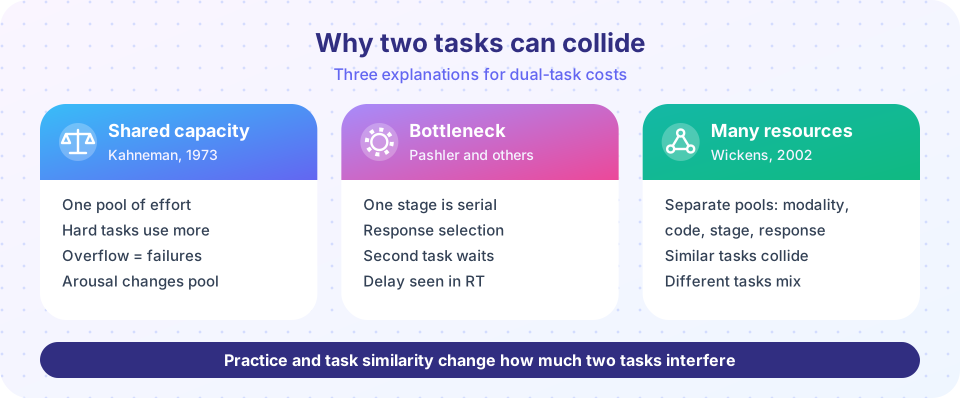
Daniel Kahneman (1973) proposed that attention is a limited pool of mental effort that tasks draw on. Hard tasks demand more. When the total demand exceeds the supply, performance falls. Arousal, motivation and the amount of effort you can mobilize change the size of the pool. A visible sign of effort is pupil dilation, which Kahneman measured: the pupil widens as mental load increases.
- Strength: accounts for the general pattern that harder tasks produce more interference.
- Weakness: it is hard to test, since "effort" is defined by the same results it tries to explain, and it does not predict which tasks will clash.
Explanation 2: the central bottleneck
In the PRP paradigm, a person responds to a stimulus for task 1 and then, a variable interval later (the SOA, stimulus onset asynchrony), to a stimulus for task 2. When SOA is long, the tasks do not overlap. As SOA gets shorter, responses to task 2 slow down, and the slowing is almost one-for-one with how much the tasks overlap. Harold Pashler (1994) argued that the best explanation is a central bottleneck: perceptual processing and motor execution can overlap between tasks, but a central stage (response selection, deciding what to do) can handle only one task at a time. The second task simply waits.
- Strength: makes a precise, testable prediction (the 'slope of -1' pattern in task 2 response time), confirmed in many experiments.
- Weakness: some studies show that with practice or with very simple, natural mappings, the bottleneck shrinks or vanishes.
Explanation 3: multiple resources
Christopher Wickens (2002) proposed several pools of resources, defined along dimensions such as:
- Stage: perception and thinking versus response.
- Modality: visual versus auditory.
- Code: spatial versus verbal.
- Channel (visual): focal versus ambient.
Tasks interfere more the more resources they share. Listening to spoken directions (auditory, verbal) while steering by sight (visual, spatial) overlap less than reading a text message (visual, verbal) while looking at the road (visual, spatial). The model has been used in designing cockpits, dashboards and alerts.
All three views capture something: there is a general limit, a particularly narrow step in central decision making, and a structure of overlapping specialized systems.
Practice and automaticity
In a famous study, Elizabeth Spelke, William Hirst and Ulric Neisser (1976) trained two students for months to read short stories while writing words to dictation. At first this was impossible; after extensive practice they could do it without loss in reading speed or comprehension. Practice had apparently made at least one of the tasks need less attention.
Walter Schneider and Richard Shiffrin (1977) distinguished controlled processing (slow, effortful, flexible, limited in capacity) from automatic processing (fast, effortless, hard to stop, needing little capacity). Searching for a target that is always the same improves until it becomes automatic; searching when the target keeps changing never does. Automatic processes free capacity, but also create errors such as the Stroop effect in the last lesson, where reading cannot be turned off.
Note that careful later work suggests practice often makes processing more efficient or reduces the bottleneck's duration rather than removing attention demands completely.
Task switching: most multitasking is switching
When two demanding tasks are "done at the same time", people mostly alternate quickly between them. Switching has costs:
- Switch cost. Robert Rogers and Stephen Monsell (1995) showed that responses are slower and less accurate on the first trial after a switch than on a repeat, even with a clear cue and time to prepare. Part of the cost is reconfiguring the goal, and part is interference from the old task set.
- Resumption costs after interruptions in real-life work: re-finding where you were takes time.
A closely related question is how habitual media multitasking relates to attention. Early work (Ophir, Nass and Wagner, 2009) found that heavy media multitaskers did worse on some filtering tasks, but later studies have been mixed and cannot tell cause from effect. The honest summary is that the long-term effects are still unsettled, whereas the immediate costs of switching and of dual-task interference are well established.
Driving and phones
Real-life research has focused on driving. David Strayer and William Johnston (2001) had people use a driving simulator while conducting a phone conversation. Drivers missed more simulated traffic signals and reacted more slowly. Importantly, hands-free conversation was about as disruptive as hand-held, which indicates that the problem is mostly mental, not manual. Later studies found similar patterns, and that talking to a passenger is somewhat less disruptive, perhaps because the passenger can see the traffic and adjust the conversation.
Interesting individual differences exist: Jason Watson and Strayer (2010) identified a small group, about 2.5% of their sample, who showed no cost in the simulator driving plus a demanding span task. They called them "supertaskers". Such people are rare, and almost everyone who feels like a supertasker is not.
These results come from simulators and controlled settings, and they cannot give the real-world risk of a specific behavior on its own, but they are consistent with population studies of crashes. Together, the evidence supports advice that is simple: do not use a phone for conversations or texting while driving.
Common misconceptions
"I can multitask well." For tasks that need thought, nearly everyone shows costs, and people tend to underestimate their own costs.
"Hands-free phone use is safe." Simulator and field studies suggest it distracts the mind as much as hand-held use.
"Practice always makes dual tasks free." It can greatly reduce costs, but new or varied tasks keep their demands.
Try it
Press Run (or Ctrl + Enter) to see the result here.
Program input · what you'd type while the program runs
Type the answers before you press Run, one per line. Each time the program reads a line (with input()), it gets the next line from this box.
Check your understanding
Quick check · 5 questions
of 5 answered You scored / 5 · perfect!
-
1. The PRP effect is that responses to a second task
At short SOAs, the second task must wait for the busy central stage, so its response is delayed. -
2. Wickens's multiple-resource theory predicts that two tasks interfere LESS when they
Tasks drawing on different resource pools overlap less. -
3. Strayer and Johnston found that hands-free phone conversation, compared with hand-held, was
The interference is mainly mental rather than manual. -
4. What did Spelke, Hirst and Neisser's students demonstrate?
Extensive practice made the combined task possible, suggesting reduced attentional demands. -
5. A switch cost is
Changing tasks needs goal reconfiguration and overcomes interference from the old task.
Summary
- Dual-task costs show that tasks compete for limited resources, especially central decision stages.
- Shared capacity, central bottleneck and multiple resource theories each explain part of the pattern.
- Practice and automaticity can greatly reduce interference.
- Most multitasking is rapid switching, which has costs; long-term effects of habitual media multitasking are unsettled.
- Simulator and field research support avoiding phone use while driving, hands-free or not.
Track your progress
Create a free account to tick off lessons and pick up where you left off on any device.
of Cognitive Psychology lessons completed