


















Lesson 50 of 50 · Projects and Practice
Further Study: Where to Go Next
Plan your next steps after cognitive psychology: related tracks on this site, classic books and journals, project ideas and a spaced review schedule to keep what you learned.
You have covered the core of cognitive psychology: methods, attention, perception, memory, knowledge and language, judgment and decisions, problem solving and expertise. This last lesson shows where the field connects to others, suggests reading and projects, and gives you a plan to keep what you have learned, because the research in this course says that without review, most of it will fade.
What you will learn
- Which related tracks on this site extend each part of the course.
- Classic books and journals for going deeper.
- Project ideas you can do with a browser and a few lines of code.
- A simple spaced-review plan.
Key terms
Cognitive neuroscience: the study of how brain processes give rise to cognition.
Computational modeling: building programs that implement a theory and make quantitative predictions.
Open science: practices such as preregistration, open data and replication.
Meta-analysis: a statistical combination of results across studies.
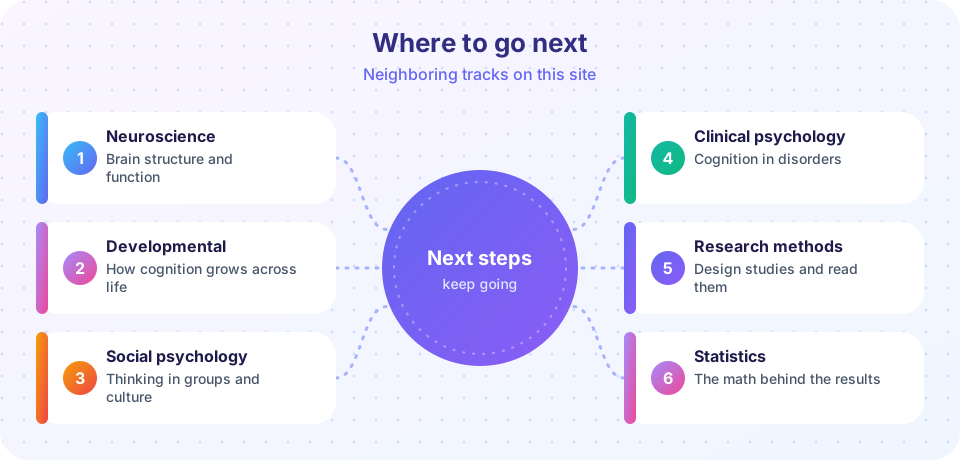
Related tracks on this site
| If you were drawn to... | Go to | Why |
|---|---|---|
| How the brain does it | Neuroscience | Hippocampus, cortex, imaging and the biology behind memory, attention and language |
| How thinking changes with age | Developmental Psychology | Memory, language and reasoning from infancy to old age |
| Thinking in groups and about people | Social Psychology | Biases, stereotypes, persuasion and group decisions |
| Cognition in disorders | Clinical Psychology | Attention, memory and reasoning in mental health conditions |
| Designing and reading studies | Research Methods in Psychology | Experimental design, measurement and ethics |
| The numbers behind the results | Statistics and Probability | Tests, effect sizes, confidence intervals and Bayes' rule |
| Learning models in code | Machine Learning | Computational parallels to concepts, categories and learning |
| The broader field | Introduction to Psychology | How cognitive psychology fits among the other areas |
Reading and sources
Primary sources are more rewarding than you might expect, especially the short, famous papers. Some well-known starting points:
- Textbooks. Michael Eysenck and Mark Keane, Cognitive Psychology: A Student's Handbook, a thorough, research-focused survey; Alan Baddeley, Michael Eysenck and Michael Anderson, Memory.
- Judgment and decisions. Daniel Kahneman, Thinking, Fast and Slow (2011), a readable overview of the heuristics-and-biases program by one of its founders (read it with the replication caveats in mind); Gerd Gigerenzer, Calculated Risks (2002), on risk communication and natural frequencies.
- Language. Steven Pinker, The Language Instinct (1994), a lively nativist introduction; compare it with usage-based accounts such as Michael Tomasello's Constructing a Language (2003).
- Classic papers. George Miller (1956) on the magical number seven; Tversky and Kahneman (1974) on judgment under uncertainty; Craik and Lockhart (1972) on levels of processing; Chase and Simon (1973) on perception in chess.
- Journals. Cognition, Journal of Experimental Psychology: General and Learning, Memory, and Cognition, Psychological Review, and Trends in Cognitive Sciences for reviews.
When you read a paper, use the checklist from the case studies lesson: what was manipulated, who took part, how large the effect was, and whether it has been replicated.
Project ideas
- Replicate a classic effect. Programme a Stroop task, a serial position experiment or a Wason task in the browser, and run it with friends. Compare your data with the published effect size.
- Build a model. Implement a toy version of a theory, such as a spreading-activation network, a cohort model, a prospect theory chooser, or a forgetting model fitted to data, and ask what happens when you change one assumption.
- Do a power analysis. For an effect you care about, find the sample size needed for 80 percent power and see whether published studies in that area had it.
- Apply it to your own study. Make a spaced retrieval schedule for a subject you are learning, and track your results for a month.
Keep what you have learned
Memory research gives a very concrete plan. After finishing a course, review after one day, three days, one week, two weeks and one month, each time by retrieving answers before looking. The code below prints that calendar from any start date.
Try it
Press Run (or Ctrl + Enter) to see the console output here.
No output.
Press Run (or Ctrl + Enter) to see the result here.
Program input · what you'd type while the program runs
Type the answers before you press Run, one per line. Each time the program reads a line (with input()), it gets the next line from this box.
Check your understanding
Quick check · 4 questions
of 4 answered You scored / 4 · perfect!
-
1. Which related track best extends the study of memory and attention to their biological basis?
Neuroscience covers the brain structures and processes behind cognition. -
2. Which habit best helps you retain this course?
Spaced retrieval is supported by the testing and spacing effects. -
3. A power analysis for your own project tells you
It links sample size, effect size and the chance of detection. -
4. When reading a classic paper, a good first check is
These questions help to judge the strength of evidence.
Summary
- Cognitive psychology connects to neuroscience, development, social and clinical psychology, methods, statistics and machine learning.
- Read primary sources critically, using a checklist for the design, sample, effect size and replication.
- Replicating effects, building models and running power analyses are good projects.
- Keep what you learned with a spaced, retrieval-based review schedule.
Return to the course page: Cognitive Psychology
Track your progress
Create a free account to tick off lessons and pick up where you left off on any device.
of Cognitive Psychology lessons completed