


















Lesson 49 of 50 · Projects and Practice
Cheat Sheet: Chapters 5 to 8 on One Page
A one-page recap of memory, knowledge and language, judgment and decisions, and problem solving: key numbers, names, findings and five principles to remember.
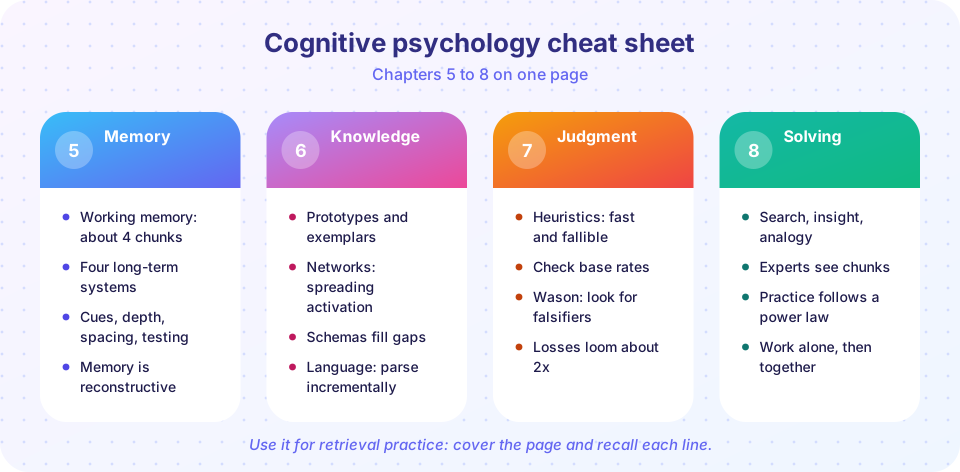
This page is the whole second half of the course on one screen: the picture, the numbers, the names and the principles. Use it before an exam, before reading a paper, or as a self-test: cover everything, look only at the poster, and try to reproduce each line.
What you will learn
- The key numbers and effects worth remembering.
- The names that go with each major finding.
- Five principles that tie the chapters together.
Key terms
Effect size: how large an effect is, regardless of sample size.
Replication: repeating a study to check the result.
Ecological validity: how well results generalize to real life.
Ecological rationality: how well a strategy fits the structure of its environment.
Key numbers
| Fact | Number |
|---|---|
| Sensory (iconic) memory | about a second or less |
| Working memory capacity | about 4 chunks (7 ± 2 in span tasks) |
| Rehearsal loop | about 2 seconds of speech |
| Trigram recall after 18 s of counting | about one in ten |
| Anchoring study (wheel 10 versus 65) | medians 25 versus 45 |
| Misinformation: "smashed" versus "contacted" | about 41 versus 32 mph |
| Screening problem (1%, 80%, 9.6%) | about 8% |
| Framing: sure option chosen | 72% (saved) versus 22% (die) |
| Loss aversion | about 2:1 (2.25 in 1992 estimates) |
| Tower of Hanoi minimum moves | 2ⁿ − 1 |
| Replication rate (2015) | about 36%, versus 97% of originals significant |
Key names
| Name | Idea |
|---|---|
| Sperling (1960) | Partial report; iconic memory |
| Baddeley and Hitch (1974) | Working memory model |
| Tulving (1972); Squire | Episodic and semantic; declarative and nondeclarative |
| Scoville and Milner (1957) | Patient H.M. |
| Craik and Lockhart (1972) | Levels of processing |
| Tulving and Thomson (1973) | Encoding specificity |
| Roediger and Karpicke (2006) | Testing effect |
| Loftus (1974, 1995) | Misinformation; false events |
| Rosch (1975, 1976) | Prototypes; basic level |
| Collins and Loftus (1975) | Spreading activation |
| Bartlett (1932) | Schemas and reconstruction |
| Bever (1970) | Garden path sentences |
| Tversky and Kahneman (1974, 1981, 1992) | Heuristics, framing, prospect theory |
| Wason (1960, 1966) | 2-4-6 and selection tasks |
| Gigerenzer | Ecological rationality; natural frequencies |
| Newell and Simon (1972) | Problem space |
| Duncker (1945) | Candle problem; functional fixedness |
| Chase and Simon (1973) | Chess chunks |
| Ericsson et al. (1993) | Deliberate practice |
| Diehl and Stroebe (1987) | Production blocking |
Five principles
- Memory is several systems, and it is reconstructive. Encoding, cues and rebuilding explain both remembering and false memory.
- Cues and processing depth decide recall. Meaningful encoding and matching retrieval cues beat repetition.
- Testing and spacing beat rereading and cramming. Feeling fluent is not the same as knowing.
- Knowledge organizes thinking. Concepts, schemas and chunks let us infer, understand and solve, and they also cause predictable errors.
- Fast thinking is useful and fallible. Check base rates, seek disconfirming evidence, watch the frame, and work alone before you work together.
Try it
Press Run (or Ctrl + Enter) to see the console output here.
No output.
Check your understanding
Quick check · 4 questions
of 4 answered You scored / 4 · perfect!
-
1. Which principle best explains why you should quiz yourself instead of rereading?
The testing effect shows that retrieval is itself a learning event. -
2. If a screening test is positive and the condition is rare, the main thing to check is
The positive predictive value depends on how common the condition is. -
3. Which name goes with 'masters recall real chess positions but not random ones'?
Chase and Simon (1973) added the random-position control to de Groot's work. -
4. Production blocking is most relevant to
Only one person can speak at a time, so ideas are lost.
Summary
- Memory has several systems and rebuilds the past; cues, depth, testing and spacing decide recall.
- Knowledge structures organize thinking and language, and heuristics make it fast and fallible.
- Experts rely on stored patterns; creativity and judgment can be helped by better methods.
- Check base rates, seek disconfirming evidence and watch the frame.
Track your progress
Create a free account to tick off lessons and pick up where you left off on any device.
of Cognitive Psychology lessons completed