


















Lesson 15 of 50 · Attention
Visual Search and Inattentional Blindness
Learn why some targets pop out and others take effort, how feature integration theory explains it, and why we miss obvious things when attention is elsewhere.
Finding your keys on a cluttered desk, a friend in a crowd, a tumor on a scan: visual search is something we do hundreds of times a day. Some searches feel instant (a red car among gray ones). Others take effort (your keys among other keys). The difference reveals how attention and vision work together. A closely related discovery is more surprising: when attention is engaged elsewhere, people can fail to notice large, plainly visible events. This lesson covers both.
What you will learn
- What preattentive features are and how pop-out works.
- How feature integration theory explains feature and conjunction search.
- What guided search and the low-prevalence effect add.
- What inattentional blindness and change blindness show, and what they do not.
Key terms
Visual search: looking for a target among distractors.
Set size: the number of items in a display.
Feature search: finding a target defined by one basic feature (such as color).
Conjunction search: finding a target defined by a combination of features (such as red and round).
Inattentional blindness: failing to notice a fully visible, unexpected object because attention is engaged on something else.
Change blindness: failing to notice a change in a scene when it coincides with a disruption.
Pop-out and effortful search
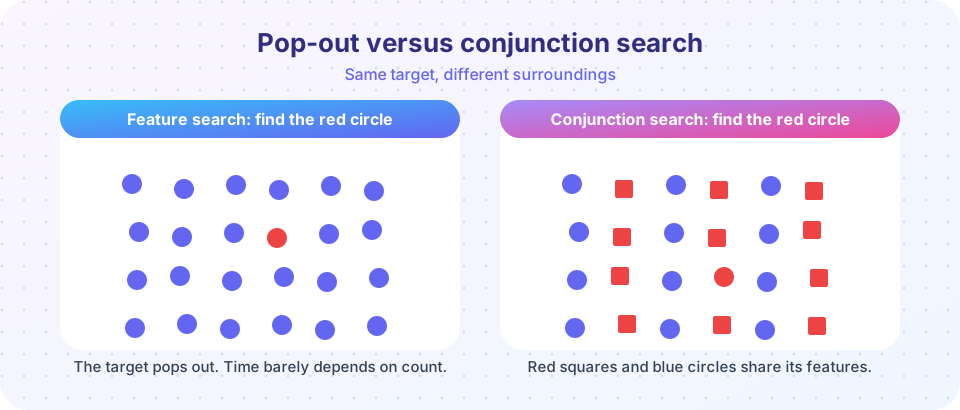
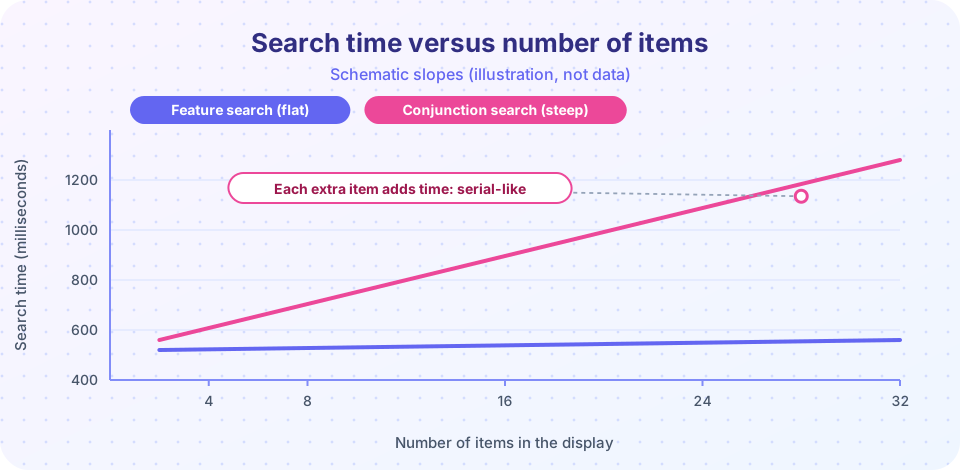
In the left panel above the target pops out. Look at how you found it: no scanning, no sense of examining items one by one. In experiments, response time stays nearly flat as the number of distractors increases. The right panel is different: the target (a red circle) shares color with the red squares and shape with the blue circles. Time to find it increases as items are added, often by 20 to 50 milliseconds per item or more, depending on the display.
The slopes are the main data. A flat slope signals efficient, parallel-like search; a steep slope signals inefficient search where items are inspected in sequence or in small groups.
Feature integration theory
Anne Treisman and Garry Gelade (1980) proposed feature integration theory (FIT) to explain this.
- Preattentive stage. Basic features such as color, orientation, size and motion are registered automatically and in parallel across the whole visual field, each in its own "feature map".
- Attention as glue. To know that this color belongs with that shape at the same place, attention must visit the location and bind the features into one object.
- Prediction. If a target differs in one feature, a feature map signals it directly (flat slope). If it is defined by a conjunction, attention must be moved from item to item (steep slope).
A striking prediction concerns what happens when attention is overloaded: features can be miscombined. Treisman and Schmidt (1982) flashed briefly displays with colored letters and found that observers sometimes reported seeing a color attached to the wrong shape, an illusory conjunction. For example, with a red X and a blue O, an observer may report a red O.
Revisions: guided search
Later work showed that conjunction search is sometimes efficient (some combinations are found faster than FIT predicts). Jeremy Wolfe's guided search model (first proposed in 1989 and refined since) proposes that the preattentive feature maps guide attention toward items that have some of the target's features (for a red circle: red things, and round things). Attention then moves to the most promising items first. This gives a continuum from efficient to inefficient search, and explains why a hybrid search for a conjunction is steep, but not as steep as a random search would be.
Where the target is rare
In real tasks, targets are often rare: a weapon in a bag, a tumor on a screening scan. Wolfe and colleagues (2005) found a low-prevalence effect: when targets appear on only about 1 percent of trials, people miss a much larger share of them than when targets appear on about half of trials, because observers adopt a more cautious, quicker "no target" decision. This matters in security screening and medical image reading, and explains why programs sometimes insert artificial targets to keep prevalence up.
Inattentional blindness
Ulric Neisser and Robert Becklen (1975) had observers follow one of two overlapping videos of hand-clapping games and press a key when a hit occurred. Many failed to notice odd events in the other video. The best-known version is the invisible gorilla study by Daniel Simons and Christopher Chabris (1999). Observers counted the passes made by players in white shirts in a video where players in black shirts were also passing a ball. About halfway through, a person in a gorilla suit walked through the scene, beat its chest and left. In the original experiment, about half of the observers did not report the gorilla. Noticing was more likely when the counting task was easier and when the unexpected event resembled the team being attended (the gorilla was a dark figure, so it was noticed less often by people following the white team), showing that attentional set matters.
Arien Mack and Irvin Rock (1998) used briefly shown displays and found a similar effect for simple shapes. Trafton Drew, Melissa Vo and Wolfe (2013) inserted a gorilla image into lung CT scans. Most of the radiologists who were looking for nodules did not notice it (about 20 of 24), even though eye tracking showed that most of those who missed it had looked directly at its location. The gorilla was visible, but not what they were looking for.
What it teaches:
- Seeing requires attention: looking is not enough. "Looked but did not see" is a real phenomenon.
- Expertise gives no immunity from the effect, although it improves what an expert is able to detect within their domain.
- It is about expectation and attentional set, not carelessness. It is not a sign of bad perception.
Change blindness
In change blindness, a change goes unnoticed when it coincides with a brief disruption: an eye movement, a blink, a screen flicker, or a cut in a film. Ronald Rensink and colleagues (1997) used a flicker paradigm, alternating an original image and a changed image with a blank between them; observers often took many alternations to find even large changes. In a field study, Simons and Levin (1998) had an experimenter ask a pedestrian for directions; during a brief disruption (workers carrying a door passed between them) the experimenter was replaced by another person. About half of the pedestrians did not notice the switch.
Change blindness suggests that our sense of a detailed, complete, continuous picture of the world is partly an illusion: much of the detail is available "on demand" by looking, not stored internally. Results vary with the type of change and with how relevant the changed object is.
A related limit in time: the attentional blink
Even within one location, attention has a limit in time. In rapid streams of items shown at about ten per second, people who identify one target often miss a second target that appears 200 to 500 milliseconds later. This attentional blink (Raymond, Shapiro and Arnell, 1992) suggests that processing a target occupies a resource for a few hundred milliseconds.
Common misconceptions
"Inattentional blindness means people are not paying attention." The opposite: it arises because people are paying close attention to something else.
"If I looked at it, I saw it." Eye tracking shows people can fixate objects they do not report.
"The gorilla study shows half of people are blind." It shows that noticing the unexpected depends on what you are doing and expecting. Most people who miss it are surprised, and many notice it when they watch again.
"Pop-out search is always instant and perfect." It depends on how different the target is, and strong differences in distractors or low contrast make it harder.
Try it
Press Run (or Ctrl + Enter) to see the result here.
Program input · what you'd type while the program runs
Type the answers before you press Run, one per line. Each time the program reads a line (with input()), it gets the next line from this box.
Check your understanding
Quick check · 5 questions
of 5 answered You scored / 5 · perfect!
-
1. In feature integration theory, which search should show a nearly flat slope?
A single distinct feature is registered preattentively in a feature map, so set size has little effect. -
2. Illusory conjunctions are
When attention is overloaded, features can be combined incorrectly. -
3. The low-prevalence effect is that rare targets are
When targets are rare, observers become cautious about reporting and miss more of them. -
4. In the Simons and Chabris gorilla study, many observers missed the gorilla because
Attention engaged on a demanding task left little for unexpected events. -
5. Change blindness occurs most readily when
A disruption removes the motion signal that would normally draw attention to the change.
Summary
- Targets defined by one feature pop out; targets defined by a combination usually need attention.
- Feature integration theory says attention binds features; guided search says features guide attention.
- Rare targets are missed more often, which matters for screening tasks.
- Inattentional blindness and change blindness show that attention is needed to see, and that we see less than we feel we do.
- The attentional blink shows a limit in time as well as space.
Next: Chapter 3 Review
Track your progress
Create a free account to tick off lessons and pick up where you left off on any device.
of Cognitive Psychology lessons completed